
























































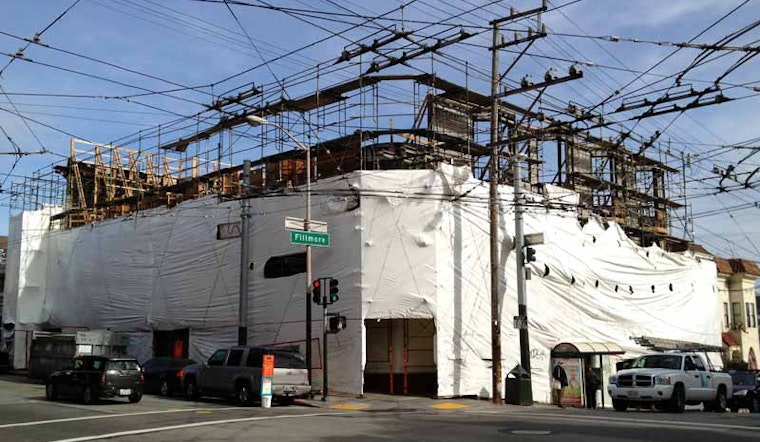
It's hard to believe, but it's been exactly six months since the September 27th fire at Haight and Fillmore.
At the three month mark, we checked in with the 30+ residents and four businesses that were displaced by the fire.
Today, we have an update on the reconstruction of the building itself.
We spoke yesterday with architect Michael Harris, whose firm Michael Harris Architecture is handling the building's redesign. Harris told us that things were moving "pretty quickly as far as these things go," which is especially impressive given how much damage the fire caused.
 Haighteration reader Stephanie D.
While demolition has been progressing, the building has been getting seismic upgrades, with steel frames being installed in the basement. This is one of several modifications needed to bring the building up to code.
Another is new stairwells and balconies in the rear of the building. The existing stairwells were "too steep, too windy, too narrow," Harris says, to be compliant with current building codes.
Also new in the building will be sprinklers in each of the 22 residential units. Though the pre-fire building did have a sprinkler system, it was limited only to corridor spaces, and not in the units themselves. Harris tells us that because this is a reconstruction project and not a new construction, the owners are not required to install sprinklers in each unit -- but perhaps motivated by the fire, they are choosing to do so anyway.
On the ground floor, the space formerly occupied by Walgreens will be expanding by "a couple hundred square feet," Harris says. This will involve the elimination of one storefront on the Fillmore side. Of the three businesses that were previously located on that side of the building, Three Twins and Estela's have both expressed interest in returning to the location, while Fecal Face Dot Gallery recently moved to the Mission and does not intend to return. Interestingly, Harris notes that Walgreens has yet to commit to signing a new lease on the space, but the expansion will proceed regardless.
One visible change at the street level will be more windows looking into Walgreens (or whatever business ends up occupying that space). Harris notes that the Walgreens space "had been pretty bastardized" over the years. The location originally housed two separate retail units, at least until some time in the 1970s, when they were combined to form one large space. This resulted in the oddly windowless, unfriendly facade. Harris views the building's remodel as an opportunity to give the retail level some unified -- and much-needed -- curb appeal.
That having been said, Harris is being careful not to take too many liberties with the design. The building does not have historic status; it's more than 50 years old, which means it's eligible, but it's been changed enough over the years to exempt it from any sort of preservation regulations. Still, to get timely approval from various city agencies -- as well as the public -- the architects intend to keep the general look and details of the building consistent with the character of the neighborhood and surrounding buildings.
This conservative approach is perhaps wise, given the daunting permit process the project is currently facing. There are conditional use permits, variances, public notices, meetings, and more required before full reconstruction can truly get underway. Plus, there is inefficiency to contend with.
Haighteration reader Stephanie D.
While demolition has been progressing, the building has been getting seismic upgrades, with steel frames being installed in the basement. This is one of several modifications needed to bring the building up to code.
Another is new stairwells and balconies in the rear of the building. The existing stairwells were "too steep, too windy, too narrow," Harris says, to be compliant with current building codes.
Also new in the building will be sprinklers in each of the 22 residential units. Though the pre-fire building did have a sprinkler system, it was limited only to corridor spaces, and not in the units themselves. Harris tells us that because this is a reconstruction project and not a new construction, the owners are not required to install sprinklers in each unit -- but perhaps motivated by the fire, they are choosing to do so anyway.
On the ground floor, the space formerly occupied by Walgreens will be expanding by "a couple hundred square feet," Harris says. This will involve the elimination of one storefront on the Fillmore side. Of the three businesses that were previously located on that side of the building, Three Twins and Estela's have both expressed interest in returning to the location, while Fecal Face Dot Gallery recently moved to the Mission and does not intend to return. Interestingly, Harris notes that Walgreens has yet to commit to signing a new lease on the space, but the expansion will proceed regardless.
One visible change at the street level will be more windows looking into Walgreens (or whatever business ends up occupying that space). Harris notes that the Walgreens space "had been pretty bastardized" over the years. The location originally housed two separate retail units, at least until some time in the 1970s, when they were combined to form one large space. This resulted in the oddly windowless, unfriendly facade. Harris views the building's remodel as an opportunity to give the retail level some unified -- and much-needed -- curb appeal.
That having been said, Harris is being careful not to take too many liberties with the design. The building does not have historic status; it's more than 50 years old, which means it's eligible, but it's been changed enough over the years to exempt it from any sort of preservation regulations. Still, to get timely approval from various city agencies -- as well as the public -- the architects intend to keep the general look and details of the building consistent with the character of the neighborhood and surrounding buildings.
This conservative approach is perhaps wise, given the daunting permit process the project is currently facing. There are conditional use permits, variances, public notices, meetings, and more required before full reconstruction can truly get underway. Plus, there is inefficiency to contend with.
We spoke yesterday with architect Michael Harris, whose firm Michael Harris Architecture is handling the building's redesign. Harris told us that things were moving "pretty quickly as far as these things go," which is especially impressive given how much damage the fire caused.
"Everything on the inside was either burnt or destroyed by water. All the electrical was gone, all the plumbing was gone, all the heat was gone."As a result, the building has effectively been gutted. Harris estimates that 90% to 95% of the demolition has been completed. "Not one single interior surface remains," he says.
Haighteration reader Stephanie D.
"It takes about 9 weeks from something being submitted [to the Planning Department] to someone just taking a look at it... It's ridiculous that it takes this long, but it does."Harris says that while the many hurdles for a project like this are "set up so that everybody [affected by a project] knows what's going on," it definitely makes San Francisco a challenging place to get things built. Under ideal conditions, if everything were to get approved and no surprises arose, Harris estimates that the project could be complete in a year to 15 months. So, perhaps a year from now, when we're marking 18 months since the fire, we'll also be sharing good news about the building's grand re-opening celebration. Fingers crossed.



