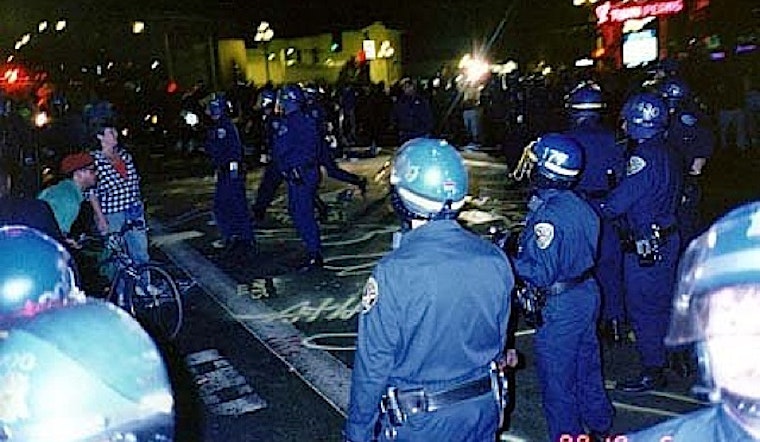
Mid poice riot in the Castro, October 6th, 1989
Twenty three years ago tonight what started out as a protest and demonstration on behalf of people living with AIDS by the AIDS Coalition To Unleash Power of San Francisco (ACT UP/SF) erupted into the single largest violation of LGBT people's rights in the history of this great City. The result of this long reaching misstep by the San Francisco Police Department (SFPD) led to the suspension of Captain Richard Cairns who rightly should've been fired, forced resignation of Police Chief Jordan's, Assistant Chief brother, Jack Jordan, as a sacrificial, political lamb, the complete loss of respect and faith of a populace in Mayor Art Agnos, reassignment of dozens of officers, overhaul of the procedures of the SFPD riot and tactical response unit and $250,000 award to those whose rights were violated won in a class action suit. Deemed the AIDS Activists generation's Stonewall it became painfully obvious to even casual observers that though it had been two decades since that riot that is heralded as the beginning of the modern day LGBT Equality Movement that we were still miles and miles from where we as a community needed to be. What follows is a personal account of the evening by Gerard Koskovich, a supporter of ACT UP/SF, local Queer Historian and one of the chief architects of San Francisco's GLBT History Museum. He first published this account in 'OutWeek', Nov. 5, 1989.
_________________________________________________________________________
When I arrived at the stark gray Federal Building for ACT UP San Francisco's contribution to the national day of AIDS protest on October 6, I anticipated nothing more than a predictable late afternoon rally and a routine march across town. Instead, by the end of the evening, I had joined hundreds of demonstrators and bystanders in defying a two-hour long police riot and military-style occupation in the largely gay Castro St. neighborhood. Mixed with calls of "Cops out of the Castro" and "This is our street," chants of protest made the historical precedents clear that Friday night. "Stonewall was a riot," we shouted, drawing courage from the example of the defiant street queens in Sheridan Square in 1969. "Dan White was a cop," we raged, recalling a judicial slap on the wrist for a homophobic assassin and the resulting White Night Riot in San Francisco in 1979.
Poster for ACT UP's National Day of Action, 1989 by the late artist Danny Sotomeyer of ACT UP/Chicago
The events of October 6 started out mildly enough. After speeches, street theater, and the burning of miniature flags, ACT UP/SF demonstrators wrapped the granite columns of the Federal Building in yards of red plastic tape to symbolize governmental stalling on the AIDS crisis. Federal marshals protecting the structure made a half-hearted effort to remove the tape, but I saw no attempt to restrain the protesters.
ACT UP/SF protestors at the SF Federal building at that start of what will turn out to be a turning point in local SF AIDS activism and the struggle for LGBT rights. Photo: Brian McNally
Around 5 p.m., we moved onto the sidewalk for a march to the Castro via City Hall and the U.S. Mint. Within minutes, the San Francisco Police Department (SFPD) had mounted a show of force unprecedented for an ACT UP San Francisco demonstration: Officers in vehicles and on foot lined up to prevent us from claiming a lane in the street; when traffic lights turned red, motorcycle cops charged the crowd to force a halt until the light changed.
San Francisco police line the sidewalk near City Hall to prevent marchers from claiming a lane in the street. Photo: Brian McNally.
Less than two blocks from the Federal Building, the first arrest took place: Moving to the curb, I watched two officers strong-arm an already shackled marcher into a paddy wagon. (I later learned that this was Bill Haskell, ACT UP's police liaison, who had approached the officers on the street to identify himself and ask about the crowd control tactics we were witnessing; they had thrown him face down on the pavement and hand-cuffed him.)
The harassment continued along the 30-block route, yet the crowd remained orderly. To SFPD announcements of "Obey the traffic laws," protesters responded with chants of "First Amendment under attack. What do we do? Act up! Fight back!" Half way to Castro St., organizers briefly halted the march; an ACT UP representative restated the AIDS-related goals of the event and urged us to focus our anger and press on despite the actions of the police. Around 7 p.m., as we approached the end of the march, word passed through the crowd that we would take over the intersection of Market and Castro Streets. A traditional finale for ACT UP San Francisco marches, this act of non-violent civil disobedience usually includes short speeches and chants, after which the crowd disperses without incident. The standard SFPD response: a few officers on foot diverting traffic to protect public safety at minimum effort and expense.
An "Unsafe" poster by the anonymous queer cultural activist group Boy With Arms Akimbo reproduces a photo of the "permanent AIDS quilt" and the SFPD sweepline on Castro Street on Oct. 6, 1989. Photo: GLBT Historical Society.
A quarter-block back from the head of the march, I could see the flashing lights of massed SFPD vehicles on Market St. Arriving at Castro St., I found that several dozen officers on foot and in vehicles had turned the marchers away from Market. Instead, we were surging left onto the Castro strip, filling the street for several yards and preventing the police from moving into the area.
As one group of approximately 50 protesters sat down and linked arms on Castro near Market, 20 others took advantage of the blockade to stage a die-in on the open lane in front of chi-chi stores and eateries. Adding stenciled slogans and spray paint in neon colors over the chalked outlines of bodies, the participants created a "permanent AIDS quilt" on the street—less than two blocks from the headquarters of the Names Project.
Your stalwart blogger having a lovely interaction with the SFPD
While approximately 500 people chanted and jeered from both sides of Castro St., the police moved in to arrest the protesters sitting on the asphalt. Finished with this activity, the officers turned their attention on the crowd, which was growing in numbers as Friday night passersby stopped to observe—and protest—the massive police presence in the heart of the gay community.
After a loud hailer order to clear the street, motorcycle and riot police advanced down the center of Castro St.. Lines of tactical unit officers pushed forward with batons held across their chests, attempting to force people onto the sidewalks. Standing at the front of the crowd on the west side of Castro, I could see no escape route; people behind me packed the sidewalk to the shopfronts or were penned in by further police lines at the rear.
The police soon charged in earnest. I saw one officer advance with his baton in a jabbing position, a technique that the San Francisco Police Commission banned after an officer using it nearly killed Farmworkers Union co-founder Delores Huerta last year. Others pushed with the sides of their batons, knocking the front of the crowd off balance. I fell against the person to my left, scraping my ear, then regained my footing.
Oct. 7th, 1989. We take back the Castro from the SFPD and leave our mark-a quilt of outlines of those they sought to oppress, those lost and those who will fight back no matter what. Photo: Patrick Clifton.
After a partial withdrawal and a second effort to clear the area, the police announced that the entire block of Castro from Market to 18th St., including the sidewalks, had been declared an illegal assembly area. The crowd held its ground, milling into the street and repeatedly chanting "Cops go home" and "Racist, sexist, anti-gay, SFPD go away." A group of officers reacted by ramming their motorcycles through the center of the crowd.
In the confusion, I lost sight of the friends I had been standing with and made my way to the opposite side of Castro St. From that vantage, I watched an officer break ranks, approach a man standing peacefully in the street, and beat him over the shoulder. Shortly thereafter, I saw a second officer pin a bystander against a news box, then club him to the pavement. Other cops joined in, one of them so eager to land a blow that he carelessly clubbed a fellow officer.


























































 _________________________________________________________________________
When I arrived at the stark gray Federal Building for ACT UP San Francisco's contribution to the national day of AIDS protest on October 6, I anticipated nothing more than a predictable late afternoon rally and a routine march across town. Instead, by the end of the evening, I had joined hundreds of demonstrators and bystanders in defying a two-hour long police riot and military-style occupation in the largely gay Castro St. neighborhood. Mixed with calls of "Cops out of the Castro" and "This is our street," chants of protest made the historical precedents clear that Friday night. "Stonewall was a riot," we shouted, drawing courage from the example of the defiant street queens in Sheridan Square in 1969. "Dan White was a cop," we raged, recalling a judicial slap on the wrist for a homophobic assassin and the resulting White Night Riot in San Francisco in 1979.
_________________________________________________________________________
When I arrived at the stark gray Federal Building for ACT UP San Francisco's contribution to the national day of AIDS protest on October 6, I anticipated nothing more than a predictable late afternoon rally and a routine march across town. Instead, by the end of the evening, I had joined hundreds of demonstrators and bystanders in defying a two-hour long police riot and military-style occupation in the largely gay Castro St. neighborhood. Mixed with calls of "Cops out of the Castro" and "This is our street," chants of protest made the historical precedents clear that Friday night. "Stonewall was a riot," we shouted, drawing courage from the example of the defiant street queens in Sheridan Square in 1969. "Dan White was a cop," we raged, recalling a judicial slap on the wrist for a homophobic assassin and the resulting White Night Riot in San Francisco in 1979.





-4.webp?w=160&h=400&fit=crop&crop=edges)