
























































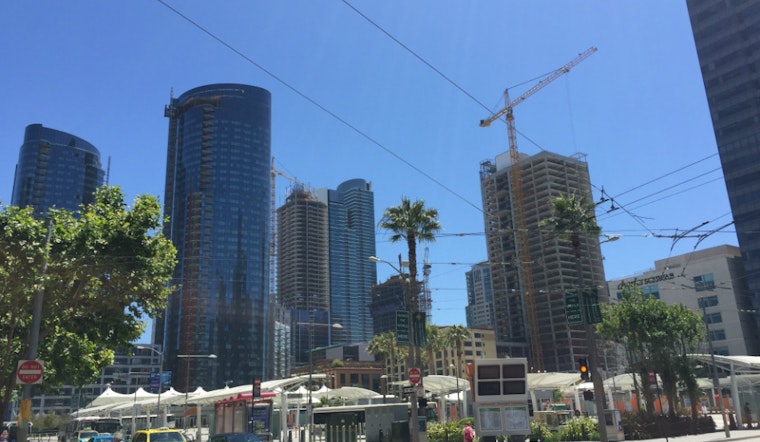
Rincon Hill neighbors have worked for three years to form the Greater Rincon Hill Community Benefit District. Now, the fledgling CBD is going up for a vote. Ballots were mailed on June 12th, and will be counted 45 days later, towards the end of July.
What is a community benefit district? In a nutshell, property owners within certain borders are asked to self-impose a tax to pay for street cleaning, tree trimming, security patrols, marketing and maintaining green space, among other neighborhood services.
Yes, the city is responsible for some of those services, but a CBD can help supplement them, particularly when so many neighborhoods and people are vying for the same pot of money from the city. CBDs are basically like homeowners' associations, but generally for mixed-use urban neighborhoods. By law, they can only provide services on public property. They started in Canada about 30 years ago, and are sometimes known as Business Improvement Districts, as in the case of Union Square.
"CBDs are the ultimate in grassroots democracy," said Jim Chappell of MJM Management Group, which Rincon Hill neighbors hired to help with the technical work on the CBD. "The neighbors, whether you own a studio apartment or high-rise building, get together and decide what kind of neighborhood they want and how to get to it and what kind of services meet their goals." Owners are taxed based on a formula that relates to square footage; most condo owners in the Greater Rincon Hill CBD would pay less than $200 per year.
By chipping in collectively, CBDs can get services at a lower rate, Chappell said. Rather than each property owner hiring a tree trimmer, they can hire a company to do the entire area en masse. Security patrols covering several blocks, instead of specific parcels, will cost less, too. Many buildings hire Patrol Specials, but once a suspect leaves the property, there's not much they can do. Creating a CBD would allow privately-hired police officers to patrol the entire Rincon Hill area.
There's another big reason for forming the CBD: An Infrastructure Financing District (IFD) formed in 2011 will generate $15.5 million in property taxes, which will stay in the district for capital improvements such as wider sidewalks, lights, trees and parks—but only if the neighbors pay for their maintenance and operations.
A CBD also gives neighborhoods an advocate at City Hall. With SoMa development booming, Rincon neighbors want a say in obtaining more green space and better transit lines to serve the area's growing population. "It's critical for getting finances and services," said Chappell, who was president of SPUR for 15 years.
This new CBD will encompass all residential and commercial properties in an area roughly spanning from Second Street to the Embarcadero and Mission to Bryant streets. The area encompasses about 2,500 owners; a couple hundred of those are owners of large commercial properties, Chappell said. For the nitty-gritty details, here's the complete final plan.
If passed, the Greater Rincon Hill CBD would be one of the largest of the city's 14 CBDs, with an initial budget of $2.5 million. That could grow to about $4 million as more property owners are added, Chappell said. The neighbors will need to form a nonprofit corporation and create a board of directors. After that, the plan is to hire three full-time employees, including an executive director, programming and marketing director, and administrative and special projects staffer.
All of this activity helps create a stronger community, said Katina Johnson, a Rincon Hill neighbor who's been involved in the project. "I love Rincon Hill," she said. "I love where I live. It’s an ideal location. But the thing I’ve been waiting for and trying to spur on in the past few years is turning it into an actual neighborhood." The CBD will also help give the area a higher profile. "The neighborhood is still marketed, at least on my street, as South Beach," Johnson said. "I love South Beach; I think it’s great. But we’re not South Beach. We’re Rincon Hill."





