

























































We recently got our hands on a stack of old local newspapers, which included issues of the Haight-Ashbury Independent, published from 1963-1966, and the Haight Ashbury Midtown Record, published from 1966-1967. Right away, we noticed some striking similarities between the issues that matter to the community today and those of over 50 years ago.
For example: on the first page of the October 10, 1963 issue of the Haight-Ashbury Independent, there's a story about how the Upper Haight needs better pedestrian scale lighting to deter crime and boost business. Sound familiar?
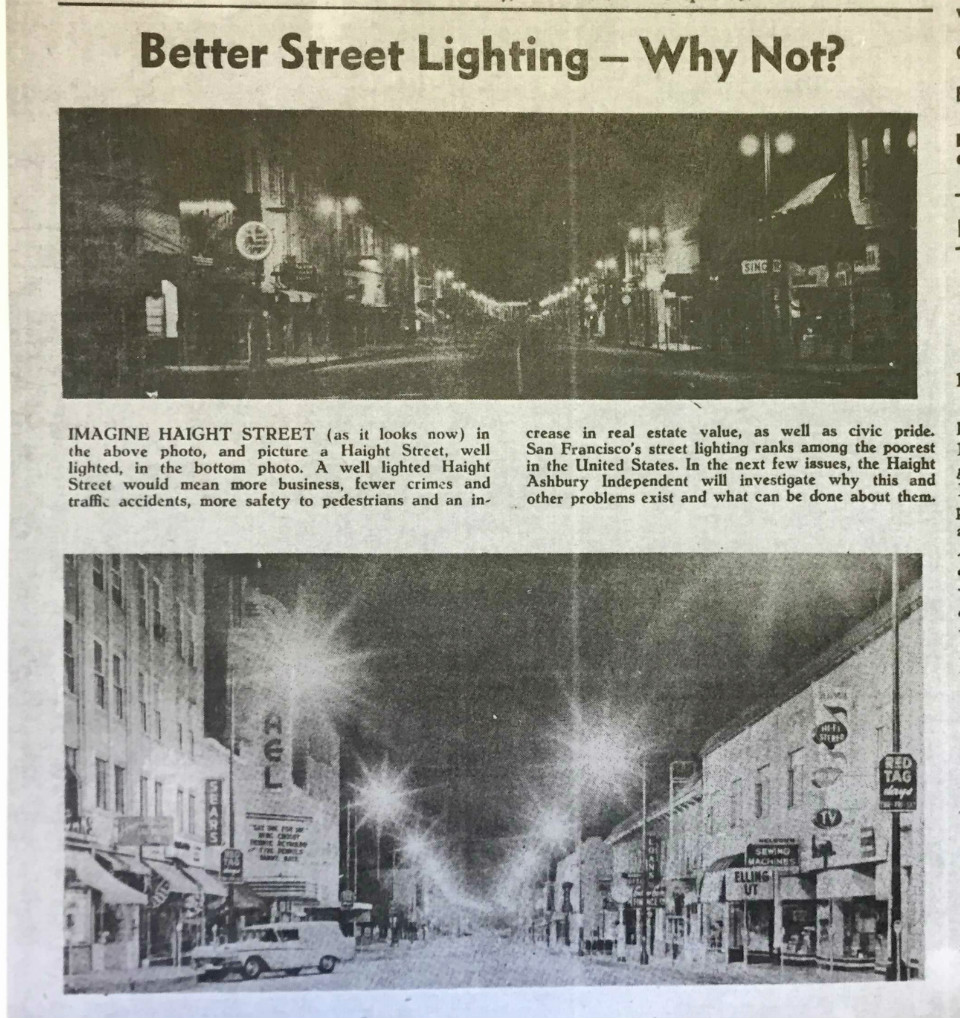
Other similarities include concerns with hippies, vagrants, and the character of the neighborhood. In 1963, the Summer of Love was still four years away, but the Haight was already abuzz with an influx of people, drugs, and politics. Several articles focus on the new crowd hanging around the Haight, often couching the discussion in the same language used today to describe travelers in the neighborhood.
The November 7, 1963 issue of the Independent features an article about "gaps in recreational opportunities, facilities, and services," in which the author notes that despite a new Boys' Club coming soon to 1950 Page (RIP), there might still not be enough wholesome activities in the neighborhood to occupy the throngs. "Those present [at a meeting] evidenced general concern for what may be an increasing number of youngsters simply roaming the streets, with no place to go and nothing to do."
The concerns only amplify once the Summer of Love hits. A headline in the August 31, 1967 edition of the Midtown Record screams: "IS THERE ANY FUTURE FOR LONG-TIME HAIGHT RESIDENTS?" Of course, the piece goes on to specify that "residents" actually means "non-hippie residents," describing the current Haight St. as "a sick scene."
The same issue quotes a letter that sounds eerily familiar:
"I don't suppose it's any great secret that over thirty long-standing merchants have been driven out of business in this community, in most part due to the influx of these 'new inhabitants.' The traffic and lack of parking facilities have driven most prospective customers to other business areas. This is not guesswork on my part. This is the word of people who have called to find my exact location because my address was so convenient, but upon finding it was in the 'Hippie' area, regretfully said they would have to shop elsewhere... Would you believe that, when my wife and I close our shop at night, we walk just ten feet to our apartment building doorway and before we can get a key into the lock, we have to shout at, threaten, and climb over the bodies of these 'new inhabitants' that have nothing better to do than sprawl all over the steps all day and all night?"
The issue also features an article about the Straight Theater's dance permit as an indicator of the deteriorating "peace and security" of the neighborhood. "A long list of 'hippie intrusions' were voiced by residents. One resident on Clayton said that 'young boys and girls are using a nearby stoop for sleeping and my front yard for sanitary purposes.' Another Oak Street resident said that 'people are feeding cats' in front of his home."
Later in the same article:
"Boxer, of the city-wide merchants association, said that 'San Francisco should clear the hippies out of town.'"
"Just how do you propose the city should get rid of them?" asked Commissioner Williams.
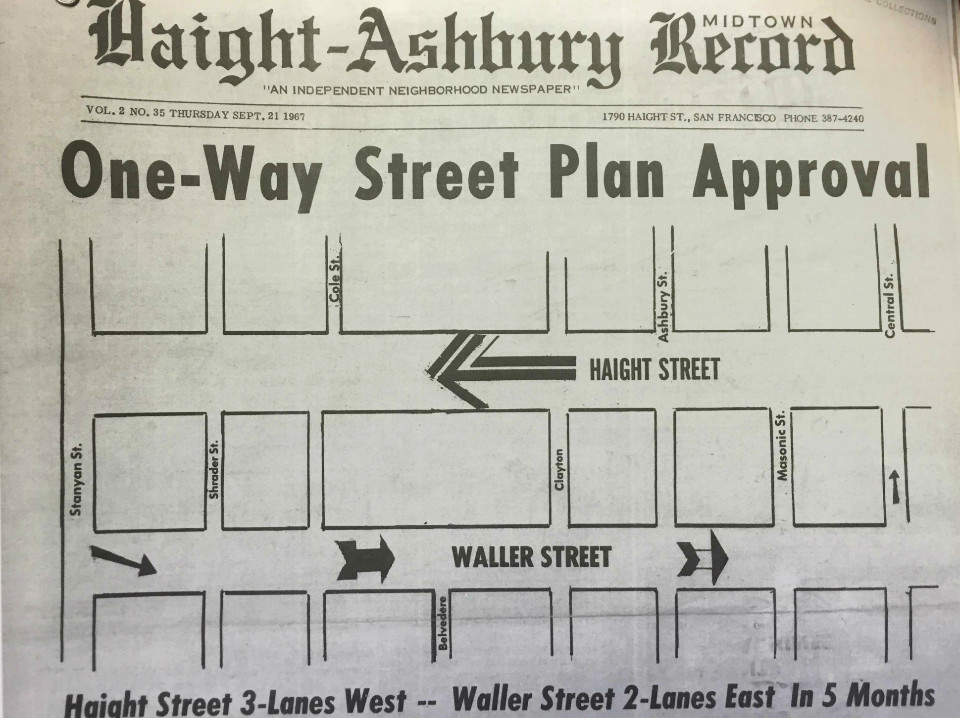
Traffic, tourists, and left turns on Masonic were also concerns back in the day. The traffic in the Haight was apparently bad enough in 1967 to warrant the approval of a plan to make Haight Street one-way heading west, and Waller Street one-way heading east.
"The one-way traffic plan for the area follows the summer jam-up of tourists, hippies, shoppers, and residents that reached a peak of 20,000 cars per day," lamented the September 21, 1967 edition of the Midtown Record. "It was disclosed that the average speed in the one-lane east bound lane on Haight Street is two miles per hour." The plan also nixed left turns onto Masonic, a move that's finally in the works today.
These days, a massive influx of tourists still jams up traffic on summer weekends in the Haight, but the debate is currently centered more around parking woes than average speed. But when it comes to street lighting, hippies, and the many other issues and trademarks of the neighborhood, it appears that the times, they are a-circular.





