

























































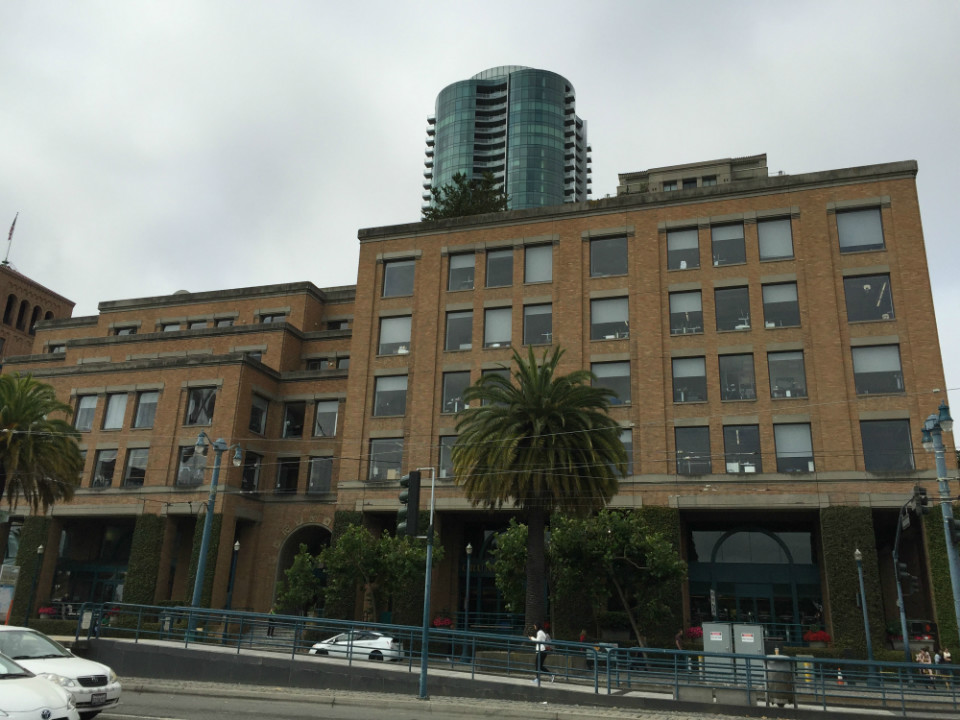
Hills Plaza, located in the former Hills Bros. Coffee warehouse between the Embarcadero and Spear Street and between Folsom and Harrison streets, isn't just home to Google's San Francisco offices and Palomino restaurant. Above the seven stories of office space, there are another 10 floors that play home to 67 condos. A few residents who bought units when they were first on the market in the early '90s still live there.
The '90s aren't ancient history by any means, but in the fast-growing world of SoMa, things are extremely different from how they were just a little under a quarter-century ago. We talked to two of the earliest residents of Hills Plaza, Reed Bement and Ron Fell, to ask about what it was like to move in at the beginning, and how they've seen the neighborhood change.
Bement, a retired attorney, reminded us that shortly after the mid-1800s Gold Rush, SoMa was the de rigueur address in town. "The area used to be the most prestigious neighborhood in San Francisco, then it went downhill, and now it’s [once again] become one of the most prestigious, if not the most prestigious, because of all of the high-rises."
Bement cited Albert Shumate's book Rincon Hill and South Park: San Francisco's Early Fashionable Neighborhood as an interesting guide to the neighborhood's past. In the 1850s and 1860s, wealthy residents and large landowners like Capt. Joseph Folsom and Sam Brannan built homes in Rincon Hill, South Beach and an area at the northwest foot of Rincon Hill known as Happy Valley. Unfortunately, the Second Street Cut, an 1869 redevelopment project intended to flatten the area, ended up destroying it.
In the late '80s and early '90s, when the coffee warehouse was refurbished, it wasn't originally intended to have residential units, Fell said. "The city was just starting to realize they had a housing shortage." So officials struck a deal with the developer to add ten floors of new housing units on top of the seven-story office building.
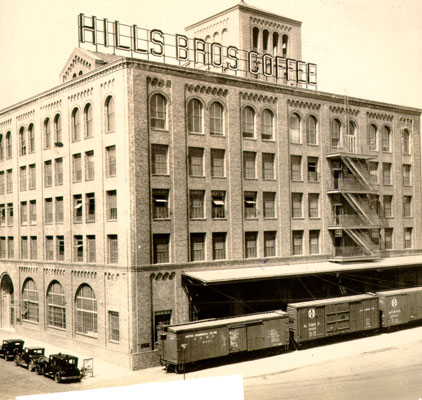
Hills Brothers Coffee warehouse, June 28, 1940. (Photo: SF Public Library Archives)
Ten of the units have terraces, with jaw-dropping views. In 1991, Fell bought one of them, a one-bedroom, because he fell in love with the spectacular bay views. "I said, 'This is pretty classy for an otherwise funky neighborhood,'" he recalls.
To this day, he admits he's kicking himself for not having bought a two-bedroom, but is glad he was wise enough not to have bought a unit with a view onto Folsom Street. Ten years later, a quarter of the units in the building lost a significant portion of their views and privacy when Gap's world headquarters was built next door.
These days, new buildings spark a feeding frenzy, but back in the '90s, it took the Hills Plaza condos nearly four years to sell out. "High-rise condo living was not something that was really ingrained in San Francisco at that time," Bement said. "Coming from suburbia or single-family dwellings with yards, some people found it wasn’t their cup of tea, living that way."
When he and his wife, Anne, first moved in, "You’d never see anyone in the elevators or the hallways. It was a pretty lonely spot in those first few years."
Aside from views, the SoMa of the early '90s had few selling points. "It was definitely a run-down neighborhood," Fell said. "There was reason to believe this could get better—it couldn’t have gotten any worse. There were a lot of vacant lots just used for parking."
At the time, the current location of the Infinity Towers, at Spear, Folsom and Main streets, was used as a weekday holding area for Golden Gate Transit buses. On the weekends, motorcycle teams came in to practice their maneuvers; as bad as that sounds, Bement says the neighborhood is actually noisier now, thanks to all of the nearby street construction.
"At the time, we had friends who were longtime San Francisco residents who had never been south of Market," Bement added. "It was sort of a forbidden territory. There wasn’t a lot going on down here. There were not a lot of buildings; the [Embarcadero] freeway was still up. I don’t know how many [bicycle] flat tires I got from freeway nails and debris that was all over the streets. They’d load up the debris and take it across the bridge to a dump in the Livermore area. You’d always pick up a nail or something that would result in a flat."
Despite the neighborhood's rough edges, "we never felt unsafe in the area," Bement said. "It wasn’t difficult in that sense. There just wasn’t a lot of activity down here; not a lot of activity on the streets. There were virtually no stores or shops in the area ... In a way, it was like living in suburbia. It was like a bedroom community. You had to go downtown, primarily by car, to get anyplace: to go shopping, to get groceries."
But what the building lacked in lifestyle conveniences, it made up for in easy commuting, Bement admitted. "Those first years, my office was right across the street at the Folgers coffee building, so I’d commute by walking one block from Howard and Spear to Folsom and Spear."
Fell recalled a few favorite neighborhood restaurants, including Etrusca, a "wonderful northern Italian" restaurant. (It later became Eric's, then the Capital Grille; most recently, it was The Cosmopolitan, which closed in spring 2012.)
After the Embarcadero freeway was torn down in the early 1990s, the neighborhood started to change. Muni light rail was added in the late '90s, AT&T Park (then Pacific Bell Park) opened in 2000, and the Ferry Building re-opened in 2003. The area started to see more foot traffic and get more developed. "We thought it eventually was going to become something, but not quite what it has become," Bement said.
Bement is now concerned about the effect growth is having on the surrounding developments. "The height limits at the time we came [to Hills Plaza] were 200 feet all around. We did not anticipate that we would have 400-foot-high buildings," he said. "The political powers that be in the city have always been open to almost any sort of development. Developers have had more money to get rulings from the Planning Commission, even though neighbors often oppose those efforts."
Nonetheless, Fell said, "It’s a very attractive part of San Francisco now. I didn’t have that vision. I didn’t think that would happen."





