
























































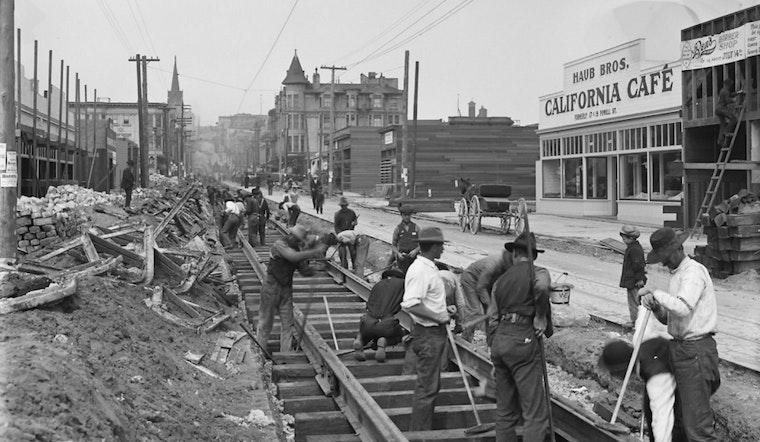
Long before the Hayes Valley Neighborhood Association (HVNA) was formed, another group presided over the shops, houses and streets: the Hayes Valley Improvement Association. Longtime readers may remember this 2012 article we wrote about the early-20th-century group, but with so many similarities between the struggles of the HVIA and those we're dealing with today, we thought it was high time to revisit the topic.
According to the San Francisco Call (the citywide newspaper of the time), the HVIA was made up of property owners and merchants who resided along Hayes Street and its cross streets. In 1907, it was reported that the group had 100 members. It held its meetings at "The Russ House" at 520 Hayes St., the space vacated earlier this year by Place Pigalle.
An avid proponent of voter registration, the HVIA often offered up its meeting space as a venue for recruiting new voters—particularly women. One meeting notice, posted in the Call in 1912, asked neighborhood residents to participate in "a heavier registration of citizens, that the whole people may express themselves in the nominating primaries in September. All women who are interested in civic betterment, whether or not they are affiliated with clubs or associations, are invited to be present."
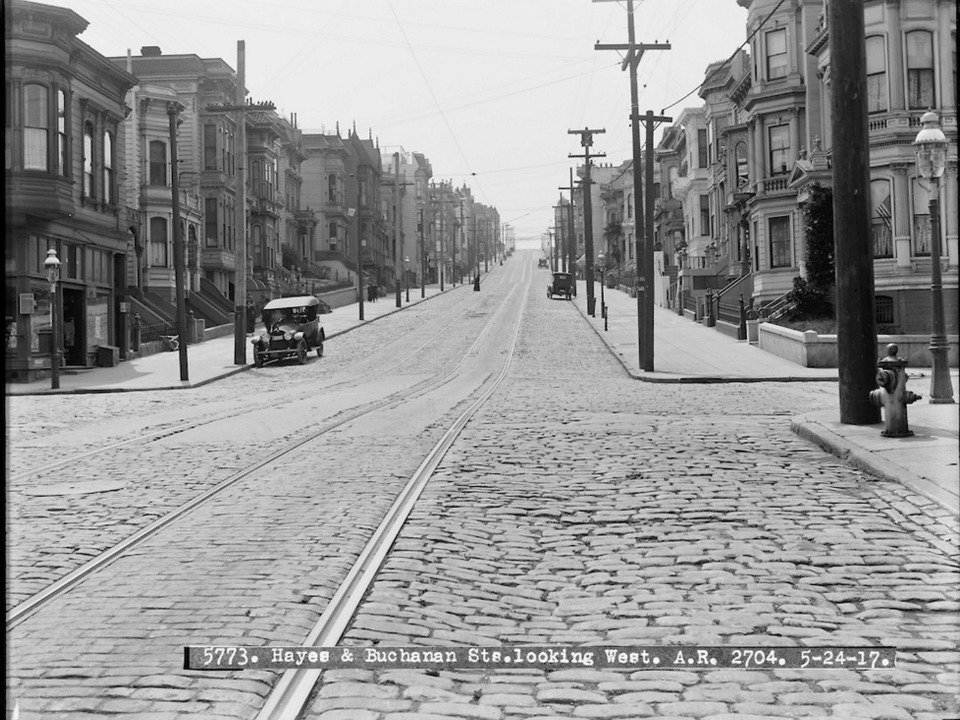
Hayes and Buchanan, 1917.
Civic betterment aside, the Improvement Society also fought for safety on its streets, particularly with regards to high-speed traffic (an issue about which the HVNA held a meeting last year). A Call article published on January 26, 1912 highlighted the dangers of speeding vehicles in the neighborhood.
"Owing to the utter disregard of automobile drivers in speeding over the streets in the Hayes Valley district, the Hayes Valley Improvement Society has appointed a committee to obtain evidence against the drivers of the machines, and help prosecute them when they appear in the courts. The committee has been designated 'The Auto Police Squad.'"
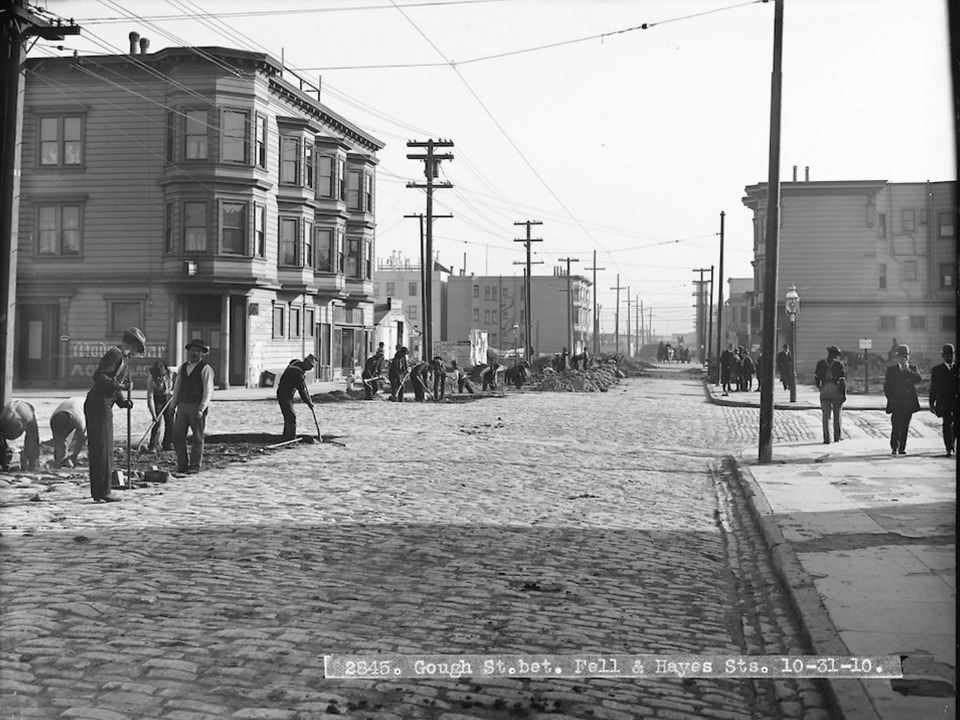
Gough between Fell and Hayes, 1906.
Other hot issues of the time included the widening of streets (and the subsequent shrinking of sidewalks), access to public transportation, the installation of street lights, and ongoing sidewalk maintenance. An article published on the 17th of January 1907 gave a rundown of that month's meeting:
"The Hayes Valley Improvement Association met last night to discuss the details of several important improvements planned for that section of the city. One of these projects is the widening of the street by reducing sidewalks from 15 to 13 feet, and as a preliminary step, a petition was drawn up for presentation to the Board of Supervisors."
In present-day Hayes Valley, the reverse is occurring: bulbouts and medians are being built, and several proposed parklets would take up street parking, but extend sidewalk seating.
Public transportation was also a vital issue for residents of the neighborhood, who asked that the grade of streets be adjusted (no small feat) in order to accommodate more cable cars.
"It is also desired that the grade between Scott and Pierce streets be reduced from 15 to 10 feet—to enable an electric line to be operated over the hill both ways. At present cars can be run outward, but the grade is 'too steep for an Inbound trolley.'"
Thanks to modern technology, the present-day 21-Hayes manages this hill just fine; more buses were added to the route in September.
During that 1907 meeting, street cleaning and sidewalk maintenance were also a concern, with residents asking the Association to take a stand on the issue.
"The President was requested to write to the Chief of Police, asking that the streets be kept clear of obstructions and standing teams, and an effort will be made to have the pavements kept in better condition."
Nowadays, street cleaning is the domain of SF Public Works, though the police-enforced clearance of "standing teams" has been less of an issue since horse-drawn carriages went out of fashion.
So next time you take the 21 down that steep hill between Scott and Pierce, narrowly miss being hit by a car on Octavia or trip over an uprooted square of sidewalk on Hayes Street, think of the neighborhood's early residents, who, 108 years earlier, were struggling with many of the same issues.





