

























































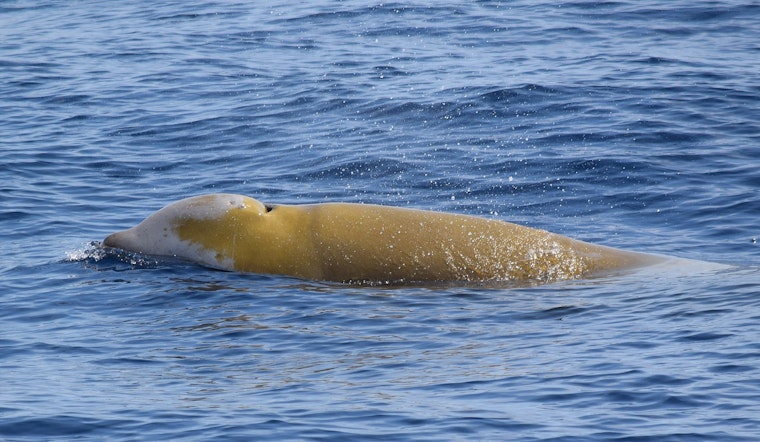
In an extraordinary turn of events, a pod of mysterious and elusive Cuvier's beaked whales made their presence known by sending waves of surprise through California's Monterey Bay during a whale-watching tour according to SFGate. This rare sighting was confirmed by marine biologist Nancy Black who has only encountered these creatures two or three times in the 35 years of her career.
With their distinctive light-brown coloring, dotted with white spots, these cetaceans are known for their pointy noses and skittish behavior, making the event all the more remarkable. The pod, consisting of four to six whales, was spotted around 10 miles northwest of Monterey Harbor as reported on Fox Weather. The whale-watching tour group, aboard Monterey Bay Whale Watch's Sea Wolf II vessell, were incredibly fortunate to witness the pod as they swiftly traveled through the open waters.
Cuvier's beaked whales, often mistaken for dolphins, are widely known for their record-breaking diving abilities. According to the National Oceanic and Atmospheric Administration (NOAA), these whales inhabit oceans worldwide but are rarely seen as they spend much of their lives diving and underwater. They have been recorded diving more than 9,000 feet and staying submerged for over an hour. The current record for the deepest dive is an astounding 9,816 feet, and the longest dive is 222 minutes!
As The New York Times reported in 2020, scientists are still trying to understand what allows these whales to stay underwater for such astonishing lengths of time. This phenomenon baffles physiologist Andreas Fahlman who stated, “They’re not supposed to be able to do this, but they do.” Clearly, there is still much to learn about these fascinating marine mammals.
In terms of population, there are roughly 5,000 Cuvier's beaked whales along the West Coast, as explained by Karin Forney, a research biologist with NOAA's Southwest Fisheries Science Center. In an email, Forney highlights that "Monterey Bay is one of the few locales where Cuvier's beaked whales can occasionally be seen relatively close to shore, because the deep Monterey Canyon that bisects the bay offers suitable habitat for this species." Nonetheless, considering their elusive nature and limited time spent on the water's surface, spotting these whales remains a rare and special treat.
The summer season in Monterey Bay often attracts a diverse mix of marine visitors which, in turn, brings in tourists and marine enthusiasts alike. In recent days, the whale-watching tour groups have treated guests to sightings of humpback whales and pods of Risso's dolphins, making the rarity of the Cuvier's beaked whales' appearance even more extraordinary.





