

























































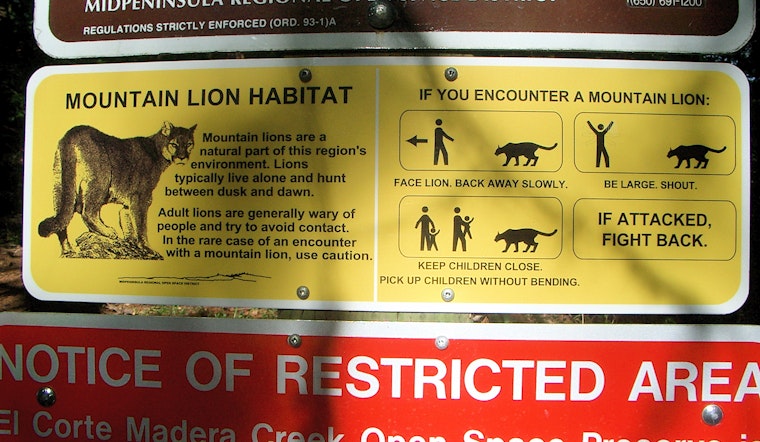
The recent discovery of a dead young mountain lion near the North Coyote Valley Conservation Area in South San Jose has sparked an urgency for better conservation efforts and enhancing safe passages for wildlife. Found lifeless along Santa Teresa Boulevard, the organization calls on drivers to be more cautious and slow down in order to prevent such incidents from occurring in the future.
Andrea Mackenzie, general manager with the Santa Clara Valley Open Space Authority, confirmed that the mountain lion likely died after being struck by a vehicle while moving between protected lands. Although the exact cause of death has yet to be determined, the California Department of Fish and Wildlife is performing a necropsy, and researchers from Santa Cruz's Puma Project have also collected samples.
The mountain lion's death underscores the importance of not only preserving natural habitats, but also ensuring safe pathways for wildlife to travel between different regions, as reported by the same KTVU news article. The North Coyote Valley Conservation Area serves as an invaluable corridor for pumas journeying between the Santa Cruz Mountains and the Diablo Range, but it is under constant pressure from encroaching development.
As Tiffany Yap, a senior scientist at the Oakland-based Center for Biological Diversity, explained, maintaining these pathways is crucial for the long-term survival of mountain lions and other wildlife species residing in the area. In September 2022, the Safe Roads and Wildlife Protection Act was signed into law requiring Caltrans to prioritize the identification of barriers to wildlife movement and implement crossing structures when building or improving roadways.
However, experts emphasize that more needs to be done, including reconsidering the development of roads and other infrastructures that could potentially slice through crucial mountain lion habitats. While Southern California pumas are often the focus of conservation efforts, Yap notes that their counterparts in the north are following a similar trajectory, making the need for increased attention in regions like the Coyote Valley all the more pressing.
For years, the Coyote Valley had been one of the most threatened landscapes in the U.S, with commercial, industrial, and residential development looming over its 1,500 acres of undeveloped land. Thankfully, action was taken in 2019 to protect the valley, as reported by KTVU. However, the mountain lion population remains vulnerable due to high-speed roadways cutting through their habitats, such as Highways 17 and 101, which obstruct their ability to connect to other regions for mating, hunting, and seeking out dens, food, and water.
Mackenzie from the Santa Clara Valley Open Space Authority points to a growing interest in finding ways to address the biodiversity crisis and foster the coexistence of wildlife and human populations. The Coyote Valley Conservation Areas Master Plan, which is currently underway, aims to support wildlife connectivity and further restoration efforts in the region. By raising public awareness of the importance of habitat protection and safe wildlife crossings, experts hope to secure a healthier, more vibrant future for the entire Santa Clara Valley and its inhabitants, both human and nonhuman.





