

























































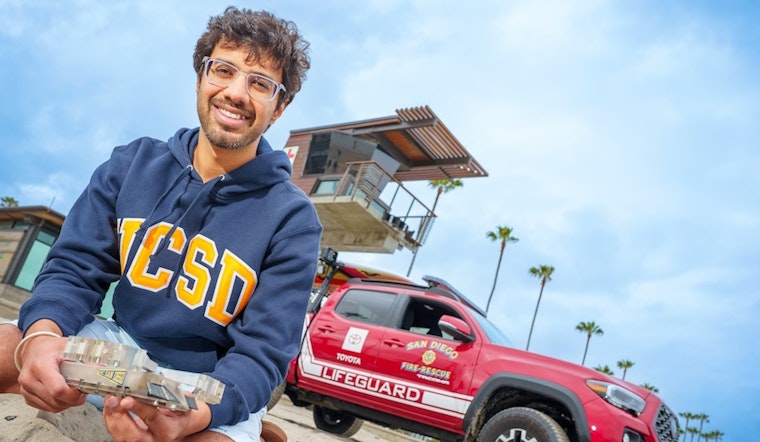
Researchers at the University of California San Diego are making waves, or perhaps more aptly, sand dunes, with their recent development of a unique robot that can swim through sand. Taking inspiration from sea turtle hatchlings, the team designed a robot with two oversized, turtle-like flippers, capable of digging itself out of the sand. The invention has potential applications in seafloor digging, extraterrestrial exploration, search and rescue missions, and more.
Traveling through sand poses numerous challenges for robots, including dealing with friction between sand grains, sensing obstacles, and coping with sand's varying behaviors, shifting between acting like a liquid and a solid. Designing a robot that could overcome these obstacles was no small feat, but understanding the locomotion of sea turtle hatchlings allowed the team to, as lead author Shivam Chopra described it, build a robot that is "both strong and streamlined," per UC San Diego News Center.
The researchers equipped the robot with force sensors at the end of its flippers, allowing it to detect obstacles as it moves, according to an Interesting Engineering article. Though the robot can best detect obstacles above its body, it still has trouble sensing objects below or directly in front of it. To maintain a level depth while swimming through sand, the team designed the robot with two foil-like surfaces, called terrafoils, on either side of its shovel-shaped nose.
Tests conducted in a laboratory tank and on La Jolla Shores, a beach near the UC San Diego campus, have shown promising results. The robot can travel at a depth of five inches in the sand at a speed of approximately 13 feet (4 meters) per hour, or 1.2 millimeters per second, as detailed by The Robot Report. While this pace may seem slow, it is comparable to other subterranean creatures such as worms and clams. In the future, the team hopes to provide the robot with the ability to burrow into the sand, in addition to merely digging itself out, and also increase its speed.
Beyond the aforementioned applications in seafloor digging, extraterrestrial exploration, and search and rescue missions, potential uses for this sand-swimming robot include the inspection of grain silos and the detection of soil contaminants. These capacities will, however, depend on the robot's ability to overcome the challenges of operating in sandy environments and effectively deal with the friction and forces involved, per UC San Diego News Center.
With support from the Office of Naval Research, the UC San Diego team's findings were published in the May 12, 2023 issue of Advanced Intelligent Systems. The development of this turtle-inspired robot highlights the importance of observing nature to inspire innovative technologies. As robots increasingly become part of our daily lives, understanding how animals like sea turtle hatchlings navigate their environments could prove crucial to the future of robotics and locomotion systems on Earth and beyond.




