

























































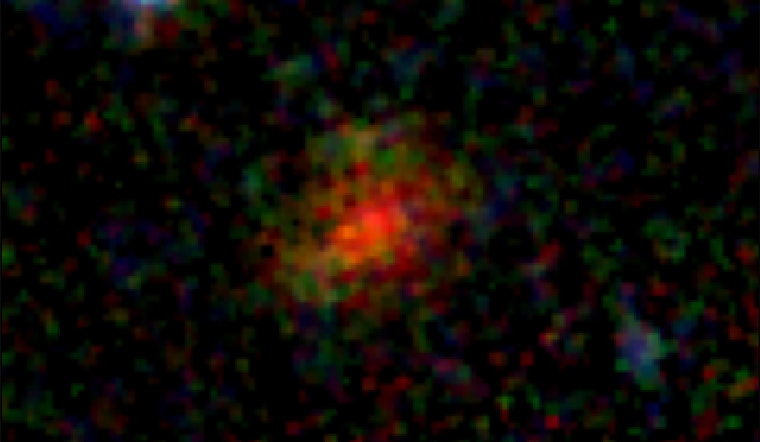
The James Webb Space Telescope has revealed a galaxy that remained elusive during the Hubble era. Known as AzTECC71, the seemingly faint galaxy has emerged from the shadows in Webb's images, indicating such galaxies could be more prevalent in the early universe than thought.
AzTECC71's detection emerged from the COSMOS-Web project, which seeks to map a sizable sky area. Scholars from The University of Texas at Austin were key in highlighting this galaxy as part of Webb's 250-hour observational agenda in its first year, as stated on UT News.
Despite its low visibility, AzTECC71 hosts a remarkable rate of star formation. Jed McKinney, a postdoctoral researcher at UT Austin, expressed to UT News, "This thing is a real monster." The challenge of detecting such galaxies suggests there could be many more obscured by dust.
Webb's discovery of AzTECC71 challenges assumptions about dust in the early universe. Previously, dust-rich galaxies evaded optical detection by instruments like Hubble. McKinney noted, "Until now, the only way we've been able to see galaxies in the early universe is from an optical perspective with Hubble," as stated in UT News.
AzTECC71 was first observed as a dust emission source by ground telescopes, then located more precisely with ALMA in Chile. Webb's infrared technology confirmed its presence, but only at wavelengths above 2.7 microns, remaining undetectable at shorter wavelengths.
Thanks to Webb's infrared capabilities, our understanding of the universe is expanding. With the telescope's ability to observe events taking place nearly a billion years after the Big Bang and to see through dense cosmic dust, it provides vital data on early galaxies. Research on objects like AzTECC71, observed at a redshift of about 6, is advancing knowledge and sparking curiosity about what other cosmic puzzles lay hidden. This work, supported by NASA amongst others, continues to uncover the secrets held in the universe’s dusty recesses.





