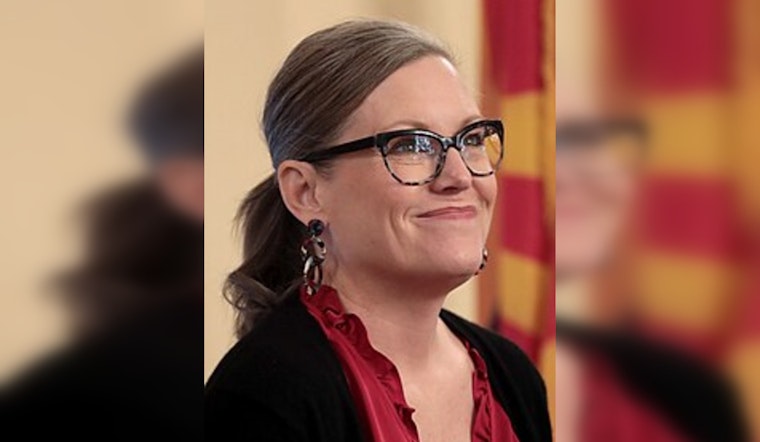
In a bold move to mitigate a gaping $889 million budget shortfall, Arizona Governor Katie Hobbs has taken the shears to transportation projects and the state's Empowerment Scholarship Accounts (ESA). Hobbs' budget proposal, totaling $16.3 billion for fiscal year 2025, is set to channel funds towards a slew of new initiatives, prominently featuring child care support and education, as reported by Phoenix Business Journal.
But the bipartisan support needed for the budget appears shaky at best. Right after the budget proposal hit the news on Jan. 12, the Republican chairmen of the House and Senate Appropriations committees had nothing but criticism, with Rep. David Livingston, R-Peoria, declaring it an "unserious mess." While Democrats commend Hobbs for protecting priorities to propel the state forward, Sen. John Kavanagh, R-Fountain Hills, agreed, saying these elements of her proposal are "dead on arrival with the Republican Majority," as detailed in a statement obtained by KGUN 9.
The crux of Hobbs' controversial budget lies in the overhaul of the ESA voucher program. This program, which currently grants families an average of $7,000 per student to finance private education, could theoretically dial back state expenses by easing the fiscal burden of public schooling. However, skeptics point out that many voucher recipients haven't stepped foot in a public school, rendering moot the program's intended cost savings. According to Hobbs' figures, unchecked enrollment could soar to over 83,000 students next year, with a staggering $822 million price tag for the state in fiscal 2025.
House Speaker Ben Toma doubled down on his pledge in a recent video, aired Monday, to staunchly oppose rollbacks or limitations to the ESA program. While vowing to shut down changes that would restrict enrollment to students with a minimum 100-day public school attendance record and scrap prior-year eligibility, Toma's stance could effectively preserve ongoing program participation for an estimated 49,500 students, notably those who have bypassed public schooling altogether. Such changes could slice approximately $244 million off state expenses, highlighting a critical junction between educational policy and fiscal prudence.
Amid the budgetary fray, the Governor seeks to extinguish an income tax credit for donations to entities that grant scholarships to private school students, expecting savings of around $185 million by fiscal 2026. Furthermore, Hobbs aims to defer non-essential capital projects and implement a nominal though universal 1% cut to executive and legislative operating funds. The proposed cuts go hand-in-hand with a strategy to funnel money into fostering homeownership among middle-class families, widening childcare accessibility, demystifying prescription drug costs, and safeguarding disabled and senior Arizonans, as Hobbs articulated.
On the horizon for education, Hobbs' budget earmarks substantial funding for an infrastructure facelift with $183 million allocated for school renovations, alongside a $200 million investment in higher education. Explicitly, nearly $46 million is tagged for the Arizona Healthy Tomorrow Initiative, poised to ignite medical education advancements across the state's universities, reported by the Phoenix Business Journal. The Department of Corrections is also set to receive a $203 million boost to satisfy court-mandated upgrades to inmate healthcare services.
While Governor Hobbs remains upbeat about Arizona's financial prospects, she maintains a conservative stance on revenue projections. The administration heralds this budget as a sound economic blueprint, albeit against a backdrop of a less rosy outlook from the Joint Legislative Budget Committee, foreseeing an $835 million revenue shortfall in fiscal 2024, according to KGUN 9. The state's fiscal drama unfolds against the polarized landscape of political ideologies, where the tug-of-war over resources, investments, and the very soul of Arizona's future continues with no clear victor in sight.