

























































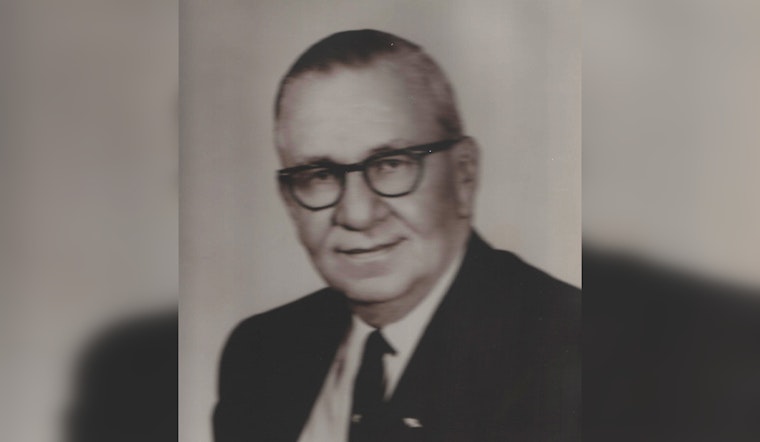
The small town of Vienna, Illinois, is about to lose a piece of its unique, if not infamous, history. The home of the late Paul Powell remembered for the 'Shoebox Scandal' that rocked Illinois politics, is due to hit the market as a vital trust fund is quickly depleting. According to the Chicago Tribune, the trust, established with $250,000 by Powell himself over fifty years ago, has maintained his birthplace as a museum, but its balance is now running critically low, spelling potential closure for the historic site.
Board member Gary Hacker of the Johnson County Genealogical and Historical Society, the current occupant of the house, said in a statement obtained by U.S. News & World Report "We're probably going to be putting it on the market for sale." The society's funds have been unable to keep up to maintain the property, which needs around $5,000 annually for upkeep, but only brought in $4,300 last year.
Powell, who was a southern Illinois political force, died unexpectedly in 1970, leaving behind a concealed stash of $800,000 in cash. His estate was eventually estimated to be worth the equivalent of $21.8 million in today's dollars. The bulk of the money was found in his suite at Springfield’s St. Nicholas Hotel, stashed in attaché cases, and even a gift box from the upscale Marshall Field & Co. department store, according to the Chicago Tribune.
Although Powell's influence has since faded, with fewer visitors drawn in by the scandalous past, the potential sale of his home serves as a stark reminder of a time when political power plays were daily fare. Hacker noted to U.S. News & World Report that memories, much like the funds in the trust, do not seem to last forever. There is a silver lining, however, as another buyer has suggested converting the home into a bed-and-breakfast, which could help to preserve this peculiar chapter of Illinois' history.




