

























































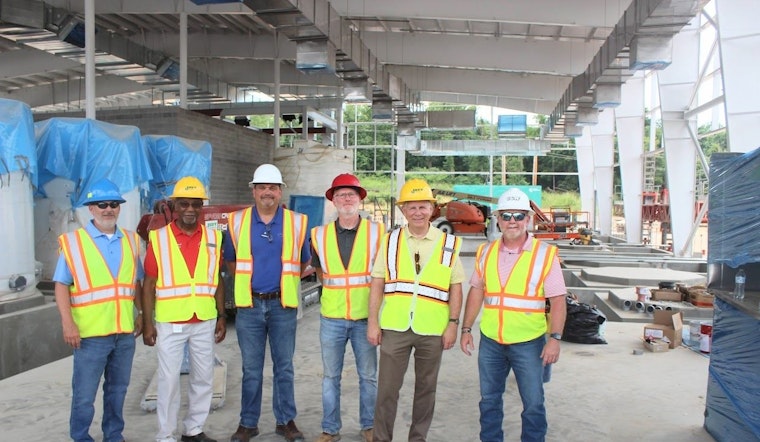
Clarksville's burgeoning population and buzzing industrial sector are set to receive a substantial boost in infrastructure. With the progress of two significant projects aimed at increasing water capacity and refining wastewater treatment, the City's Gas & Water Department announced. The construction of a second water treatment plant in North Clarksville aims to fulfill the rising water demands of the city, while upgrades to the existing wastewater treatment plant with a thermal dryer will streamline waste management efforts.
The necessity for these infrastructure improvements was underscored by Clarksville Mayor Joe Pitts, "It is imperative for a City growing as fast as we are to have a second water treatment plant to take care of our needs for generations," and lauded the work of Clarksville Gas & Water General Manager Mark Riggins and his team in planning and executing the projects, with Riggins adding, the new water treatment plant is not only crucial for current redundancy but also for supporting future growth, and the thermal dryer innovation will substantially decrease the byproducts heading to the local landfill, reducing volume, odor, and saving space in our landfill, which comes at a time when Clarksville, according to City officials, is experiencing sustained population growth and successfully attracting new business.
The North Clarksville Water Treatment Plant (NCWTP) will sprawl over roughly 30 acres and hold a service capacity of 36 million gallons per day (MGD). This figure complements the existing South Clarksville Water Treatment Plant's 28 MGD, collectively aiming for a 64 MGD capacity. Considering Clarksville's current average daily water demand of 19 MGD with spikes up to 25 MGD.
Even as the city's fabric expands, so does the vision for its waste treatment. A state-of-the-art thermal dryer is slated for integration at the Wastewater Treatment Plant (WWTP), transforming biosolids into stabilized, pelletized form for possible land application, or alternatively, allowing for continued disposal at the Bi-County Landfill. The new system is expected to impact odor complaints and transport efficiency, housing the process in a new 65-foot-tall building equipped with a natural gas-fired furnace to provide the necessary heat, while ancillary equipment will cater to waste capture and processing, this in accord with the city's vision for sustainability and management of byproducts.
The funding framework for these projects includes bond issuance and grant money, notably with the WWTP's thermal dryer project partially backed by the American Rescue Plan amounting to over $15 million in grants. The figures speak to not just the scale but the commitment to modernizing Clarksville's physical underpinning, ensuring a future-proofed blueprint for water consumption and waste treatment that rises in concert with its community pursuits and environmental accountability, as per City report.




