

























































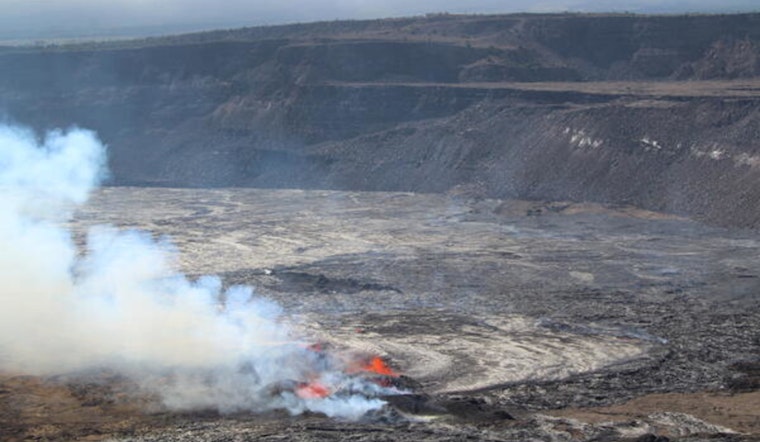
As the dust settles on Kilauea's latest eruption, Hawaiian Volcano Observatory (HVO) geologists have cleared out the temporary webcams that bore witness to the spectacle of nature's might. These instruments, which had been installed to monitor the June 3 event, are being moved to another location likely to provide new insights — near Cone Peak, KHON2 reports.
The shifting of these webcams is not just a simple relocation. During the transition, the geologists stumbled upon a scene painted not by human hands, but by the earth’s fiery breath. Splashes of vibrant sulfur deposits, which from a distance could be mistaken for a street artist's work, were discovered at the eruption site. These are in fact natural crystals, remnants of the volcanic activity that lasted about 12 hours, Hawaii News Now detailed.
It's not just the sulfur that calls for attention post-eruption. The landscape bears scars in the form of extensive cracking uprift of the fissure, a visual testament to the force that lay beneath. Spectators were afforded views of this geological transformation through the lens of the webcams, the very tools being redeployed by the HVO geologists. Their continuous dedication enables both public safety and scientific inquiry, lending eyes where human presence cannot safely tread.
Furthermore, the HVO team took note of weak residual outgassing at certain points across the landscape, a subtle yet poignant reminder of the power that had so recently been unleashed. Nature's processes are never truly at rest, even in the wake of what some might consider an event's conclusion. These observations suggest that Kilauea's activity, though perhaps quiet for now, continues in less visible but nonetheless significant ways.


