

























































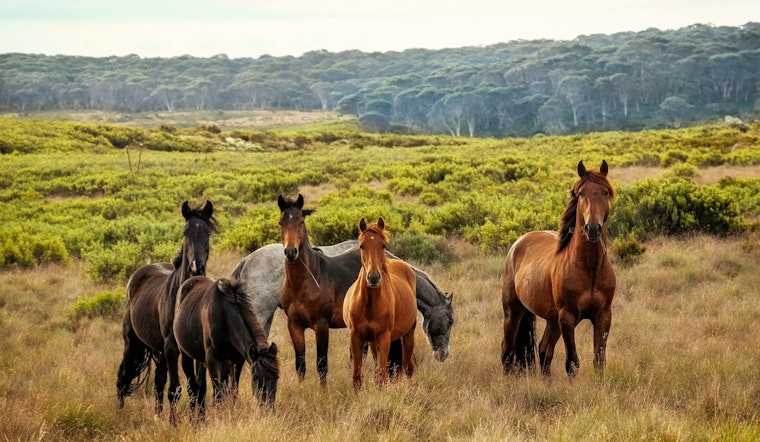
The ongoing dispute over the management of Salt River's wild horse herd in Tonto National Forest has reached the courts. The Center for Biological Diversity has taken legal steps to compel the U.S. Forest Guillermo Service to scale down the number of horses, alleging that their presence in excessive numbers threatens the existence of both the land and the endangered species that inhabit it. According to ABC15, the Center for Biological Diversity aims to reduce the herd size to 50 in order to protect the delicate desert ecosystem and its native wildlife, such as the Neotropical Songbirds, Yellow-Billed Cuckoo, Southwestern Willow Flycatchers, and the Yuma Clapper Rail.
Amidst the legal tangle, the Salt River Wild Horse Management Group is pushing back, challenging the notion that the horses negatively impact their environment. In a statement obtained by ABC15, Simone Netherlands, president of the nonprofit group, asserts that there is no solid scientific evidence supporting these claims. Her group believes that a population of only 50 horses would not be viable and advocates for maintaining the herd at a minimum of 200 members. Moreover, this group has taken steps towards herd management with a birth control program, although they estimate it will take a decade to bring the herd down to the agreed number.
Meanwhile, the bigger picture of habitat sustainability is contested. The Center for Biological Diversity's recent lawsuit claims that, according to federal range scientists, the land can only sustain 28–44 horses, a stark contrast to the Forest Service's most recent count of 400 to 500 horses. AZ Mirror reports that cattle ranching was already terminated in the Lower Salt River Recreation Area in 1978 due to insufficient forage, further calling into question the land’s ability to support the current horse population.
Conservationists highlight the devastating effect on the local fauna. Charles Babbitt, conservation chair of the Maricopa Audubon Society, told AZ Mirror, "With horses eating all the riparian tree saplings, these trees can’t grow into the mature cottonwoods that desert nesting bald eagles need." Additionally, John Koleszar, past president of Arizona Sportsmen for Wildlife Conservation, claims that the environment has become so barren that native quail no longer have habitat for nesting, pointing to horses as a significant contributor to such deterioration.
As the lawsuit unfolds, the central contention remains whether the region's delicate ecosystem can sustain the current population of the Salt River wild horses. With conflicting views on ecological impacts and animal management methods, both conservationists and horse advocates remain firmly committed to their cause. The Department of Justice, representing the U.S. Forest Service, is pushing for the case's dismissal, but the Center for Biological Diversity is undeterred, as reported by ABC15. A resolution, however, appears to be on a distant horizon with the natural world hanging in the balance.





