

























































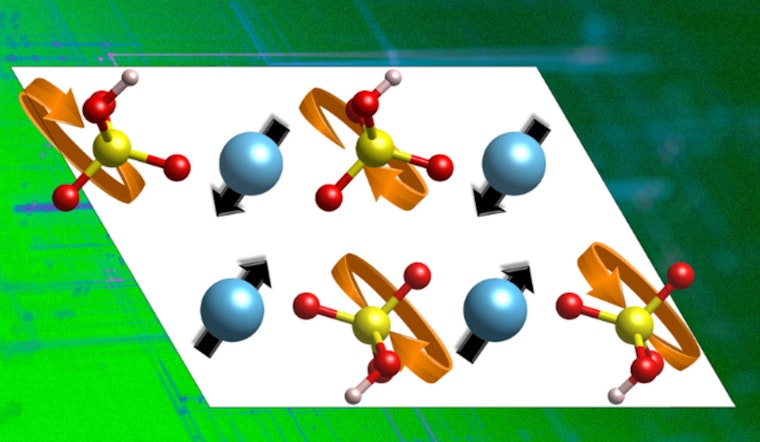
Engineers from MIT have identified critical characteristics of materials that could enhance the efficiency of a slew of green technologies, such as fuel cells and electrolyzers. According to a report published by MIT News, this research opens the door to potential advancements in energy-efficient batteries and could even pave the way for innovative computing devices. Proton-conducting materials are pivotal because, unlike most of today's electronics that rely on electron movement, these conduct protons. Fast proton conduction at lower temperatures would alleviate the high energy consumption and material degradation associated with the high-temperature operation of current inorganic proton conductors.
The discovery, thoroughly described in the journal Energy and Environmental Sciences, spotlights how MIT engineers, in collaboration with Northwestern University, have quantitatively honed in on the precise attributes that contribute to swift proton conduction. Bilge Yildiz, the Breene M. Kerr Professor in the departments of Nuclear Science and Engineering, and Materials Science and Engineering at MIT, outlined the consequence of this research for renewable energy applications. "Proton conductors are needed in clean energy conversion applications such as fuel cells, where we use hydrogen to produce carbon dioxide-free electricity," Yildiz said. Traditional means of hydrogen production, such as steam methane reforming, are carbon dioxide-intensive, which this new advancement seeks to revolutionize through electrochemical processes, as reported by MIT News.
Currently, proton conduction in inorganic materials is hampered by the need for extreme operating temperatures between 200 to 600 degrees Celsius. However, Yildiz points out the drawbacks of this approach, noting "Going to higher temperatures is not desirable because that makes the whole system more challenging, and the material durability becomes an issue," as noted by the same news source. In their search for low-temperature alternatives, the MIT team evaluated the atomic configurations of solid acids and pinpointed the lattice flexibility as a crucial factor in proton conduction. By using computer simulations, they assessed various materials previously unconsidered as proton conductors and identified six new promising candidates.
While these candidates exhibit evidence of outperforming existing materials, Yildiz cautions about potential uncertainties, stating, "I don't want to say exactly how much higher the conductivity will be, but these look very promising." The research team's goal is to entice experimental exploration turning these compounds into practical proton conductors. Besides the potential benefits in efficient hydrogen and ammonia production, the new insight at the atomic scale could enhance our understanding of proton conduction mechanisms, as per MIT News.
Funding for the groundbreaking work was sourced from the U.S. Department of Energy, the Wallenberg Foundation, and the U.S. National Science Foundation. The practical development of devices utilizing these proton-conducting materials may still be several years away, but the foundation laid by this research offers a compelling prospective for the realm of clean technology and, by extension, the global effort to mitigate climate change.





