

























































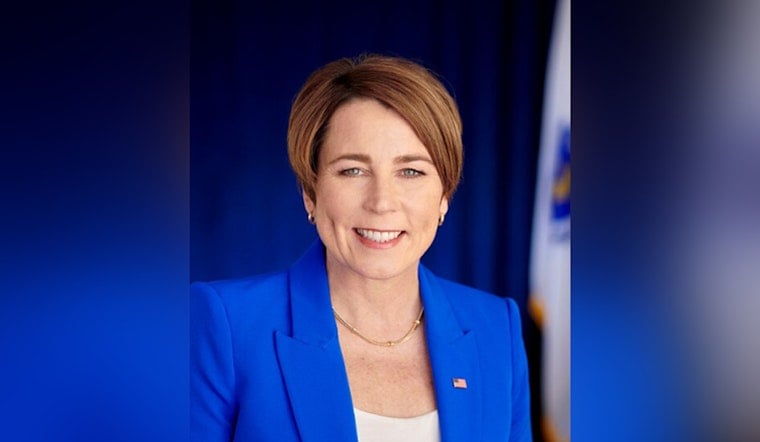
Massachusetts has appointed its first-ever chief heat officer, tapping former Biden administration climate aide Katie Schlick to lead a new statewide push against rising temperatures that are already reshaping public health and infrastructure across the Commonwealth. Governor Maura Healey announced the appointment, positioning Massachusetts as only the second state in the nation, after Arizona, to create such a role.
According to The Boston Globe, Schlick previously served as special assistant to the national climate advisor under the Biden administration and worked for the U.S. Climate Alliance, a coalition of governors, before joining the Healey administration. She is a Yale University graduate who also worked as an environmental planner in Connecticut, including a stint with the Naugatuck Valley Council of Governments. Her new position, which carries a salary range of $80,000 to $90,000, is funded by The Boston Foundation, which has made extreme heat a focus of its philanthropic work.
Schlick will report to the state's climate chief and the Department of Public Health commissioner, according to the Globe's reporting, and will establish an intergovernmental council tasked with developing an action plan to reduce extreme heat threats to vulnerable populations, critical infrastructure, and natural resources. Healey said the new role will help keep Massachusetts and its residents safe, framing the appointment as part of a broader effort to prepare the state for the mounting threat of extreme temperatures.
Following Arizona's Lead, Building on a Municipal Model
Massachusetts is following a path first cleared by cities. Miami-Dade County appointed the world's first local chief heat officer in May 2021, a role later echoed by Los Angeles, before Arizona created the nation's first statewide version in March 2024 when Governor Katie Hobbs appointed Dr. Eugene Livar, according to the Arizona Department of Health Services. Arizona created that position after extreme heat contributed to hundreds of state fatalities amid a national toll that reached roughly 2,300 deaths in 2023, per the same agency.
Nationally, extreme heat remains the single leading weather-related killer, contributing to those estimated 2,300 deaths in 2023 and driving more than 120,000 emergency department visits across the country, as Smithsonian Magazine has reported. Heat kills more people than any other extreme weather event, and heat waves cause spikes in emergency room visits, a pattern the Globe's reporting also affirms. Massachusetts has already warmed nearly 3.5 degrees Fahrenheit since the start of the past century, and the state could see two to three times as many 90-degree days by 2050 compared with the historic average, according to the Globe.
A Predictable Threat, Officials Say
Massachusetts Department of Public Health Commissioner Robbie Goldstein said the predictable nature of extreme heat allows officials to prepare and act before people get sick, describing it as a predictable public health threat rather than a sudden disaster. Schlick echoed that framing in her own comments, saying Massachusetts is taking bold, coordinated action to protect and uplift communities amid another record-breaking year of heat and smoke. Officials have also noted that extreme-heat deaths are largely preventable when people have places to cool off, underscoring the stakes behind Schlick's coordination role.
Climate change is driving hotter summers and more frequent, intense heat waves, and heat waves also strain the electricity grid's capacity to meet air-conditioning demand, according to the Globe's reporting. Schlick's job will be to provide dedicated expertise and coordination for Massachusetts's efforts to prepare for extreme heat, collaborating with state government and local communities to combat its deadly consequences. She previously supported other states as they developed and implemented their own climate resilience strategies before taking on this role.
Boston's Own Heat Divide
The new state role arrives against a backdrop of stark neighborhood-level disparities in Boston itself. The city's 2022 Heat Resilience Plan found that historically redlined neighborhoods can run up to 7.5°F hotter during the day and 3.6°F hotter at night, with 40% less tree canopy, disproportionately burdening residents in Dorchester, Roxbury, East Boston, and Chinatown, according to the City of Boston. The Boston Foundation, which is now funding Schlick's position, has also backed the B-COOL pilot project alongside Boston University researchers, installing micro-sensors in environmental justice neighborhoods to feed real-time temperature data into municipal heat emergency protocols.
That local strain has already tested emergency systems directly. During Boston's June 2025 heat emergency, Boston Emergency Medical Services projected a 10% to 15% surge in 911 calls tied to heat-related medical distress, prompting the city to open cooling centers and deploy street outreach teams. Boston saw similarly punishing conditions again this summer, with heat indices topping 100°F around the Fourth of July.
State Role Fills Gaps as Federal Rules Loom
Schlick's position also lands amid a shifting federal regulatory landscape. The Occupational Safety and Health Administration proposed a Heat Injury and Illness Prevention rule in August 2024 that would require employers to provide water, shaded rest areas, and mandatory paid breaks once workplace heat indices hit 80°F and 90°F, a framework state heat strategies will likely need to navigate as they take shape. Separately, U.S. Senator Jacky Rosen introduced the Extreme Heat Emergency Act in May, which would add extreme heat to FEMA's major disaster declaration list, potentially opening federal aid to state and local governments during severe heat waves that currently rely primarily on local budgets.
Massachusetts's move builds on groundwork Healey laid in January 2023, when she created the cabinet-level Office of Climate Innovation and Resilience and named Melissa Hoffer as the state's first climate chief, a position widely described as the nation's first cabinet-level climate chief role. That effort produced the ResilientMass Plan later that year, which tracks 142 state agency climate adaptation actions, from a new Office of Climate Science to strengthened building codes. Schlick's heat chief role now gives that broader framework a dedicated point person focused specifically on the threat that, according to state and federal officials, is already Massachusetts's deadliest weather hazard.





