

























































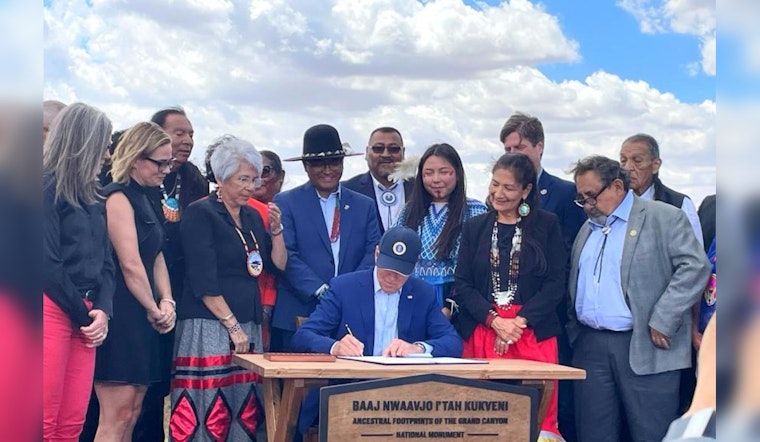
Amid ongoing debates over land use and resource extraction, a recent executive action by President Biden to create a new national monument in Northern Arizona has sparked controversy and calls for legislative intervention. The "Baaj Nwaavjo I’tah Kukveni Ancestral Footprints of the Grand Canyon National Monument" covers over 900,000 acres and has been criticized by Arizona lawmakers as an instance of presidential overreach, as reported in an op-ed published on August 22nd, 2024. The Antiquities Act of 1906, which allows a president to designate national monuments, requires that such designations be limited to the "smallest area" necessary to protect the landmarks in question, a condition that critics argue has not been met in this case.
The newly formed monument has further implications as it encompasses regions identified for their high-grade uranium deposits, which could play a key role in the United States' move towards zero-emission nuclear power. Proponents of the mining argue that tapping into this resource could simultaneously bolster national security by reducing dependence on foreign uranium and improve groundwater quality. However, local tribes, including the Navajo Nation, have opposed the extraction, citing environmental concerns and the significance of the region to their heritage. Despite their previous lobbying, the designation which they sought only materialized after the discovery of renewed mining interests in the area.
This tension is not isolated to environmental concerns but extends into economic and infrastructural domains. The Navajo Nation is currently involved in a historic water settlement with Congress involving $5 billion for various water projects, including a significant pipeline expected to generate substantial economic benefits for the tribe. Some argue that the tribe's opposition to uranium mining contradicts its partnership with Arizona on other resource matters. Advocates of the mining hint at the economic boost that such activities could provide, which, in their view, is complicated by the tribe's stance and actions post-designation.
Legislation is on the table to approve the water settlement, but Arizona legislators are pushing for an amendment that would revoke the monument designation and require congressional approval for future monuments in the state, similar to a provision already in place for Wyoming. They argue that the President's proclamation deviates from the original intent of the Antiquities Act, which was not meant to block economic development but to protect historical sites. According to the op-ed, the state has called for these changes as both a measure of economic protection and a balance against perceived executive overreach.
Arizona, already home to 19 national monuments, is at a crossroads where historical preservation, resource management, and presidential authority intersect. With the proposed Northeastern Arizona Indian Water Rights Settlement Act (S.4633 and H.R.8940) awaiting action, Congress has an opportunity to address what some perceive as an imbalance between conservation, cultural interests, and economic needs. The outcome may well set a precedent for how similar disputes are negotiated in the future.





