

























































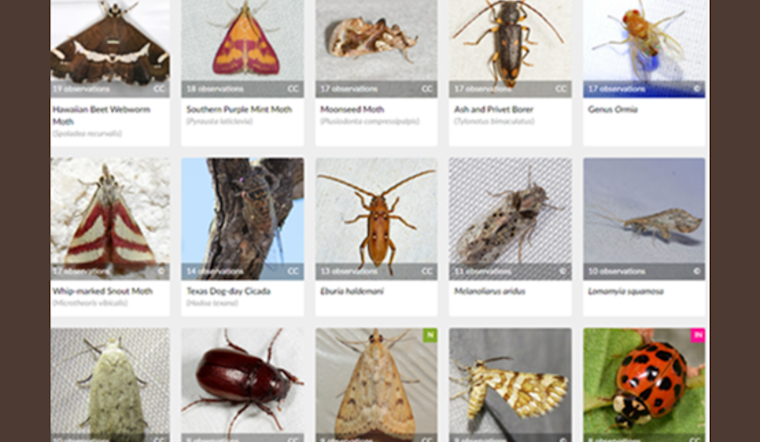
When night falls and the city lights fade, a whole other world springs to life. That's exactly what went down at Tandy Hills Natural Area on Aug. 10, as discovered by Park & Recreation Department's natural resource assistant interns. Working with the Texas Parks & Wildlife Department and other nature-conscious organizations, these interns unveiled a nocturnal extravaganza that drew in 112 nature enthusiasts eager to spy on the denizens of the dark.
The event was about as far from an average night out as it gets, providing a front-row seat to the unheralded pollinators of the night. In a study space of under 2 acres, the iNaturalist app and some dark lights were all the tools needed to document almost 200 species which included, as reported by the City of Fort Worth, a couple of bats and the glow-up of the night–scorpions that turned luminous under ultraviolet light.
Take a gander at these figures: 156 insect species, accompanying 10 arachnids, 24 plant species, 1 slithering reptile, a lone bird, two bats, and one rabbit all made the list. It turns out that those pesky bug zappers are more than just an annoyance; they zap away critical creatures of the night. The insects they target, like moths and beetles, are navigated by stars and moonlight and are central players in feeding everyone from birds to reptiles.
Once done with the creepy crawlies, attendees were wooed to the telescope station handled by the Fort Worth Astronomical Society. There, they caught a glimpse of celestial wonders like Saturn, teasing with its rings, and a distant Neptune. This peek into the cosmic realm complemented the on-ground discoveries, framing the night's theme: the delicate balance between terrestrial and celestial navigation.





