

























































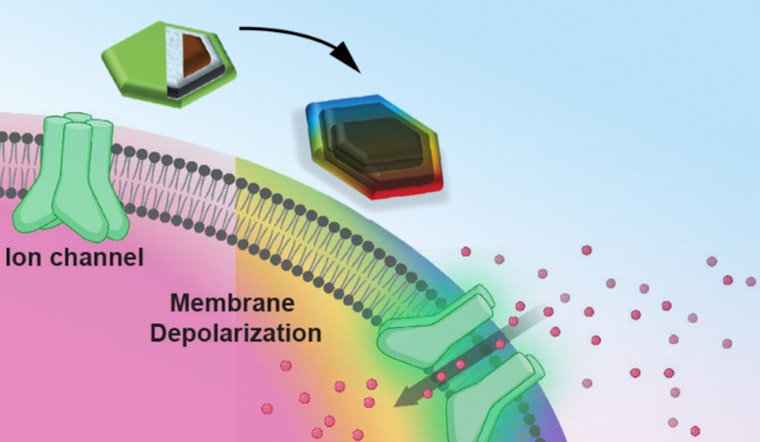
In a development that could signify a new era for non-invasive neural therapies, MIT researchers have created tiny magnetic nanodiscs capable of remotely stimulating brain regions without the need for implants or genetic modification. As per a report by MIT News, these discs—which measure roughly 250 nanometers, or about 1/500 the width of a human hair—can be injected into brain tissue and activated from outside the body using a magnetic field.
The approach, detailed in the journal Nature Nanotechnology, may offer an alternative to Deep Brain Stimulation (DBS), which despite its efficacy in treating neurological conditions, comes with the trade-offs of surgical risks and complications. Impressively, the nanodiscs maintain capacity to stimulate neurons without genetic modifications, surmounting the hurdles faced by other magnetic methods previously reliant on such techniques.
Polina Anikeeva, who helms MIT’s Bioelectronics group, and graduate student Ye Ji Kim, with contributions from 17 other collaborators from MIT and Germany, stand behind the research. Kim synthesized the nanodiscs and, along with Noah Kent, a postdoc in Anikeeva's lab, scrutinized their properties. Encased with a two-layer magnetic core and possessing a piezoelectric shell, they morph shape under magnetization, and this deformation induces an electrical response capable of exciting neurons.
Tests on cultured neurons and mouse brains revealed that the nanodiscs can be effectively activated by an external electromagnet for localized neural stimulation. Describing the process, Ye Ji Kim said in a statement obtained by MIT News, "This stimulation did not require any genetic modification," a significant leap forward in the field of neural manipulation. The research suggests that applying a weak electromagnet can trigger the particles, inducing rotations in treated mice and demonstrating potential in managing Parkinson's disease and other motor control issues.
While past attempts at magnetoelectric stimulation have used spherical particles with limited success, the distinctive shape of these new nanodiscs boosts the magnetostriction by over a 1000-fold. However, the conversion from magnetic to electric impulse registers only four times better than conventional methods, suggesting there's more work to be done. Kim notes a stark area for improvement: "That’s where a lot of the future work will be focused, on making sure that the thousand times amplification in magnetostriction can be converted into a thousand times amplification in the magnetoelectric coupling."
The immediate application of this technology is expected to be in the realm of animal model research, while human clinical usage remains on the horizon, pending extensive safety trials and regulatory reviews. "When we find that these particles are really useful in a particular clinical context, then we imagine that there will be a pathway for them to undergo more rigorous large animal safety studies," Anikeeva commented about the future pathway for these novel nanodiscs. There's a clear potential for these nanoparticles to a transformative impact on the treatment of neurological disorders, with a less invasive approach that could alleviate some of the inherent risks of current methods, once additional research establishes their efficacy and safety.



