

























































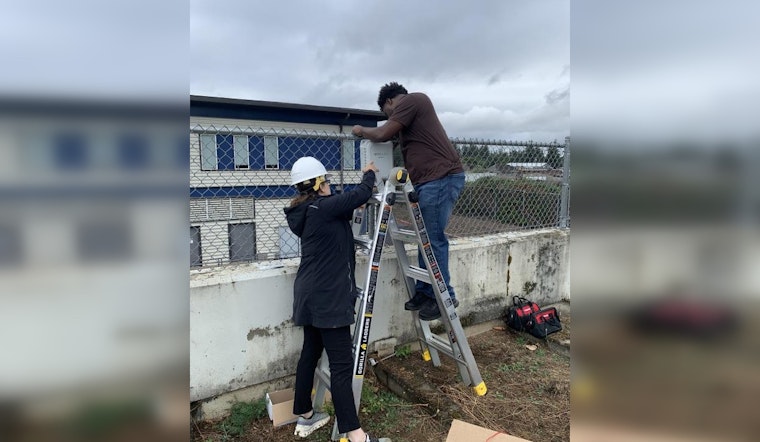
In an effort to actively improve air quality in Multnomah County's Rockwood neighborhood, a joint endeavor involving the County and The Blueprint Foundation utilizes a federal EPA grant specifically targeted at areas suffering from environmental racism. Wil Bridges, a technical advisor for The Blueprint Foundation, was recently spotted mounting a solar-powered air quality monitoring system near the County's Yeon Building—an area chosen for its proximity to a gravel mine known to stir up dust and affect local air conditions. "The semi-trucks are picking up gravel and driving right through our neighborhoods," Bridges told Multnomah County News, highlighting the direct impact on the community.
The initiative is more than an act of environmental vigilance; it is designed to provide actionable, accurate data that assists not only in real-time decision-making but also in understanding the long-term effects of specific interventions—such as replacing wood stoves or installing energy-efficient windows. This data-driven approach aims to tightly monitor and respond to the air quality issues plaguing Rockwood, where residents are disproportionally at risk from environmental factors leading to poorer health outcomes. Despite the challenges encountered, the efforts are underscored by a sense of ownership and efficacy as Bridges and partners work to bring to light the conditions long endured by this diverse community.
Beyond monitoring, the program includes green job training for local youth, who learn from professionals within their own community about building and installing the air quality monitors. As reported by Multnomah County News, one such youth, 13-year-old Kingston, got involved with his younger brother Max, both building their own monitors and deepening their awareness of their environment. These efforts reflect a past where understanding and changing local conditions were the domain of the few, rather than the shared responsibility that it has become.
The grant from the U.S. EPA, amounting to just under a million dollars, not only facilitates the replacement of high-pollutant heating systems but also promises to affordably shade and cool a neighborhood built atop an urban heat island. "This project is both interesting and innovative, blending science, policy and STEAM education," John Wasiutynski, director of Multnomah County's Office of Sustainability, recognized the comprehensive nature of the grant. Against a backdrop of economic struggle and environmental injustices, these initiatives seek to even out disparities that have long inflicted Rockwood, doing so with a future-forward approach that empowers the very residents most affected.
The collaborative venture between The Blueprint Foundation and Multnomah County extends its influence, having engaged student scientists as young as 10 in the construction and installation of a network of air monitors. As these students, including former participants now furthering their studies in computer science, become mentors for new learners, they perpetuate a cycle of knowledge, confidence, and community involvement. As noted by Dr. Derron Coles of the Change is in the Air project, allowing Black and Brown students to be taught by those who represent their own experiences cultivates an environment where "Making mistakes feels a lot different" compared to spaces that lack diversity. These projects, therefore, represent more than mechanisms of environmental control—they symbolize a commitment to cultivating resilience and empowerment within a community historically overlooked.





