

























































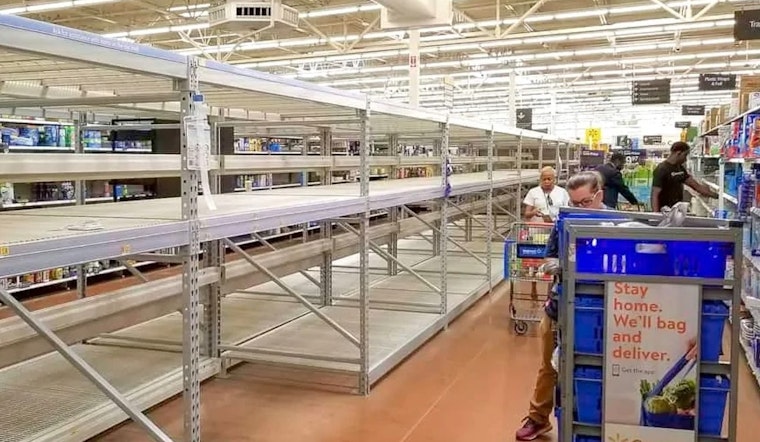
As the International Longshoremen's Association (ILA) strike at East and Gulf Coast ports rolls into its second day, local shoppers are swiftly responding with a marked uptick in purchases of essential goods. Social media platforms are flooded with images and videos showing depleted shelves at supermarkets, as individuals brace for the potential long-term consequences of the port strike on their daily lives. Notably, a video clip shared by author and photographer Denise Van Patten on social media showcased the stark reality of empty water sections at her local Kroger—a sight amplified by the recent aftermath of Hurricane Helene in East Tennessee and captured by FreightWaves.
Furthermore, reports from South Carolina described an analogous trend, with residents facing an early shortage of bottled water in stores such as Sam's and Walmart, as evidenced by a post from social media user Micheal Coker. The ILA's demands for improved wages, benefits, and measures to combat port automation have been met with resounding support from truck drivers, who have symbolically honked their horns in solidarity with the striking dockworkers—a gesture reliably reported by FOX 10 Phoenix. Notably, both dockworkers and truckers confront the advancing threat of job losses due to increased automation, which forms a central issue in the ongoing strike.
Anxieties are further compounded by the approach of the winter season, traditionally not a growing season in the U.S., which threatens to drive grocery prices up if the strike extends over a prolonged period. Ryan Sunderlin of Buys Imported Produce conveyed this concern to FOX 10 Phoenix, stating, "Winter is not typically the growing season in the U.S. so if this prolongs a month, two months, three months, be prepared to see prices relatively higher at the grocery store." In the backdrop of these comments, the sight of some 120 ships en route to the East Coast, with no immediate prospect of being docked or offloaded, underscores the gravity of the situation for consumers and businesses alike.
Concerns about the wider economic repercussions are driving calls for intervention at the federal level. Matthew Shay, president and CEO of the National Retail Federation, has been vocal about the urgency of the situation. "A disruption of this scale during this pivotal moment in our nation's economic recovery will have devastating consequences for American workers, their families and local communities," Shay said in a news release as reported by FreightWaves. He urged the Biden administration to intervene "immediately to prevent further hardship and deeper economic consequences."
The agricultural sector could face staggering losses if the strike persists, making to potentially suffer significant impacts according to an American Farm Bureau Federation Economist, Daniel Munch. The economist highlighted in a podcast that "The disruption to overall agricultural trade is expected to be about $1.4 billion each week that a strike is in place." Munch's comments, as shared by FreightWaves, underlines the specific risks to commodities like poultry, raw cotton, red meat, dairy products, and soybeans that predominantly ship through East Coast ports.
Retail giants such as Walmart have communicated their preparedness for this kind of supply chain disruption. Jeffrey Essary, a global communications spokesperson for Walmart, told FreightWaves, "We prepare for unforeseen disruptions in our supply chain and maintain additional sources of supply to ensure we have key products available for our customers when and how they want them." These assurances notwithstanding, the looming uncertainty serves as a stark reminder of the delicate balance within our nation's supply infrastructure.





