

























































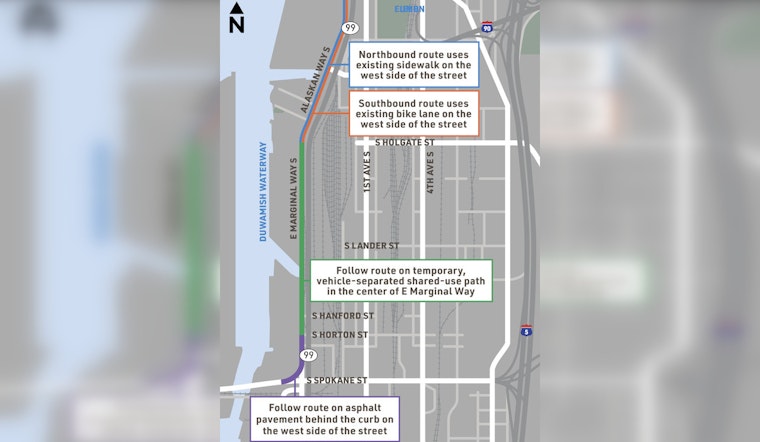
Construction on the North Segment of the East Marginal Way Corridor Improvement Project, which kicked off in March this year, has marched into its next phase of reshaping the arterial for cyclists and pedestrians alike. With an end date projected for spring 2026, those accustomed to rolling through this stretch between Spokane and Atlantic Streets are now navigating new paths set in asphalt and paint. The Seattle Department of Transportation (SDOT) has outlined detailed detours to ensure continuity in the mobility fabric of the city's industrious harbor edge.
Cyclists, in particular, have now to temporarily adapt to follow a new curb-separated path that escorts them along the western flank of East Marginal Way South. This alteration, designed to efficiently channel the two-wheeled amidst the rubble and rhythms of progress, will bridge them over to an interim shared route before spilling them back out onto familiar pavement at Holgate. "Our goal is to minimize disruptions and maintain safe access for people walking, biking, and rolling along the corridor during construction," declared the SDOT in an announcement, a testament to their commitment to safety and access.
However, the journey for general-purpose traffic has been rerouted to alternate streets, with the stretch of E Marginal Way S now a no-go until the projection's completion. 1st Ave S stands as a major detour conduit, easing the flow of cars and commuters around the construction's heart. SDOT has maintained access for those on foot, bikes, or rolling devices through careful planning and continuous updates to wayfinding signage.
While the hum of freight forges on, uninterrupted for portside operations, truckers weaving their down E Marginal Way S are temporarily being flagged down different channels, subject to the choreography of detours and lane closures. Local access, a vein often overlooked amidst such logistical surgery, is promised continuity despite the construction's sprawl. "Access is maintained for people walking, biking, and rolling along E Marginal Way S using different routes to avoid active construction areas," the SDOT emphasized, ensuring the lifeblood of local transit keeps to flow through the neighborhood's arteries.
Further sweetening the deal is the prospect of new public art stemming from the project's collaboration with the Office of Arts & Culture. Artist Will Schlough is spearheading an art installation along the corridor, keen on mirroring the diverse users of the thoroughfare. The community's opinion is not only welcomed but sought, with a public meeting and a survey offering channels for voice and vision. "There are several ways to get involved," beckoned the SDOT, an invitation to blend the locals' breath and blood into the final art piece that will grace East Marginal Way's rebirth.





