

























































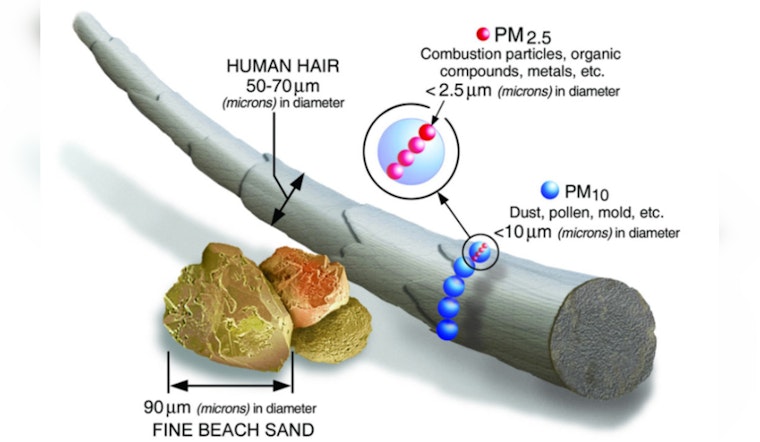
As residents in the Maricopa region rang in the New Year with fireworks and wood-burning celebrations, they also set a global high-water mark for PM-2.5 pollution, a concerning feat that has put air quality concerns front and center for 2025. According to the Maricopa Association of Governments, January 1st saw some of the highest levels of these fine particulate matter pollutants, known primarily as a byproduct of various combustion activities, including those from power plants, industries, and automobiles.
These tiny particles are more insidious than their size might suggest, capable of breaching the sanctuary of our lungs and bloodstream, where they birth a myriad of health problems. Despite this New Year's Day spike, for most of the year, Maricopa Association of Governments reassures that PM-2.5 levels are typically within "good" and "moderate" ranges, owing to decades of implemented control measures aimed at reducing dust and emissions.
The transient triumph in battling PM-2.5 does little to assuage the persistence of ozone pollution. Ozone, while invisible, traces its lineage to a volatile union of sunlight, nitrogen oxides, and volatile organic compounds—both naturally occurring and man-made. Recently, those in power have seen the tightening fist of the Environmental Protection Agency, which has consecutively heightened national ozone standards. Despite over 70% reductions in state-manufactured emissions over the past thirty years, the latest Environmental Protection Agency ozone standards loom large, unmet, with ozone levels stubbornly rising, as reported by the Maricopa Association of Governments.
To tackle the ozone beast, Maricopa Association of Governments reports coordinating with the EPA while emphasizing the region's successes and pitfalls in a meeting with EPA Administrator Lee Zeldin and Senator Mark Kelly. "Sponsoring New Scientific Research to Understand How Ozone Pollution is Formed in Our Region," outlines an initiative for a Ground Level Ozone Research (GLOR) study in partnership with ASU and local air quality agencies. This project, set to unfurl in the summer of 2025, aims to dispense policy-relevant evidence and insight on local ozone issues.
Moreover, Maricopa Association of Governments strategies include a Moderate Area Ozone Plan for the particularly prickly challenge of external ozone sources. The plan, which must be palatable to the EPA, points to natural causes and out-of-state transport as major contributors, in addition to recent wildfires, to the region’s ozone problem—ultimately seeking to deflect sanctions and restrictions that harm business and industry. Additionally, Maricopa Association of Governments underscores the benefits of cleaner transportation, as supported by Prop 479, focusing on upgrades to congestion-reducing infrastructure, and greener modes of transit from buses to bikes.





