

























































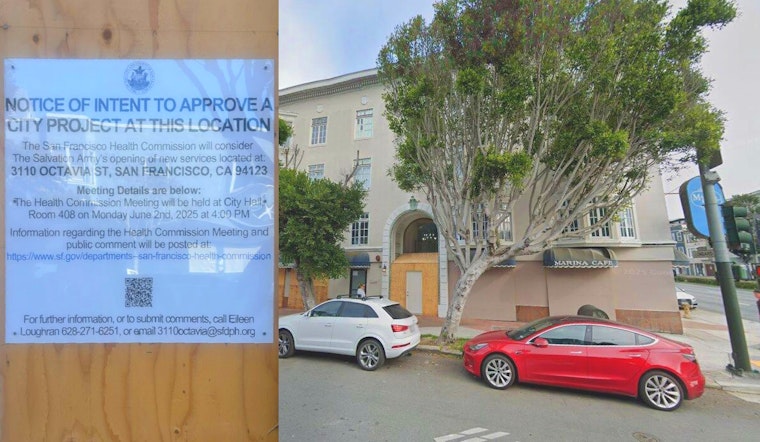
Amid ongoing efforts to tackle the homelessness and drug issues in San Francisco, the city is pushing forward with a new development in the Marina District, where a building that formerly housed the Marina Inn will now become a two-year recovery housing facility. This initiative comes from The Salvation Army and the Health Commission, and it's set to provide post-treatment housing for adults who have completed residential substance use disorder treatment. As per the city's website, the program at 3110 Octavia Street aims to empower its participants towards lasting recovery, emphasizing stability, financial independence, and personal growth.
Represenatives for the Salvation Army spoke with Hoodline San Francisco and shared comments from Steve Adami, Executive Director of The Way Out, who provided new details about the forthcoming program. According to Adami, the Marina Inn will become a two-year Transitional Recovery Residence for adults exiting residential drug treatment. “The program will offer a range of wraparound services, including case management, recovery-supportive services, support groups, life skills, career development, family reunification, and assistance in securing permanent housing,” Adami told Hoodline. The site will include 40 units with 68 beds, each featuring private baths.
Conversations around this project have ignited a range of reactions in the community. Hoodline San Francisco first became aware of this project due to posts on Nextdoor which reveal a tapestry of concerns and endorsements. Resident Erin Roach noted that the facility "is only for women who have jobs and are trying to transition out of homelessness" and will be managed by the Salvation Army. The Salvation Army's history of supporting people in recovery is echoed by Martha Sullivan from Upper Pacific Heights who mentioned, "Salvation Army is sober living, not harm reduction." Community members like Tj Arza of Upper Pacific Heights profess support for such initiatives, "I'd love more centers available to those looking to rehabilitate and re enter society."
Asked why the site was selected, Adami explained the location was chosen for its “strategic location that would ensure people in recovery, living drug and alcohol free, had a safe and supportive environment in a neighborhood that is not impacted by drugs and homelessness.”
Alongside discussions of community integration and support, the project has also triggered concerns about the location's suitability and potential implications. A community meeting has been set for May 6 to address these concerns, providing a platform for the public to engage with and better understand the proposed services. As reported by the San Francisco Health Commission, the services will be funded by the Department of Public Health and aim to be well managed, adhering to a Good Neighbor Policy.
Adami said the Salvation Army is engaging directly with neighborhood residents and businesses, and is participating in the Prop I community meeting on May 6. “We have met with some neighbors and the Department of Public Health has done neighborhood outreach,” he said. To address concerns about safety and the project’s impact on the area, Adami highlighted several strategies, including regular bi-weekly community meetings to start, program liaisons dedicated to communication with the neighborhood, direct access to the project’s Executive Director, strict program rules like no loitering and regular/random drug testing, and the launch of neighborhood beautification projects.
For those interested in learning more, Adami noted, "This project is part of The Salvation Army’s recovery-focused homeless initiative, The Way Out (TheWayOutSF.org). When the site is ready, we will offer tours of the Marina Inn, as well as our other programs throughout San Francisco. The May 6th community meeting will be a great opportunity for people to ask questions.”
Meanwhile, the Department of Homelessness and Supportive Housing has outlined several other projects across the city, as part of Prop I, to address homelessness – from recovery-focused shelters to family stayover programs. While the Marina initiative is one piece of a broader puzzle, it highlights the diverse approaches San Francisco is deploying in order to address a complex social issue. The city reports that ongoing meetings with the community are key to hear feedback and continuously improve the offered services.
Housing programs like the one being established at 3110 Octavia Street are not new to the area. The former King Edward II Inn previously served as housing for transitional-age youth, offering a break from homelessness and paving a path towards self-sufficiency. In an earlier period, the initiative has faced opposition but eventually found a way to become a source of opportunity and hope for many, according to statements residents told SFGate.
This new project arises on the back of the property’s listing in November 2024 as a former boutique hotel with significant historical value. The Marina Inn, with its 40 guest rooms and prime location, once offered a lucrative real estate opportunity, as detailed in its listing on Compass. Today, it readies to serve the community in a different capacity, continuing San Francisco's dialogue on how best to provide aid to those in need and integrate supportive services in diverse neighborhoods.
Hoodline SF reached out to the San Francisco Department of Public Health, but has not yet heard back.


