

























































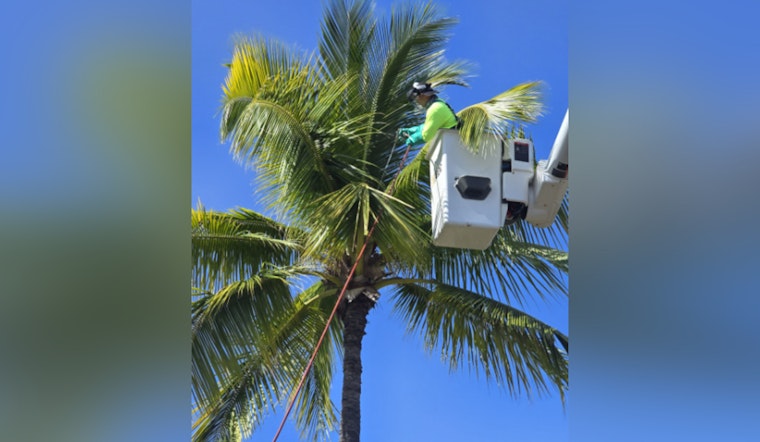
The Hawai‘i Department of Agriculture and the County of Hawai‘i Public Works Department have started a new treatment effort at the Ellison Onizuka Kona International Airport to control the spread of the coconut rhinoceros beetle. Treatments began on Tuesday, and Hawai‘i Department of Agriculture chairperson Sharon Hurd expressed appreciation for the support, saying, "Mahalo, again, to Mayor Kimo Alameda and his public works crew– their resources and assistance have been phenomenal in this coordinated effort." Local agencies continue to collaborate on the effort in West Hawai‘i, according to the Hawai‘i Department of Agriculture.
The Hawai‘i Department of Agriculture and County of Hawai‘i Public Works Department have been addressing a beetle infestation since January 2025, using boom trucks to treat palm crowns. The County of Hawai‘i Public Works Department has provided a 75-foot boom truck to assist in reaching tall trees. Since March, 10 adult beetles have been found in areas such as Keāhole Ag Park, Natural Energy Laboratory of Hawai‘i, and Kohanaiki. The Hawai‘i Department of Agriculture has implemented a treatment plan targeting 38 trees in Waikoloa Village and other locations including KOA, Natural Energy Laboratory of Hawai‘i, and Honokōhau Small Boat Harbor. Additional treatments were carried out at West Hawai‘i Veteran’s Cemetery following the discovery of a beetle wing.
Residents are being asked to check mulch, compost, and soil products for the presence of the coconut rhinoceros beetle. The beetle can be identified by its size, dark color, and a single horn, as well as the V-shaped cuts it leaves on palm leaves. Coconuts from treated trees should not be consumed. For more information on prevention and pesticide use, residents can visit the CRB Response website or contact the state's Pest Hotline and the Hawai‘i Department of Agriculture’s Pesticides Branch. Multiple agencies, including Hawai‘i Department of Agriculture, Big Island Invasive Species Committee, the University of Hawai‘i, and the County of Hawai‘i, are conducting surveillance to monitor the situation.





