

























































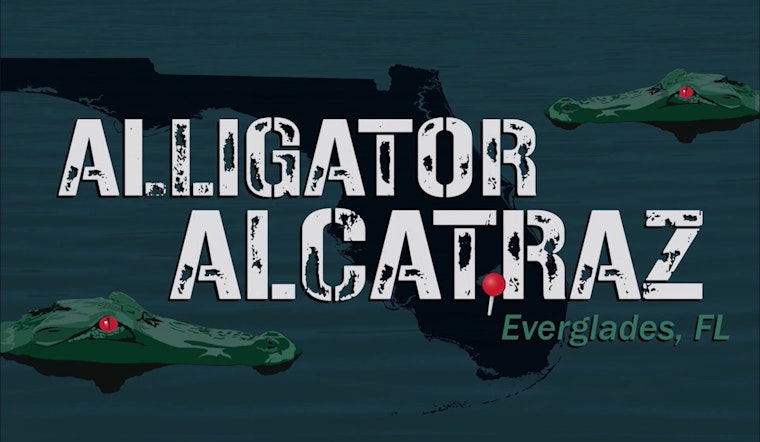
Florida's Attorney General has a wild idea for dealing with immigration detention that's equal parts audacious and absurd. James Uthmeier wants to build a 1,000-bed facility smack in the middle of the Everglades, complete with natural security guards: alligators and pythons.
The proposal, dubbed "Alligator Alcatraz" by Uthmeier himself, would transform the largely abandoned Dade-Collier Training and Transition Airport into what he calls "the one-stop shop to carry out President Trump's mass deportation agenda." According to the Orlando Sentinel, the facility could be operational within 30 to 60 days of construction beginning.
Alligator Alcatraz - this existing island in the middle of the swamp presents a great option for criminal alien detention and deportation. https://t.co/CHQYdy09mT
— James Uthmeier (@JamesUthmeierFL) June 20, 2025
"If people get out, there's not much waiting for them other than alligators and pythons," Uthmeier declared in his Thursday announcement video. "Nowhere to go, nowhere to hide."
The proposed site sits on 54575 East Tamiami Trail in Ochoppee, Florida, roughly 55 miles west of downtown Miami. The 24,960-acre property was originally planned in the 1960s as the world's largest airport—five times the size of JFK—but environmental concerns scuttled those grandiose plans after just one runway was completed. As reported by Wikipedia, the airport now serves primarily as a pilot training facility with minimal activity.
Uthmeier argues the location presents an "efficient, low-cost opportunity" because "you don't need to invest that much in the perimeter." The 30-square-mile area is completely surrounded by Everglades wetlands, though it's technically outside Everglades National Park boundaries.
This isn't Uthmeier's first time making headlines for hardline immigration stances. Just days before announcing "Alligator Alcatraz," NBC News reported that a federal judge held him in civil contempt for defying a court order that put parts of Florida's new immigration enforcement law on hold.
The former DeSantis chief of staff, who was appointed Attorney General after Ashley Moody moved to the U.S. Senate, has embraced the controversy. "If being held in contempt is what it costs to defend the rule of law and stand firmly behind President Trump's agenda on illegal immigration, so be it," he wrote on social media following the contempt ruling.
The proposal has gained traction in unexpected places. The Department of Homeland Security retweeted Uthmeier's announcement, calling it a "force multiplier" for completing Trump's immigration mission.
The timing appears strategic, as immigration detention facilities nationwide are experiencing severe overcrowding. According to recent data, ICE detained 39,703 people by January 2025, well above the 41,500 beds Congress has funded. Current detention numbers have surged to nearly 50,000, pushing the system beyond its limits.
Prism Reports documented alarming conditions in Florida's existing detention centers, including reports of overcrowding, medical neglect, and substandard living conditions at facilities like Krome Detention Center.
Part of Trump's Broader Prison Expansion Plans
Uthmeier's swamp prison isn't the administration's only audacious incarceration proposal. Earlier this year, Trump announced plans to reopen the notorious Alcatraz Federal Penitentiary in San Francisco Bay as a supermax facility for "America's most ruthless and violent offenders." Hoodline San Francisco investigated the feasibility of that proposal, finding significant practical and legal obstacles to converting the now-tourist destination back into a working prison.
The Alcatraz announcement drew sharp mockery from local officials, with San Francisco Sheriff Paul Miyamoto sarcastically offering his "assistance" with the conversion in what was clearly a jab at the president's plan. "We'd be pleased to offer our assistance with this conversion," Miyamoto said, tongue firmly in cheek.
Both proposals share a theatrical quality that critics say prioritizes political messaging over practical corrections policy. Where Trump's Alcatraz plan faces the challenge of converting a protected National Historic Landmark surrounded by frigid bay waters, Uthmeier's version substitutes alligators and pythons for the natural barriers.
Environmental Opposition Mobilizes
Environmental groups and Indigenous leaders are pushing back hard against the proposal. Betty Osceola of the Miccosukee Tribe organized a protest event for Sunday at the proposed site, titled "Say No to Alligator Alcatraz." Coastal Breeze News reported that Osceola noticed increased security at the typically open site following Uthmeier's announcement.
Eve Samples, Executive Director of Friends of the Everglades, told CBS Miami that the organization strongly opposes the plan due to environmental concerns about the ecologically sensitive area.
Social Media Reactions and Political Theater
The proposal has generated significant online discussion, ranging from enthusiastic support to sharp criticism. Conservative outlets have embraced the concept, with some calling it "based" and praising Florida's creativity. Twitchy compiled numerous supportive social media posts, including jokes about "reptile dysfunction" and comparisons to AI-generated parody videos about using dinosaurs to guard borders.
Critics have denounced the proposal as political theater designed to grab headlines rather than address immigration challenges seriously. Several environmental advocates and immigration rights groups have characterized it as unnecessarily cruel and potentially harmful to both detainees and the ecosystem.
Florida's Broader Immigration Strategy
The "Alligator Alcatraz" proposal fits into Florida's aggressive approach to immigration enforcement under Governor Ron DeSantis. Earlier this year, the state unveiled a comprehensive 37-page Immigration Enforcement Operations Plan that includes rapid detention facility construction, using Florida National Guard officers as immigration judges, and deportation flights using state contractors.
Florida currently leads the nation in 287(g) agreements, which allow local law enforcement to work directly with ICE. Of the 629 such agreements nationwide, 43 percent are in Florida, far outpacing second-place Texas at 14 percent.
Legal and Practical Hurdles
Despite the bold announcement, significant obstacles remain. Miami-Dade County officials haven't responded to inquiries about involvement in planning discussions, and the feasibility of rapidly constructing detention facilities in the environmentally protected area remains unclear. The site currently lacks basic infrastructure like barracks or support facilities needed for housing people.
Environmental lawyers point out that the Big Cypress National Preserve, where the airport is located, is protected by strict federal laws limiting human impact. Any major construction project would likely face lengthy environmental review processes and potential legal challenges.





