

























































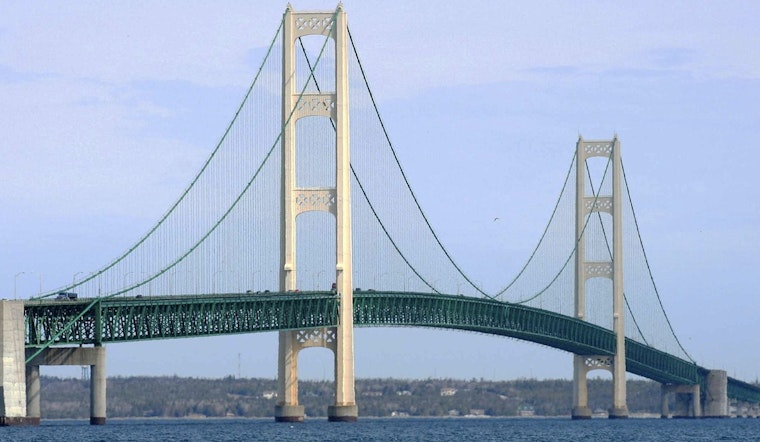
Michigan's iconic Mackinac Bridge drew attention this week as it seemed to disappear into a haze caused by smoke from Canadian wildfires. The Mackinac Bridge Authority clarified on social media that the "fog" was actually smoke. They confirmed: "Unfortunately, what you're seeing today is not fog surrounding the @mackinacbridge but smoke coming from the wildfires and our neighbors to the North," as detailed in a report by the Detroit Free Press.
The smoke has been so extensive that visibility on the bridge was significantly reduced on Wednesday. The connection between Michigan’s Upper and Lower Peninsulas has become a visible reminder of the wildfires raging across the Canadian provinces of Saskatchewan, Manitoba, and Alberta. More than 33,000 people have been evacuated, and officials have declared a state of emergency in Manitoba and Saskatchewan as they work to control the numerous fires, as CBS Detroit reported.
Air quality in the area took a hit as well. The Michigan Department of Environment, Great Lakes and Energy (EGLE) told residents to brace for "unhealthy for sensitive groups" conditions, with brief periods potentially reaching unhealthy levels. The situation also prompted a red flag warning in Western Upper Michigan on Monday, highlighting the risk of fire weather conditions. Despite a forecast to clear from today until tomorrow, there's anticipation for smoke to revisit the region as soon as next Sunday, as CBS Detroit covered.
Meanwhile, Detroit and Chicago were ranked among the world's most polluted cities yesterday afternoon. EGLE's Air Quality Advisory spread across all counties in Michigan's Lower Peninsula until today, with worst conditions experienced in the southern parts of the state. EGLE meteorologist Alec Kownacki elucidated: "The cold front that brought the smoke with it overnight should be clearing out soon and bringing the smoke with it," and transitioned to a warning that "we are suspecting smoke to come back," Bridges Michigan addressed these challenges in its recent article.
Bridges Michigan also emphasized the importance of self-protection against the smoky conditions. Staying indoors is recommended, particularly if air quality is at a red-level alert. Dr. Brian McComb, chief medical officer for Munson Healthcare, advised: "If you start to feel like your lungs are affected very quickly, then you should probably (limit exposure) closer to the 10 to 20 minute range." Moreover, for live updates on air quality, Michigan residents are pointed to the new Michigan.gov/MiAir dashboard, where air quality levels throughout Michigan can be viewed and free email or text alerts are available through the EnviroFlash program, as detailed in the Bridges Michigan report.





