

























































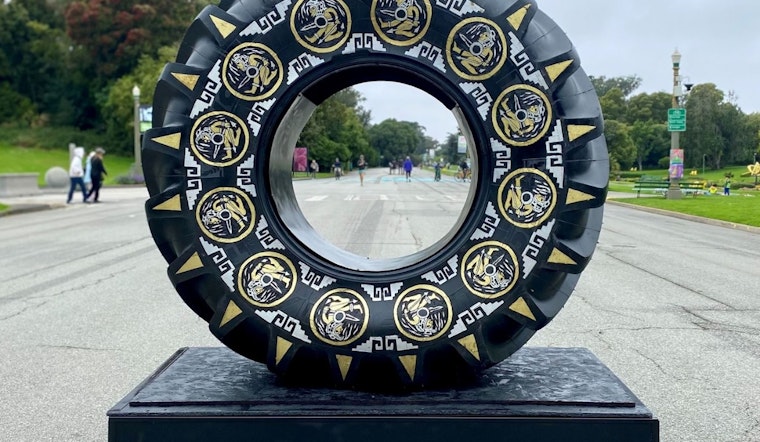
Six towering sculptures have quietly claimed their spot along JFK Promenade, marking the latest chapter in Golden Gate Park's ongoing transformation into an outdoor art gallery. Mexican artist Betsabeé Romero has installed tire-based sculptures that pulse with stories of movement, migration, and cultural resilience—urban totems that feel both ancient and urgently contemporary.
The installation stretches between Conservatory Drive East and Conservatory Drive West, creating what SF Recreation and Park Department describes as an artistic meditation on "sustainability, the act of reclaiming space—replacing noise and pollution with beauty, movement, and healing." The sculptures will remain through March 2026, giving visitors ample time to experience Romero's distinctive approach to public art.
From Mechanic Shop to Museum Walls
Romero has built an international reputation by transforming discarded automotive materials into profound artistic statements. As she explained to The Metropolitan Museum of Art, she describes herself as a "mechanic artist," carving intricate designs into used tires using what she calls a tattooing process, then filling those patterns with metallic paint that catches light and shadow throughout the day.
Her credentials run deep. According to National Museum of Women in the Arts, Romero's sculptures and installations have been featured in more than 40 solo exhibitions at museums and contemporary art spaces across the Americas, Europe, Africa and Asia, with work held in major collections including the Neuberger Museum, Phoenix Art Museum, the British Museum, and the Daros Latinamerica Collection in Switzerland. Her 2018 installation in Washington, D.C., explored similar themes of migration and cultural memory, establishing a consistent artistic voice that speaks to global experiences of movement and displacement.
The Power Partnership Reshaping SF's Art Landscape
This installation represents more than a single artistic gesture—it's part of a systematic effort to reshape San Francisco's public art landscape. The collaboration between SF Rec and Park, nonprofit Illuminate, art production agency Building 180, and the Sijbrandij Foundation has been strategically placing ambitious installations throughout the city.
The Sijbrandij Foundation launched its "Big Art SF" initiative in 2024 with an ambitious goal: placing 100 sculptures throughout the Bay Area over three years. Building 180, the women-led art production agency behind this installation, specializes in what founder Shannon Riley calls "impossible works of public art"—large-scale projects that require complex logistics and extensive permitting.
According to their website, Building 180 has managed several of San Francisco's most prominent recent installations, including the 45-foot sculpture "R-Evolution" that has appeared at various downtown locations, demonstrating the organization's capacity for handling monumental public art projects.
JFK Promenade's Cultural Evolution
Romero's sculptures arrive during a pivotal moment for this stretch of Golden Gate Park. The JFK Promenade became permanently car-free following voter approval in 2022, as Hoodline reported during the heated ballot campaigns. The 1.5-mile stretch has since evolved into a deliberately curated cultural corridor.
The promenade now hosts rotating installations, including the recently unveiled 100-foot sea serpent "Naga" that San Francisco Chronicle reports has become the largest public art installation in Golden Gate Park history. The Golden Mile Project has added street murals, public pianos, and distinctive yellow Adirondack chairs, transforming what was once primarily a transit route into a destination for art and community gathering.
Art as Economic Development Tool
The push for monumental public art reflects a broader strategy among San Francisco leaders to use culture as an economic development tool. With downtown foot traffic still recovering from pandemic impacts, city officials have been investing in spectacular public art to draw people back to public spaces. San Francisco Arts Commission cites studies showing that public art increases foot traffic and economic activity.
This approach has shown early success. Streetsblog San Francisco documented how the initial wave of pandemic-era art installations helped build community support for making the JFK closure permanent, transforming public perception of what had initially been viewed as an emergency inconvenience.
The Economics of Temporary Installations
While specific budget details for Romero's installation haven't been disclosed, similar projects provide context for the financial investment involved. According to Illuminate, installing the Naga serpent required a $400,000 budget. The R-Evolution sculpture involved moving and anchoring 13,000 pounds of sculpture plus an additional 16,000 pounds of steel anchoring—a logistical undertaking that highlights the complexity of large-scale public art installation.
The temporary nature of these installations—Romero's pieces will remain through March 2026—allows for artistic experimentation on a scale that would be challenging for permanent installations. This approach enables the city to test community response while providing artists with prestigious platforms for ambitious work.
Cultural Commentary Through Industrial Materials
Romero's choice to work with discarded tires carries particular resonance in San Francisco, a city defined by stories of movement and transformation. Her sculptures inherently reference mobility and migration, speaking to the Bay Area's role as both an immigration gateway and a center for technological innovation. Arte al Día notes that her work explores "the tensions between local and historical traditions and industrialized, consumerist societies."
The installation also arrives amid San Francisco's broader reassessment of its commemorative landscape. The Arts Commission's "Shaping Legacy" project has been working to, according to their website, "reckon with the legacy of white supremacy, patriarchy, and colonialism reflected in public spaces" while creating opportunities for new artist-led installations. Romero's work contributes to ongoing conversations about whose stories get told in public spaces and how those narratives are expressed.
Looking Ahead
As San Francisco continues navigating questions about public space, economic recovery, and cultural identity, installations like Romero's offer examples of how the city might evolve. The transformation of JFK Drive from contested roadway to cultural destination demonstrates how community enthusiasm can drive successful urban planning outcomes.
For visitors to Golden Gate Park, Romero's installation provides an opportunity to experience art that transforms automotive waste into statements about resilience and renewal. In a city that has always defined itself through its capacity for reinvention, these tire-based sculptures serve as both historical markers and forward-looking symbols—evidence that the most meaningful transformations often begin with the most unexpected materials.





