

























































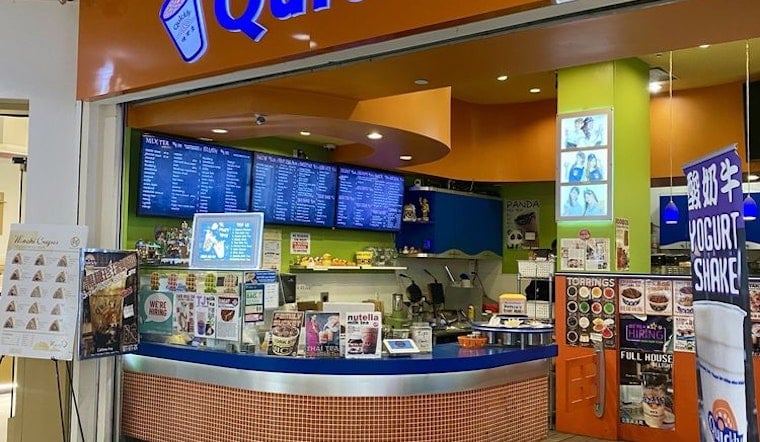
The boba counter that has fueled two decades of San Francisco State cram sessions is dark, and the red placard on the door at Stonestown Galleria explains why: rodents. San Francisco health inspectors suspended the permit for Quickly at 3251 20th Ave., Suite 160 on July 30, ordering the shop shut on the spot after documenting droppings scattered from the dry storage rack all the way out to the front shelving where customers place their orders. A reinspection the following afternoon lasted five minutes and ended the same way — still closed.
The routine inspection began at 3 p.m. on Thursday, July 30, and ran an hour and fifteen minutes, according to the San Francisco Department of Public Health report signed by inspector Cristina Fung-Autry. The permit is held by Hot Chicks Cafe Inc., which operates the mall location under the Quickly banner. Under the city's placard system, a closure means SF.gov considers the hazards too serious to fix while the doors stay open.
What the inspector found
The rodent evidence was not confined to a back corner. Inspectors logged numerous droppings on the floor beneath the dry-storage food rack, on a can in back storage, underneath the three-compartment sink, on the service area counter, and in the front shelving where staff hand drinks to customers — the last one being the detail that will stick with anyone who has waited in that line with a receipt in hand.
The rest of the report reads like a full audit of the workflow behind the counter. An employee was observed washing their hands without soap, in cold water, and redid it correctly at the inspector's request. No sanitizing solution was ready for use in the third compartment sink, and it had to be mixed on the spot. Dishes were being washed in the food preparation sink rather than a proper warewashing setup, no probe thermometer could be produced when the inspector asked for one, wet wiping cloths sat on the counters, and the floors under equipment had accumulated food debris.
Two findings stand out. The deli cold top was holding an ambient temperature of 50°F — well above the 41°F legal ceiling — with food testing at 45°F moved to a working unit and the cooler ordered out of service. And an electric screwdriver fitted with a mixing attachment was found in use; per the person in charge, the improvised power tool was being used to mix iced tea. Inspectors ordered it discontinued in favor of food-grade equipment.
The boba itself was a repeat problem
The tapioca pearls measured 89°F at the time of inspection with no discard label attached — a violation flagged in the report as a repeat. Under Time as a Public Health Control rules, potentially hazardous food held out of temperature has to be labeled with a discard time and tossed after four hours. The explanation offered by the person in charge, as recorded verbatim by the inspector, was that the boba sells quicker than four hours.
That defense may well be true on a Friday afternoon when the mall is full of SFSU students. It is also not how the code works, and the "repeat" notation means someone had already been told. The report additionally requires written approval from Environmental Health before a facility can use time rather than temperature as its control — approval the shop does not appear to have.
Five minutes on Friday, and still closed
Fung-Autry returned at 1:30 p.m. on Friday, July 31, and was back out the door by 1:35. Droppings were still present on the floor underneath the food preparation counters and on the shelving below them. The inspector's notes state plainly that because rodent activity evidence continued, the facility would remain closed until all corrective actions were completed.
The reopening checklist is specific: hire licensed pest control and produce a service report dated on or after July 30, remove all droppings and sanitize affected surfaces, seal every gap and crevice a quarter-inch or larger with rodent-proof material such as sheet metal — the report is emphatic that spray foam does not count — cover all food in containers with tight-fitting lids, and clean the walls, floors, and equipment. One more paperwork wrinkle: the license certificate listed on the report carries an expiration date of March 31, 2026, four months before the inspection.
A mall in transition, and a chain with a reputation problem
Quickly is one of the oldest names in American bubble tea, a Taiwanese chain founded in the 1990s that has since grown past 2,000 locations worldwide, according to Tasting Table. Ubiquity has not translated into affection at this particular outpost, which sits at a 1.8-star average across roughly 140 reviews on Yelp — the lowest-rated Quickly in the city by a wide margin, with complaints about watered-down drinks long predating any inspector's visit.
The timing is awkward for a mall actively remaking its food lineup. HEYTEA, the Chinese chain that went viral after BLACKPINK's Lisa posted with one of its matcha drinks, has been slated for a Level 1 space at Stonestown, per KRON4, joining 85°C Bakery Cafe, Matcha Cafe Maiko, and Peet's. The Galleria, which sits directly north of SFSU per Wikipedia, has spent years courting exactly the customer base Quickly has been coasting on. Hoodline has also covered the mall's move to evict Blondie's Pizza over unpaid rent, another sign that legacy food tenants there are not being carried.
Not an isolated case
San Francisco has closed a steady stream of food businesses over rodents this year. In April, inspectors shuttered a North Beach Thai restaurant after finding droppings behind customer booths and a dead rat on the floor. In June, an Omakase Restaurant Group outpost at Chase Center was shut down when inspectors found live mice and gnawed-through food bags in the kitchen. Even Marina institution Balboa Cafe drew a major rodent infestation citation in January.
Part of the pressure is regulatory. California's Poison-Free Wildlife Act, signed in September 2024 and effective at the start of 2025, extended the state's moratorium to all anticoagulant rodenticides, giving California the strictest rat-poison rules in the country, according to the Center for Biological Diversity. Violations carry penalties of up to $25,000 per day, as reported by Pest Management Professional. When a Cupertino Whole Foods stayed closed for an extended stretch last year, an entomologist told NBC Bay Area that the pest control firm's request for a waiver to use the banned products was denied, and that the store might have reopened sooner with them.
That is the trap operators are in: exclusion and sanitation are now the primary tools, and both take time and money. It is also worth saying that neither the law nor the rats made anyone stir tea with a power drill.
Legal exposure
The suspension was issued under Sections 114405 and 114409 of the California Health and Safety Code and San Francisco Health Code sections 440(j) and 440.1. All food handling must cease until Environmental Health reinstates the permit, and the closure placard can be removed only by a department inspector.
Hot Chicks Cafe Inc. has 15 calendar days from service of the notice to request a hearing to contest the suspension; failure to do so waives that right. An owner, manager, or operator who ignores a closure notice can be charged with a misdemeanor carrying a fine of up to $1,000 and up to six months in jail per offense. Hoodline has reached out to the operator for comment and will update this story.



