

























































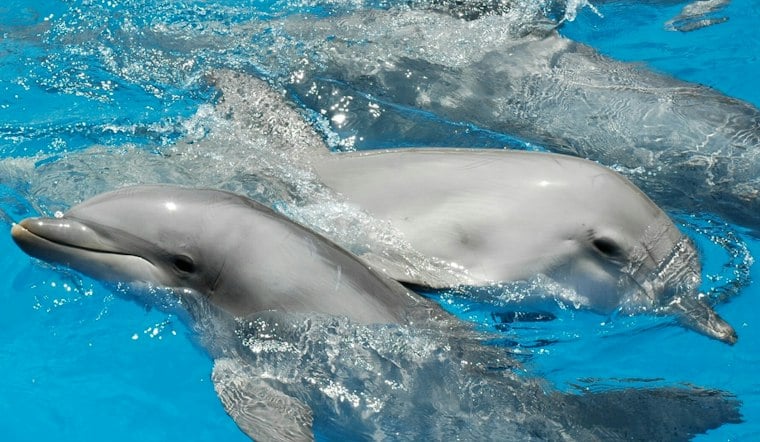
Two bottlenose dolphins died weeks apart at Six Flags Discovery Kingdom in Vallejo this October, bringing the number of dolphin deaths at the park since July to three and reigniting calls from animal-rights advocates to move the park's surviving dolphins to seaside sanctuaries. Six Flags confirmed the deaths of the two dolphins, Apollo and Avalon, this week, while records cited by People for the Ethical Treatment of Animals paint a grim timeline of illness and decline inside the park's tanks.
Six Flags confirmed the deaths of Apollo and Avalon in a statement to CBS News Sacramento, according to KION Central Coast. Records obtained by PETA show 32-year-old Avalon died Oct. 4 with her cause of death listed as undetermined, while 11-year-old Apollo, who was born at the park, was euthanized Oct. 15 following what the records described as an acute illness and presumed sepsis. Bottlenose dolphins typically live 40 to 60 years in the wild, according to the National Oceanic and Atmospheric Administration, which releases such records periodically.
Six Flags told reporters that necropsies were performed on both animals but that any findings remain preliminary. “Any information regarding cause of death remains preliminary and we will not speculate beyond that,” the company said, per the same KION report. The park also pointed to its accreditation with the Zoological Association of America and its certification by American Humane as evidence of its animal-care standards.
A Third Death Since July
Apollo and Avalon's deaths were the second and third involving dolphins at Discovery Kingdom since July, PETA said. In July, 47-year-old Chelsea was euthanized after recurring chronic health problems and a declining quality of life, according to NOAA records cited in the same reporting. Together, the three deaths have drawn fresh attention to the Vallejo park, which moved from Redwood City in 1986 and now sits on 135 acres between State Route 37 and Interstate 80, housing giraffes, lions and other species alongside its marine mammals.
PETA President Tracy Reiman sent a letter Tuesday to Six Flags Entertainment Corporation CEO John Reilly requesting that the company release its remaining dolphins to seaside sanctuaries. Reiman said Apollo and Avalon never experienced life outside the tanks where they were born and died. Six Flags Entertainment Corporation did not immediately respond to a request for comment on the letter.
Public Opinion and Industry-Wide Pressure
The push comes amid broader public skepticism about marine mammal captivity. A nationwide survey commissioned by PETA and conducted by The Harris Poll found that 92% of 2,001 U.S. adults surveyed believed dolphins belong in the ocean rather than in tanks, and 80% supported releasing captive dolphins or sending them to seaside sanctuaries when possible, according to a PETA news release. The same survey found 57% of respondents would view a marine park negatively after learning it keeps dolphins for entertainment, while 63% would view one more positively if it committed to sending its dolphins to sanctuaries.
Discovery Kingdom is not an isolated case. At Sea Life Park in Waimanalo, Hawaii, a 38-year-old dolphin named Hiʻipoi, who was born at that park, became ill in early September and died in October, as reported by Hawaii News Now. PETA responded by calling on that park's new owners to release its remaining 10 dolphins to a seaside sanctuary.
Transfers themselves carry risk, according to marine mammal scientists tracking a separate case in Canada. After Marineland moved its remaining captive whales and dolphins to five destinations over the summer, four belugas and one dolphin had died by late September, per CBC News. That dolphin, a blind Black Sea bottlenose named Echo believed to be about 30 years old, died overnight after his condition deteriorated rapidly following his transfer from Marineland to Oceanogràfic in Spain. Marine mammal scientist Naomi Rose told CBC that transport is very stressful for cetaceans, while fellow scientist Valeria Vergara said psychological stress is absolutely related to physiological stress in marine mammals.
PETA's letter to Six Flags cited successful precedents elsewhere, including the transfer of two belugas from a marine park in China to a sanctuary in Iceland, according to a separate PETA news release. Whether Discovery Kingdom's remaining dolphins could follow a similar path remains an open question, one that now hangs over a park that has housed marine mammals in Vallejo for four decades.





