

























































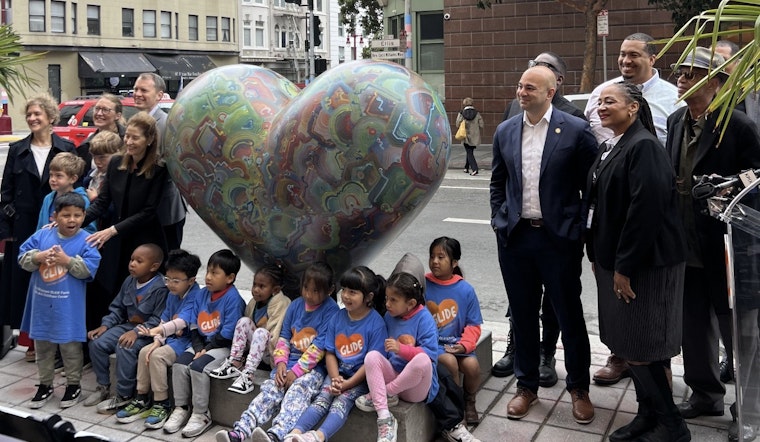
One of the famous, vibrant 400-pound heart sculptures that have dotted the city for two decades finally landed in the Tenderloin yesterday, marking a symbolic first for a neighborhood that's more accustomed to being overlooked than celebrated. The unveiling ceremony at GLIDE Memorial Church brought together an unusually optimistic crowd of city officials, community leaders, and residents who see this as something bigger than just another piece of public art.
The heart, painted in Jaz Cameron's signature geometric style with bursts of joyous color, was gifted to GLIDE by the San Francisco General Hospital Foundation. It's a fitting match—GLIDE points out the sculpture coincidentally mirrors their longtime logo, making it feel like destiny rather than charity.
It was a brand new day in the Tenderloin as we unveiled the first Hearts in SF artwork in the neighborhood.
— Bilal Mahmood 馬百樂 (@bilalmahmood) July 30, 2025
And no better place to have it than at @GLIDEsf
SFGH Foundation places the hearts throughout San Francisco to celebrate the joy and love we all carry for our city.
This… pic.twitter.com/5aZJ09rQZ9
Mahmood's Equity Crusade Gets a Boost
District 5 Supervisor Bilal Mahmood used the moment to push his ongoing crusade for what he calls "geographic equity"—basically, getting other neighborhoods to step up and shoulder their share of the city's social services burden. The fact that he's a Tenderloin renter himself, not just a politician dropping by for a photo op, adds weight to his words.
Mahmood's been grinding on legislation that would force every district to host at least one homeless shelter or treatment facility. Right now, the Tenderloin houses about 20 of them while some swanky districts have exactly zero. Mission Local reports that Mayor Lurie is pushing amendments that could gut the proposal, setting up what might be Mahmood's first real political test.
The math is brutal: Mahmood needs eight votes to override a mayoral veto, and The Standard notes that supervisors representing wealthier districts aren't exactly rushing to volunteer their neighborhoods.
Street Art Goes Mainstream
Cameron, the artist behind the heart, has been a Tenderloin fixture for years, setting up his outdoor gallery on 2nd Street and adding splashes of geometric color to walls around the city. The Hospital Foundation describes him as "a cherished San Francisco street artist" whose work has become particularly visible near the ballpark during Giants games.
Getting a street artist's work formally installed as part of the prestigious Hearts program feels like the city finally acknowledging what the neighborhood has known all along—there's real talent here, not just problems to be managed.
Progress with a Side of Displacement
The timing isn't random. The Tenderloin has been showing genuine signs of improvement after years of intensive intervention. A business curfew requiring most shops to close from midnight to 5 a.m. has worked better than expected—ABC7 reports service calls dropped 18% and crimes fell 13% over nine months.
But there's a predictable catch. Chronicle analysis shows that as the Tenderloin cleanup intensified, property crime actually increased in nearby SoMa and Mission Bay. It's the classic San Francisco shuffle—clean up one area, watch the problems migrate two blocks over.
GLIDE Doubles Down on Staying Power
GLIDE has been the neighborhood's anchor since 1931, evolving from a small Methodist congregation into a social services powerhouse that serves over 2,000 free meals daily. After winning independence from the United Methodist Church in a legal battle that Hoodline covered extensively, they're now planning a $200 million expansion that would add a 10-story building.
That's serious money and a serious commitment to the neighborhood's future—not the kind of investment you make if you think things are hopeless.
Residents Want Control, Not Just Services
The heart unveiling comes as residents are demanding more say in their neighborhood's future. Mission Local reports that community groups are pushing for $4 million over three years in what would be the city's largest "participatory budget" process—letting residents decide how improvement funds get spent instead of leaving it to bureaucrats who don't live here.
It's part of a broader shift in how the Tenderloin sees itself. After decades of being the city's unofficial dumping ground for everything nobody else wanted, the neighborhood is asserting itself as a place deserving investment, not just intervention.
San Francisco General Hospital Foundation CEO Kim Meredith, speaking at the ceremony, emphasized the symbolic importance of finally bringing a heart to the Tenderloin. For a program that has historically favored high-visibility tourist spots and corporate lobbies, GLIDE's permanent installation suggests the city is starting to think differently about where hearts—both literal and metaphorical—belong.





