

























































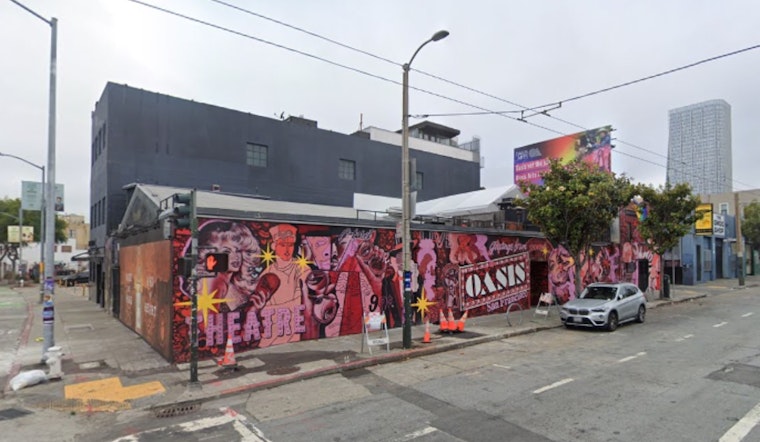
Oasis, San Francisco's internationally acclaimed drag club and cabaret venue, announced this week it will permanently close its doors on January 1, 2026, marking another devastating blow to the Bay Area's struggling arts ecosystem. The SOMA district nightclub's closure represents the latest casualty in what industry observers increasingly describe as an "arts death spiral" gripping the region.
The 8,000-square-foot venue at 298 11th Street has been operating at a financial loss "for some time," according to the San Francisco Chronicle. Owner D'arcy Drollinger, who serves as the city's first Drag Laureate, revealed he has been personally subsidizing the club monthly and "cashed in the majority of my retirement account" to keep the venue operational.
"We've been struggling like a lot of other venues. Our margins are razor thin," Drollinger told the Chronicle. The venue's financial pressures intensified following a July 2024 armed robbery that led to increased insurance and security costs, compounding already declining post-pandemic attendance and reduced bar revenue, as reported by ABC7.
A Pioneering Cultural Institution
Oasis opened on New Year's Eve 2014 as a collaboration between Drollinger and the late drag legend Heklina, transforming a former gay bathhouse into what KQED describes as the only venue of its size in the country created for and by drag artists. The club gained international recognition for hosting celebrities including Cher, Jane Fonda, and numerous "RuPaul's Drag Race" stars, while serving as an incubator for emerging queer talent through programs like the all-Black drag revue "Reparations."
The venue's significance to San Francisco's LGBTQ+ community deepened tragically in April 2023 when co-founder Heklina (Stefan Grygelko) was found dead in a London apartment while on tour. The San Francisco Standard reports that nearly two years later, London police released CCTV footage of three men connected to the case, though the exact cause of death remains officially undetermined.
Broader Pattern of Cultural Venue Closures
Oasis joins a growing list of Bay Area cultural venues that have shuttered in recent years, reflecting broader economic pressures facing the region's arts community. Mission District music venue Amnesia closed in January 2024, citing unsustainable business conditions, according to KQED. The venue's statement acknowledged "the hard truth is that this business is not fiscally sustainable."
Other significant closures include the shuttering of PianoFight's San Francisco and Oakland locations in March 2023, and Valencia Street music venue Amado's, which blamed city bike lane installations for driving away customers. Do The Bay documented these and other venue closures as part of a broader pattern affecting the region's entertainment landscape.
Federal Arts Funding Cuts Compound Crisis
The cultural venue crisis intensified in May 2025 when over 80 Bay Area arts groups lost National Endowment for the Arts grants totaling more than $2.5 million, as reported by SFist. Affected organizations range from major institutions like Berkeley Repertory Theatre and SFJAZZ to smaller groups including The Lab and San Jose Taiko. Many arts leaders view these cuts as politically motivated, particularly impacting projects highlighting diversity and LGBTQ+ communities.
Historic LGBTQ+ Venue Landscape Under Threat
San Francisco's LGBTQ+ nightlife has suffered significant losses over the past decade. The Golden Gate Xpress documented the closure of numerous historic venues including Esta Noche, Trocadero Transfer, Lexington, Universe, and Pendulum, with many shuttering before the COVID-19 pandemic further decimated the scene.
The Gangway, which operated for over a century as San Francisco's oldest continuously surviving gay bar, closed in 2018 following a liquor license transfer, according to KQED. Research by Oberlin College's Greggor Mattson showed that 37% of gay bars nationwide closed between 2007 and 2019, a trend that has continued accelerating.
Economic Realities of Operating Small Venues
Drollinger explained that Oasis requires 90% capacity every night to remain financially sustainable, an increasingly difficult threshold to meet. "Right out of the pandemic, we saw a quick surge where we got excited to go back out, but then little by little people got real used to going back to staying at home and ordering DoorDash and watching TV," he told KQED.
The venue attempted various survival strategies, including a $270,000 telethon in March 2021 and a $50,000 fundraiser in May 2025 that fell short of its $400,000 goal. Despite receiving Shuttered Venue Operator Grant funding and moving programming under the Oasis Arts nonprofit, financial pressures ultimately proved insurmountable.
Community Impact and Cultural Legacy
Beyond entertainment, Oasis served as a vital community gathering space during significant events, including election nights and memorial services following Heklina's death. The venue's "Princess" nights became legendary within the drag community, while programs like "Reparations" provided crucial platforms for Black performers in a predominantly white scene.
"There is an intense community of people that are hardcore for Oasis, and it's all Darcy's doing," Snaxx, the venue's director of programs and staff, told the Chronicle. The venue also launched careers for performers like drag artist Snaxx, actor Michael Phillis, and "Reparations" founder Nicki Jizz.
Future Plans and Ongoing Mission
While the physical venue will close, Drollinger plans to continue Oasis's mission through Oasis Arts, the nonprofit organization that will present programming at venues throughout the Bay Area. "By closing the doors of the club, we're opening up a world of new possibilities," he stated in the closure announcement.
The club will remain open through December 2025, with a planned New Year's Eve closing that would bookend its decade-long run, having opened on New Year's Eve 2014. Current programming includes the musical parody "Jurrasiq Parq," which runs through August 2.
As San Francisco grapples with broader challenges including commercial real estate struggles, changing entertainment consumption patterns, and reduced municipal arts funding, the loss of Oasis represents more than the closure of a single venue. It symbolizes the ongoing transformation of a city once synonymous with groundbreaking LGBTQ+ culture and artistic innovation, raising questions about what cultural institutions can survive in an increasingly expensive and economically challenging environment.





