

























































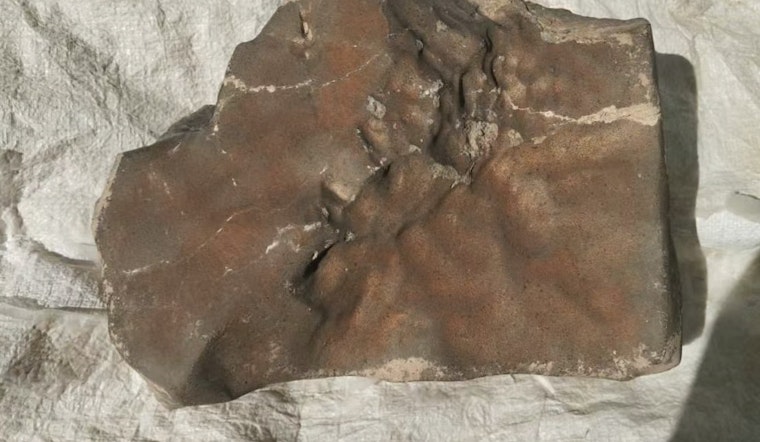
The interplanetary trip of a 54-pound chunk of Mars to a New York auction house culminated in a sale that soared to $5.3 million, edging past presale estimates of $2 million to $4 million. Named NWA 16788, the Martian meteorite was found in the Sahara Desert in Niger and, according to NBC New York, is the heftiest piece of Mars ever located on Earth. The rock made its presence felt at Sotheby’s auction where, after starting with two advance bids of $1.9 million and $2 million, it incited fervor among bidders as the auctioneer worked to coax out higher offers.
The journey of the meteorite to Earth was the result of a massive asteroid striking Mars, launching NWA 16788 approximately 140 million miles across the solar system. "This is the largest piece of Mars on planet Earth. The odds of this getting from there to here are astronomically small," Sotheby's vice chairman for science and natural history Cassandra Hatton told ABC News. Indeed, the serendipity of its landing in a terrain accessible to a meteorite hunter in November 2023, rather than an open ocean, seems to have equally captivated collectors and observers.
The excitement around the Martian rock was matched by equally impressive sales at the auction. A Ceratosaurus dinosaur skeleton fetched a staggering $30.5 million, significantly over its estimate, while the skull of a Pachycephalosaurus was acquired for $1.4 million. The auction, part of Sotheby's Geek Week 2025, encompassed 122 items ranging from other meteorites and fossils to gem-quality minerals, highlighting the enduring fascination with extraterrestrial and prehistoric objects.
But NWA 16788 wasn't just a hit for its size; it's a scientific goldmine too. "This isn't just a miraculous find, but a massive data set that can help us unlock the secrets of our neighbor, the red planet," Hatton explained to ABC News. The specimen is classified as an olivine-microgabbroic shergottite — a rock believed to form from slowly cooling Martian magma. The glassy surface of NWA 16788 suggests high heat impacted it as it plunged through Earth’s atmosphere, providing unique data points for future study. Prior to the auction, the rock graced public exhibitions in Rome and Arezzo, revealing a trajectory as noteworthy for its scientific import as it was for its auction value.
The identity of the new owner remains undisclosed, leaving unanswered the question of whether NWA 16788 will continue to be showcased or will its journey conclude in a private collection.





