

























































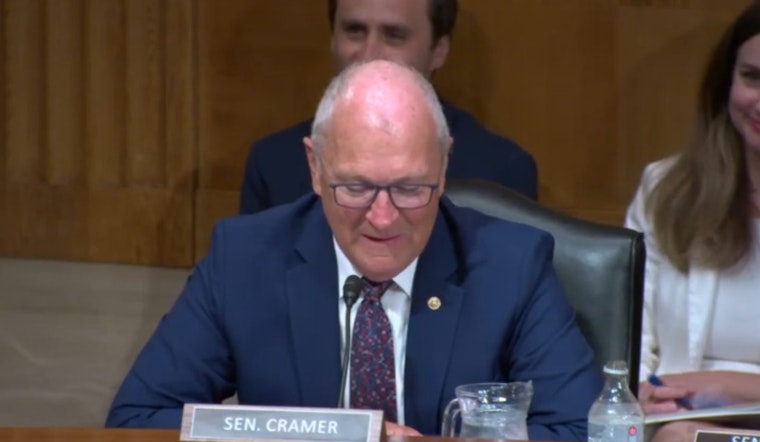
At a recent Senate Environment and Public Works Committee hearing, the development of the Surface Transportation Reauthorization Bill took center stage, with U.S. Senator Kevin Cramer (R-ND) heading the conversation. The focus of the hearing revolved around several points, one being the implications of an EV registration fee, and another the complexities of permitting processes. Senator Cramer, who leads the EPW Transportation and Infrastructure Subcommittee, took the opportunity to introduce North Dakota Governor Kelly Armstrong as the first witness.
Despite the dry subject matter, Cramer's introduction of Armstrong carried a personal touch. "What’s interesting to me about Governor Armstrong is he's not naturally a politician at all," said Cramer in a statement made by his official Senate website. "In fact, he’s quite naturally the opposite. […] But Governor Armstrong brings that perspective, and as I look forward to hearing from the mayor, I think for all of us up here, it’s really, really important to remember that there’s probably no better illustration of the juxtaposition of the relationship between the federal government, local and state governments than in infrastructure." The respect between the two politicians was evident as they navigated the complexities of rural and urban needs in the transport landscape.
Armstrong's presence at the hearing was not just a formality. His experience as a leader of a predominantly rural state like North Dakota was foregrounded by Cramer as critical to the discussion. North Dakota's economic contribution, from energy to agriculture, is disproportionate to its local consumption needs. Understanding this dynamic was posed as essential to informing federal transportation policy.
"Kelly brings that very important perspective from a rural state that produces a lot of things that we don’t consume in our own state, or at least we don’t consume nearly in the supply that we provide to a hungry world and a growing economy," Cramer elaborated, as reported on his official Senate website . The Senator's point underscores the inherent interdependence between rural production capacities and urban consumption demands. This balance, and the role transportation policies play in sustaining it, is at the heart of the legislative discussions. Whether it be transporting durum wheat or ensuring energy reaches its destination, the interplay between production and infrastructure remains integral to the local and national economy.





