

























































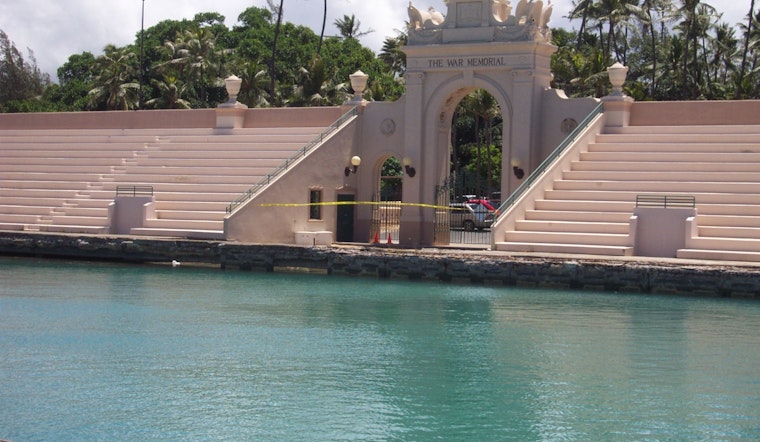
A powerful art installation has transformed the long-shuttered Waikiki War Memorial Natatorium into a canvas for reflection on war, peace, and remembrance this week. The Renkon Project brought together film projection, live dance, and taiko drumming to commemorate the 80th anniversary of the atomic bombing of Hiroshima, creating an unprecedented display at one of Hawaii's most historically significant yet neglected monuments.
According to Hawaii News Now, the commemoration featured live performances by Butoh Master Hiroko Tamano and Taiko Master Kenny Endo, with film projections screened against the natatorium walls from 7 to 9 p.m. Hawaii Public Radio reported that former culture and arts reporter Noe Tanigawa invited the public to witness lotus and war images grace the memorial walls.
Sister Cities United in Remembrance
The timing carries special significance given Honolulu's deep connections to Hiroshima. As detailed by Hawaii Public Radio, Honolulu Mayor Rick Blangiardi traveled to Japan to mark the occasion in Hiroshima, which is Honolulu's oldest sister city. Aloha State Daily noted that Hiroshima named Mayor Blangiardi an honorary citizen on August 4 as part of sister city exchanges.
The relationship between the two cities runs deep, with Spectrum Local News reporting that a replica Hiroshima Peace Bell was presented as a gift to Hawaii in 1985 by the Hiroshima Prefectural Government to recognize the long-standing relationship between the cities.
A Memorial Seeking Resurrection
The choice of venue adds particular poignancy to the commemoration. The Waikiki Natatorium War Memorial, originally built to honor approximately 10,000 men and women from the then-Territory of Hawaii who served during World War I, has been closed to the public since the 1980s due to disrepair. Despite being recognized as a National Treasure by the National Trust for Historic Preservation, the facility has suffered from decades of neglect by local and state government.
The natatorium once served as the epicenter of Hawaii's swimming and watersports heritage for about 50 years. When it opened on August 24, 1927, Olympic Gold Medalist and "father of modern surfing" Duke Kahanamoku took the first ceremonial swim, and it later hosted celebrity swimmers including Esther Williams, Buster Crabbe, and Johnny Weissmuller.
Art as Vehicle for Memory
Hawaii Public Radio explained that "Renkon" refers to lotus root in Japanese, symbolizing resilience and rebirth even in muddy waters—a fitting metaphor for the project's themes. According to Spectrum Local News, the Renkon Project is described as a "heart-opening" series of experiences celebrating the connection between all living things.
The commemoration comes at a critical time for remembrance efforts. NPR reported that with survivors rapidly declining and their average age now exceeding 86, this anniversary is considered the last milestone event for many hibakusha. The urgency of preserving their stories makes artistic endeavors like the Renkon Project increasingly vital.
Broader Community Engagement
The Waikiki installation was part of broader 80th anniversary commemorations throughout Hawaii. Spectrum Local News noted that the United Japanese Society of Hawaii and Honolulu Hiroshima Kenjin Kai hosted gatherings featuring remarks by Governor Josh Green and Consul General Yoshinori Kodama of Japan. Dr. Nobuyuki Miki of Kuakini Medical Center also shared experiences of hibakusha currently living in Hawaii.
The project extends beyond Waikiki, with a live performance and film projection planned for Kenny Endo's "Ma vs. Groove" 50th anniversary concert at the University of Hawaii at Manoa Kennedy Theatre to commemorate the Nagasaki bombing anniversary. The current City and County of Honolulu government has launched efforts to rehabilitate the natatorium, with hopes to have work underway by the facility's centennial in August 2027.





