

























































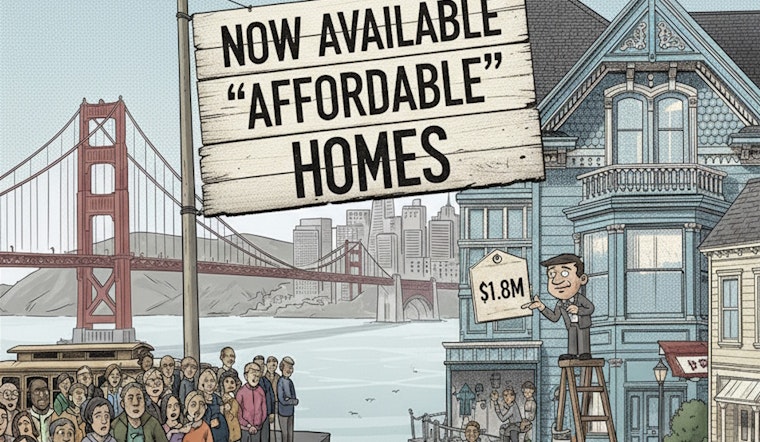
San Francisco just achieved something that seemed mathematically impossible three years ago—and somehow made it feel both triumphant and heartbreaking at the same time. The city has become the only major American metro to wrestle housing costs back to pre-pandemic "normal" levels, a statistical victory that highlights both the city's economic resilience and the brutal reality of who gets to participate in that success.
The numbers tell a story of remarkable recovery. The city's mortgage payment-to-income ratio dropped to 67.1% in July, down from 74.1% in July 2018, when housing was last considered "relatively manageable" by national standards. Redfin's latest report positions San Francisco as the lone success story among America's major metros in returning to pre-pandemic affordability benchmarks.
This isn't just statistical noise—it's evidence of an economy firing on all cylinders. While other cities struggle with stagnant wage growth and persistent affordability challenges, San Francisco has engineered something closer to an economic miracle, powered by the artificial intelligence revolution that's transforming the global economy.
AI Boom Powers Economic Dominance
The secret behind San Francisco's triumph isn't falling home prices—median values still hover around $1.48 million—but explosive wage growth that has fundamentally altered the city's economic landscape. Household incomes are surging 7.7% annually, nearly double the national rate of 3.9%, driven by artificial intelligence companies that have made the city ground zero for the next technological revolution.
"AI companies are setting up shop here—not just in Silicon Valley—and they're offering unusually high salaries and big signing bonuses to attract talent," explained Ali Mafi, a Redfin Premier agent witnessing this transformation firsthand. "I'm seeing more young tech workers and couples moving in with the means to buy. With incomes rising and home prices holding steady, those buyers view the market as an opportunity for relative value."
This represents something unprecedented: a major metro where technological innovation has grown the economic pie fast enough to actually improve housing affordability metrics. While cities from Austin to Miami struggled to balance growth with livability, San Francisco has managed to have both—at least for those positioned to benefit from the AI economy.
The timing couldn't be more perfect. City leaders who secured political control during the last election cycle are now presiding over an economic expansion that validates their vision of San Francisco as an innovation capital capable of generating shared prosperity.
Leaving Competitors in the Dust
The achievement becomes even more impressive when compared to traditional rival cities. Recent Zillow analysis reveals that only 13.6% of San Francisco homes qualify as affordable for median-income buyers. That might sound discouraging until you consider the competition: New York manages just 12.5%, Boston sits at 11.9%, and Los Angeles claims the worst performance nationwide with only 3% of homes affordable to typical earners.
The rental market tells an even starker story of San Francisco's relative strength. While eight major metros now require six-figure incomes for comfortable renting, San Francisco's competitors fare worse. New York tops the list requiring $145,000 annually, followed by Boston at $127,000, while San Francisco's requirements reflect a more balanced equation between costs and earning potential.
Perhaps most tellingly, Zillow economists determined that even theoretical 0% mortgage rates wouldn't make median homes affordable in New York, Los Angeles, or Miami—but conspicuously didn't include San Francisco in that impossibility list, suggesting the city's wage growth has created genuine pathways to homeownership that simply don't exist elsewhere.
The Post-Pandemic Pretenders
Cities that positioned themselves as San Francisco alternatives during the remote work boom are discovering that replicating the innovation economy isn't as simple as marketing campaigns suggested. Nashville's median home price of approximately $490,000 sounds affordable until you consider local wages, with Zillow forecasting modest 3.4% growth that reflects a fundamentally different economic trajectory than San Francisco's AI-powered expansion.
Miami provides the most cautionary tale. The city successfully imported California-style housing costs without the corresponding wage growth, now requiring $100,000+ rental incomes while lacking the innovation ecosystem to justify such expenses. Austin, despite its tech ambitions, notably doesn't appear on Zillow's list of markets requiring six-figure rental incomes—a sign that growth without foundation creates different challenges than San Francisco's more sustainable expansion.
Regional Success Story
The Bay Area's broader performance reinforces San Francisco's leadership position. Oakland is positioned to join the "normal" category within months, according to Redfin projections, while San Jose faces a timeline extending to May 2029. This suggests San Francisco's success isn't isolated but represents the leading edge of a regional economic transformation.
The achievement stems partly from strategic advantages built over decades. Home prices have risen just 8% since July 2018, compared to 56% nationally, because the city had already achieved market maturity that provided stability during broader turbulence. This foundation, combined with accelerating wage growth, created conditions for statistical improvement that proved impossible to replicate elsewhere.
The Reality Check
San Francisco's success doesn't solve housing challenges for everyone. Asad Khan, Redfin's senior economist, acknowledges the fundamental contradiction: "It's clearly not possible for the typical San Francisco household to devote nearly 70% of their income to housing. The metro's high mortgage payment-to-income ratio highlights that homes were being traded among a relatively concentrated share of high-wealth households."
This creates a tale of two cities. The AI boom has generated enormous wealth for tech workers, creating a class of residents who can navigate $1.48 million median home prices with relative ease. Meanwhile, teachers, firefighters, and service workers—the backbone of any functional city—face the same mathematical impossibilities that plague residents of less economically dynamic metros.
The construction pipeline remains problematic despite statistical improvements. More than 70,000 approved housing units sit unbuilt due to financing challenges and construction costs that rank among the world's highest. The city's 6% real estate transfer tax for high-end sales—the nation's highest—exemplifies policies that generate revenue while potentially constraining supply expansion.
Market-rate housing construction has essentially stalled, with government-subsidized affordable housing dominating current production. Of 110 housing projects under construction across the Bay Area, 90 are affordable housing developments—a ratio that suggests market dynamics favor high-end transactions while leaving middle-income residents with limited options.
Policy Success and Challenges
Mayor Daniel Lurie's Family Zoning Plan represents an attempt to build on economic success with regulatory reform. Introduced in June, the initiative aims to address supply constraints through strategic upzoning along commercial and transit corridors. State law requires the city to adopt a compliant rezoning plan by January 31, 2026, creating urgency around implementation despite neighborhood opposition.
The broader California context amplifies both San Francisco's achievement and its ongoing challenges. Statewide, households need approximately $237,000 in annual income to qualify for a mortgage on a mid-tier home—more than double the state's median household income. Monthly payments for newly purchased homes have increased 82% since January 2020, while wages grew just 23%, creating affordability gaps that San Francisco's AI-driven wage growth has uniquely addressed.
California's Proposition 13 property tax structure adds complexity, with new buyers paying more than twice as much in property taxes compared to long-term homeowners in major cities. This system incentivizes staying put while penalizing newcomers—dynamics that San Francisco's high wages help offset but don't eliminate.
Most significantly, housing unaffordability patterns pioneered in San Francisco are spreading nationwide. What once seemed like a uniquely Bay Area problem has become a national phenomenon, suggesting the city was less an outlier than an early indicator of broader economic trends.
San Francisco's return to "normal" housing costs represents both triumph and paradox. The city has achieved something no other major metro could manage, demonstrating economic dynamism that attracts global attention and investment. Yet this success creates new forms of inequality and displacement that challenge traditional notions of urban prosperity. In becoming the first major city to conquer post-pandemic housing challenges, San Francisco has also become a laboratory for the opportunities and tensions that define 21st-century economic success.





