

























































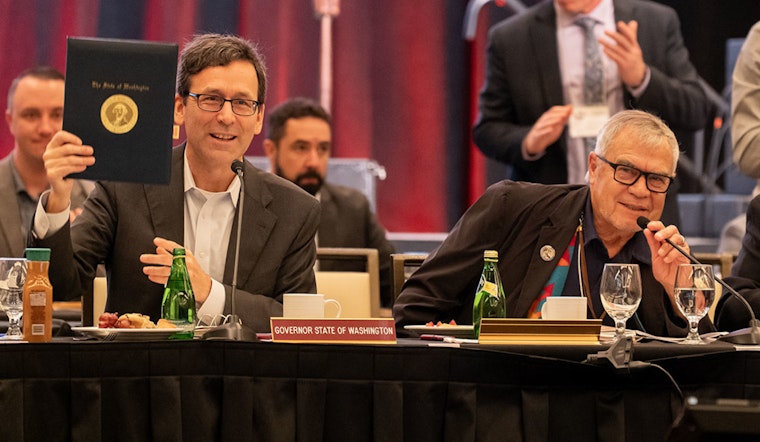
In an effort to strengthen ties between Washington state and its Tribal Nations, Governor Bob Ferguson inked a new executive order that sets out to revamp partnerships with indigenous communities. According to an announcement from his office, the move aims to bolster government-to-government relations and foster collaborations on pressing issues.
Aligning his latest directive with the voices of Tribal leaders, Governor Ferguson's order mandates several action points for state agencies. They are instructed to proactively engage with Tribal Nations, foster Native art and culture, and integrate Indigenous Knowledge into decision-making, according to a statement obtained by support from the Governor's office. Full transparency is expected as well with an annual reporting requirement on activities impacting Tribal Nations. Hosted by the Cowlitz Indian Tribe, the signing event marked Governor Ferguson’s engagement with the statewide tribes, reflecting a commitment formed over a career spanning decades.
William "Bill" Iyall, the Chairman of the Cowlitz Indian Tribe, told the Governor's office, "For generations, Tribal Nations have sought relationships with state leaders built on mutual respect and a meaningful recognition of tribal sovereignty." The executive order ushered in by Governor Ferguson has been well-received, representing a benchmark for state engagement and promising stronger collaboration as Tribes and the state tackle shared challenges.
Among the directives, state agencies are required to consult with Tribes when policies or actions may impact them and to ensure Tribal liaisons report directly to agency heads. Initiated in his first nine months in office, the order builds on his past advocacy for Indigenous rights during his tenure as Attorney General. Pursuing legislation such as the state's Missing Indigenous Person Alert system, Ferguson has consistently strived for justice, most notably with his establishment of a Missing and Murdered Indigenous People Task Force and a committee dedicated to addressing the harms of Indian boarding schools.
The Governor's Office of Indian Affairs is tasked to create Tribal consultation guidelines before the 2026 Centennial Accord, and these must be adopted by cabinet agencies within a year of their release. Furthermore, key state officials and policy advisors are expected to partake in in-person training to promote effective state-Tribe communication, with a consensus on learning from GOIA and Tribal Nations.
Looking ahead, Governor Ferguson's executive order paves the way for more inclusive and respectful dialogue with Washington's Tribal Nations, acknowledging years of effort to uplift and respect Indigenous communities' rights and wisdom. Citing examples from history such as the 1989 Centennial Accord and the 1999 Millennium Agreement, this active measure seeks to actualize longstanding promises for a more equitable and collaborative future.





