

























































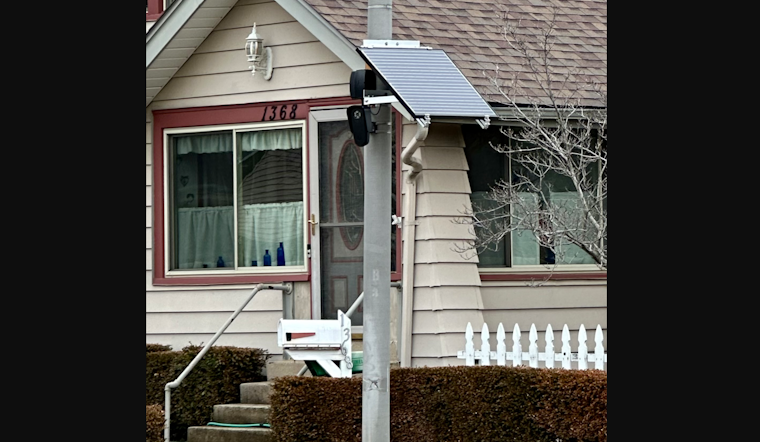
Oakland’s latest crime-fighting tech push just slammed into a stalemate at City Hall, where the City Council’s Public Safety Committee split 2-2 on a plan to expand and consolidate the city’s Flock Safety license-plate reader network. The deadlock leaves the proposal frozen for now and laid bare a sharp divide over whether these cameras are a smart way to track carjackings and stolen vehicles or a fast track to mass surveillance.
Supporters that include some business groups and neighborhood advocates say the system helps detectives move faster on cases. Opponents warn that it hands too much power and data to a private vendor and opens the door to third-party access to sensitive location information. With no majority, the measure did not advance out of committee, and how or when it might return to the full council is unclear.
Television cameras captured just how tense the hearing got. As reported by KRON4, reporter Lindsey Ford showed residents and councilmembers trading pointed testimony as the motion failed. The segment highlighted the sheer volume of public comment and the split among officials over where to draw the line between privacy and public safety.
The committee’s 2-2 vote saw Councilmembers Ken Houston and Charlene Wang backing the recommendation, while Carroll Fife and Rowena Brown opposed it, according to reporting by Bay City News Service on SFGATE. The package included a roughly $2.25 million contract with Flock Safety, about 40 new pan tilt zoom cameras focused on downtown corridors and a plan to fold privately owned CCTV feeds into a cloud system that would hold automated license plate reader data for up to 30 days, according to the city’s agenda. City staff pitched the move as an upgrade that would replace an aging vehicle mounted ALPR system and streamline access to time sensitive investigative leads.
Supporters say it speeds investigations
Oakland police officers and downtown business advocates told the committee the cameras are already helping generate leads and have contributed to drops in some vehicle crime categories. Lieutenant Gabriel Urquiza told SFGATE, “How we are measuring success is basically a change in behavior,” pointing to lower carjacking figures as a key metric. Supporters urged the city to approve a limited two year contract while longer term staffing and violence intervention strategies continue to ramp up.
Privacy watchdogs push back
Privacy advocates and civil liberties groups lined up on the other side, arguing that the plan would centralize a massive trove of location information that could be misused. The city’s volunteer Privacy Advisory Commission voted 4-2 against moving the policy forward, and two commissioners resigned over concerns about mass surveillance, reporting by Oaklandside shows. Opponents also pointed to broader examples in which ALPR data was reportedly accessed by outside agencies as proof that contractual language and technical controls do not always hold up under pressure.
Legal and data sharing questions
State law and recent guidance from the California Attorney General have tightened restrictions on sharing ALPR data with out of state or federal agencies, a point civil liberties advocates have hammered repeatedly. The Electronic Frontier Foundation has documented cases in which dozens of California law enforcement agencies kept sending driver location information to outside entities despite those limits, underscoring how difficult enforcement can be.
Flock Safety publishes a Flock Safety transparency portal that outlines prohibited uses and access rules for its system, but critics argue that independent audits and tougher termination clauses are still needed to make sure the city can shut off the tap if partners or other agencies break the rules.
What’s next at City Hall
Because the committee failed to reach a majority, the proposal is expected to resurface on the council calendar for more debate and possible amendments rather than disappearing entirely. The city’s meeting schedule shows the Flock contract is one of several hot button public safety items coming up in the weeks ahead, according to the city calendar.
Councilmembers on both sides of the vote signaled that the fight is not over, and that staff will keep revising vendor obligations and data protection language before anything heads to a final up or down vote.




