

























































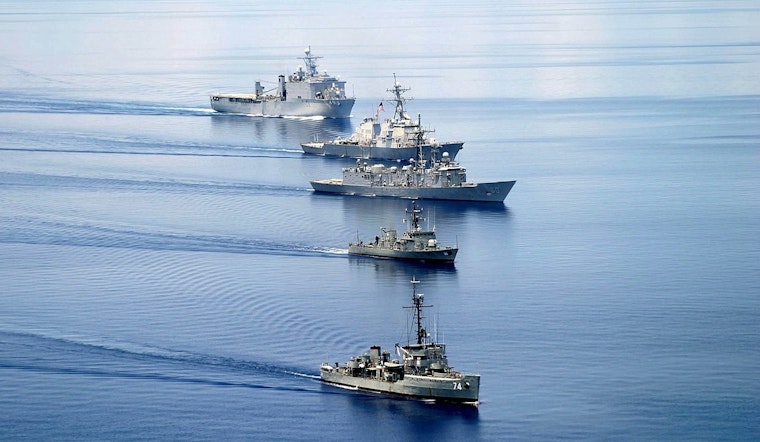
Honolulu quietly hosted some of the world’s most closely watched military talks this week, as uniformed officials from the United States and China met Tuesday through Thursday to hash out how to avoid dangerous run-ins at sea and in the air.
The working-level maritime security sessions brought together officers from U.S. Indo‑Pacific Command, the Pacific Fleet, Pacific Air Forces, the U.S. Coast Guard and representatives of the People’s Liberation Army Navy. U.S. Indo‑Pacific Command said it hosted the semi‑annual Military Maritime Consultative Agreement working group in Honolulu, where delegations reviewed operational safety and risk‑reduction measures, according to U.S. Indo‑Pacific Command. The command shared photos and a short writeup of the meetings.
What They Discussed
China’s navy characterized the closed‑door conversations as “frank and constructive,” saying delegates walked through “typical cases” of recent naval and air encounters and assessed how well existing Rules of Behavior for Safety of Air and Maritime Encounters are being followed, according to Reuters. The goal, the Chinese side said, was to make frontline operations more professional and cut down the risk of miscalculation when ships and aircraft get uncomfortably close.
In the same account, China’s navy also took aim at U.S. freedom‑of‑navigation and overflight operations in contested areas such as the Taiwan Strait and the South China Sea, arguing it resolutely opposes "any infringement, provocation,” and stressing its displeasure even as the talks continued. Both sides traded ideas for a follow‑up working group meeting in 2026, as per Xinhua via the Ministry of National Defense, which noted the statement appeared on the PLA Navy’s official social media channel.
U.S. Response And Context
From Washington’s perspective, the Honolulu sit‑down fits into a broader push to reopen and stabilize military‑to‑military lines of communication with Beijing. Defense Secretary Pete Hegseth has been pressing for more regular contact and has recently flagged China’s stepped‑up military activity around Taiwan and in the South China Sea as particularly worrying, as noted by AP.
The Pentagon has also urged greater transparency from Beijing about key pieces of its ongoing military modernization, arguing that clearer information can lower the odds of miscalculation or accidental escalation, as reported by Reuters.
How The Mechanism Works
The Military Maritime Consultative Agreement, along with a 2014 U.S.‑China memorandum on rules of behavior, is a voluntary, non‑binding framework designed to give commanders and crews predictable patterns for encounters at sea and in the air. According to a Congressional Research Service backgrounder, the memorandum and its annexes draw heavily on existing international norms and are intended to help frontline units avoid risky close‑in maneuvers that could spiral into something far more serious.
Why It Matters For Honolulu
While the talks were about global flashpoints like the Taiwan Strait and the South China Sea, hosting them put Honolulu squarely in the middle of high‑stakes Indo‑Pacific military diplomacy. The city’s role as headquarters for U.S. Indo‑Pacific Command already makes it a strategic nerve center, and these latest meetings reinforced that status.
Local coverage noted that officials did not publicly disclose the exact venue, though the sessions involved senior U.S. Pacific commanders, according to the Honolulu Star‑Advertiser. The Chinese navy says the working group will reconvene in 2026, a sign that despite sharp disagreements over operations near Taiwan and in the South China Sea, both sides still see value in keeping at least this one channel open on Oʻahu’s doorstep.





