

























































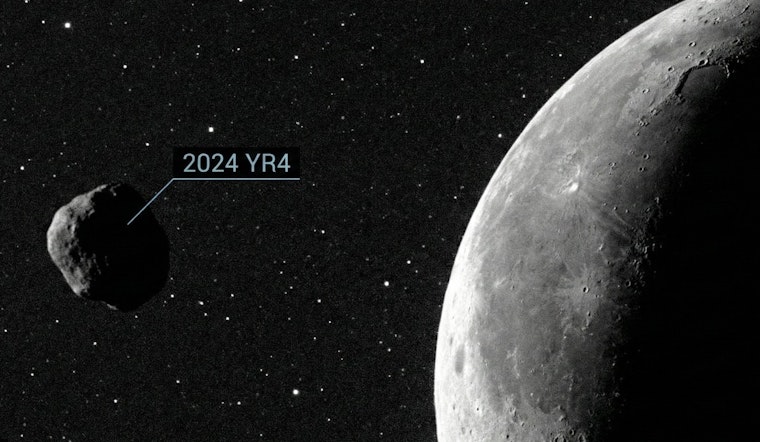
From its first detection using an instrument designed in part by teams based in the Bay, to follow-up orbit analysis conducted at major NASA centers in Houston and Pasadena, asteroid 2024 YR4 has unexpectedly tied several U.S. cities into one of the most detailed space-risk debates in years. The roughly 50- to 70-meter space rock no longer threatens Earth in 2032, but researchers — including those at NASA’s Goddard Institute in New York City, where some of the orbital-probability modeling runs — say a potential lunar strike could still spell trouble for near-Earth space. A hit of that size, combined with the asteroid’s uncertain mass, could eject enough debris to pepper the space around our planet, so teams across the U.S. are already gaming out what to do if the odds do not shrink.
According to ESA, the best current orbit calculations put the chance of a lunar impact on December 22, 2032, at about four percent. As outlined by NASA, infrared data from the James Webb Space Telescope — analyzed partly through teams at the Space Telescope Science Institute, which collaborates with researchers in the Bay Area and New York — have narrowed YR4’s size estimate to roughly 53 to 67 meters and have effectively ruled out a 2032 collision with Earth.
Paper Lays Out Options, Including A Controversial Nuke
A multi author preprint that includes several NASA affiliated researchers — including contributors at Johnson Space Center near Houston, and modeling groups who often coordinate with tech-aerospace partners in the Bay Area and Los Angeles — walks through what could be done if that four percent starts creeping higher. The study weighs reconnaissance missions, kinetic impactors and a so called "nuclear robust disruption" as possible responses if a Moon impact begins to look likely. As reported by NBC News, the authors argue that planners should run the numbers on both gentle orbital nudges and high energy disruption now, so policy makers are not scrambling for options late in the game.
What The Preprint Actually Says
The paper, posted to arXiv, evaluates a mix of reconnaissance, deflection and disruption strategies and concludes that traditional slow push deflection looks impractical without a close up mass measurement. It notes that nuclear robust disruption missions could be launched during windows from late 2029 through late 2031, while reconnaissance missions timed for late 2028 would be needed to collect crucial data on YR4's mass and composition so that a safer mitigation path can be chosen.
DART Proved A Nudge Can Work, But Limits Remain
NASA's 2022 Double Asteroid Redirection Test, better known as DART, showed that a kinetic impactor can indeed move a space rock. The mission slammed a spacecraft into the moonlet Dimorphos and shortened its orbital period by about 32 minutes. That was historic, and also a reminder that reality is messy. The DART result highlighted complexities such as plumes of ejecta, rubble pile structures and tiny but important velocity changes. All of that makes it hard to simply copy and paste the same playbook onto a very different target, particularly an oblate, fast spinning object like YR4, without first flying a reconnaissance mission. NASA has laid out those details in its mission release.
Why A Moon Hit Would Matter
Even if humans are not standing on the impact site, a hit on the Moon would not just be a pretty new crater for telescope fans. Modeling in the preprint shows that a YR4 impact could kick up a short lived storm of micrometeoroids into near Earth space. The authors warn that in some scenarios, the micrometeoroid flux in low Earth orbit could jump by orders of magnitude for several days, creating a temporary, but serious, hazard for satellites, crewed spacecraft and planned lunar infrastructure. Those findings are part of what is driving the push for early characterization of the asteroid (arXiv).
How Astronomers Will Shrink The Odds
To nail down what they are dealing with, teams used the James Webb Space Telescope in March 2025 to better constrain YR4's size and shape. Coordinated follow up campaigns have already reduced the uncertainty in its orbit, but the asteroid will be mostly out of reach for ground based telescopes until it swings back around in 2028. Researchers presented these observational results, along with the JWST timetable, at the joint EPSC DPS meeting in 2025. Organizers say that once astronomers observe the next apparition, they should finally be able to give a decisive answer on YR4's 2032 trajectories (EPSC-DPS2025).
For now, NASA is firmly in the "watch and wait" camp. The agency is emphasizing observation over intervention and has told reporters it has no plans to deflect the object at this time, according to NBC News. Scientists, including the teams behind the Webb observations, argue that tracking small, fast moving objects now and rehearsing mitigation scenarios on paper is the only way to be ready if the odds refuse to drop to zero once YR4 comes back into view. That case for preparation is reflected in coverage by National Geographic and in conference presentations.





