

























































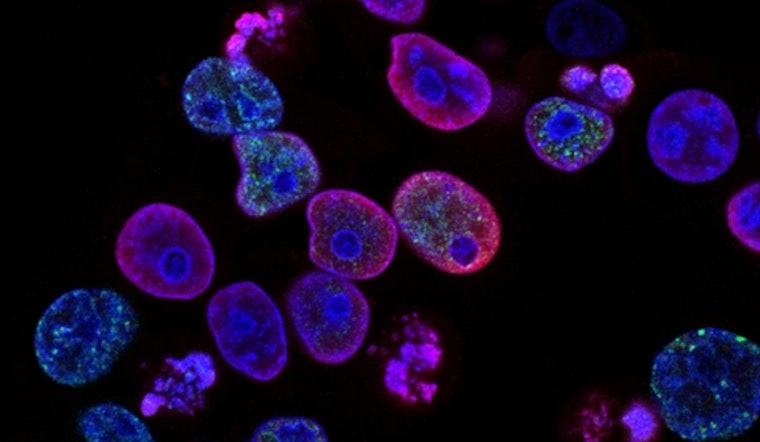
Scientists at UT Southwestern in Dallas say they have finally nailed down the human protein that makes cells literally burst during necroptosis, a form of inflammatory programmed cell death. The work centers on SIGLEC12 and the way it is switched on by a partner enzyme, revealing a fresh, druggable choke point in the cell death process that could matter for sepsis, Crohn’s disease, Alzheimer’s, ALS, and certain cancers. In lab dishes, the team tracked the final, membrane-shredding moment in human cells and walked away with a precise molecular target for future drug development.
How the team found the missing link
To hunt for the last piece of the necroptosis puzzle, the researchers ran a genome-wide CRISPR-Cas9 knockout screen in human cells that were engineered to crank out an activated form of MLKL, the final known executioner in the necroptosis cascade. Most cells went through necroptosis and ruptured as expected. A few, however, swelled up like balloons and never popped. Those survivors were missing SIGLEC12, which the authors interpret as evidence that SIGLEC12 is required for plasma-membrane rupture during necroptosis, according to Nature.
TMPRSS4 flips the switch
Digging deeper, the team found that a transmembrane serine protease called TMPRSS4 cuts SIGLEC12 to produce a fragment of about 20 kilodaltons that looks a lot like the membrane-rupturing protein NINJ1. In the lab, that cleaved piece alone was enough to make membranes burst. UT Southwestern reports that the cleavage step appears to be the crucial activation switch for SIGLEC12's destructive activity, as described by UT Southwestern.
Mutation patterns in cancer and the population
The researchers also combed through cancer genomics datasets and turned up dozens of SIGLEC12 variants in tumor samples and in the general population that reduce TMPRSS4 cleavage and weaken SIGLEC12 function. Specific variants such as Ser458Phe and Arg528Trp impair cleavage and may help explain why many cancer cells shrug off necroptosis, the authors report in Nature.
Where treatments might go from here
Because necroptosis spews out inflammatory signals that can aggravate infections and chronic diseases, the discovery points to two prime drug targets, SIGLEC12 itself and its activating protease TMPRSS4, that could potentially be modulated to block harmful membrane rupture. "Our study identifies a human-specific mediator of necroptotic membrane rupture, revealing a previously unknown, druggable control point in inflammatory cell death," study leader Ayaz Najafov said, as reported by Dallas Innovates.
Next steps and caveats
The authors caution that SIGLEC12's membrane-rupture role appears to be specific to humans, since knocking out the mouse version of the gene did not stop membrane rupture. That means moving from cell culture to animal experiments and eventual therapies will require models that closely mirror human biology. The paper lists Hyunjin Noh as first author and names Zeena Hashem among the contributors, and the work was backed by the National Institute of General Medical Sciences and an NCI Cancer Center Support Grant, giving the team a defined runway for the next round of preclinical studies.



