

























































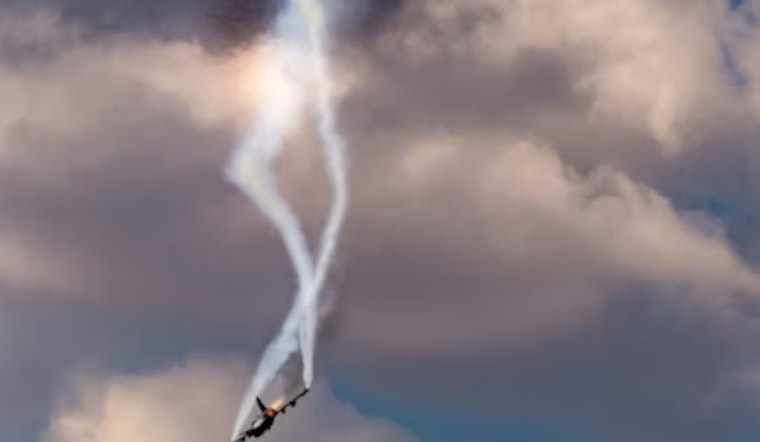
Less than ten minutes after lifting off from Stockton on May 7, 1964, Pacific Air Lines Flight 773 went down in the hills east of San Ramon, killing all 44 people on board. Radio recordings later captured a terrified fragment interpreted as “Skipper’s shot” and “we’ve been shot,” and investigators determined that the pilots had been attacked from inside the cabin. The violence was so stark and unexpected that it helped change how airlines thought about the cockpit door for decades to come, according to the SFGATE.
What happened that morning
As the Fairchild F‑27 approached the Bay Area just before 6:50 AM, air‑traffic controllers heard a high‑pitched, garbled transmission and then saw the radar target disappear. A nearby United crew soon reported a plume of black smoke curling up from the hills. The Civil Aeronautics Board later found that the aircraft suddenly entered a rapid, uncontrolled descent from about 5,000 feet and slammed into an east‑facing slope near Camino Tassajara, scattering wreckage across roughly 1,000 feet and leaving no survivors, according to the Civil Aeronautics Board.
The man in the back
Investigators ultimately focused on one passenger: 27‑year‑old Francisco Paula Gonzales, a Philippine‑born sailor who had competed in the Dragon class at the 1960 Rome Olympics, per Olympedia. According to contemporary coverage and the CAB record, Gonzales bought a .357‑caliber Smith & Wesson the night before the flight, took out large life‑insurance policies at the airport and told people he planned to die, as reported at the time by TIME. Authorities concluded that he walked through the unlocked cockpit door, shot Captain Ernest Clark and First Officer Ray Andress, then fatally shot himself, leaving the F‑27 with no one at the controls.
Investigation and the physical evidence
On the hillside, search teams recovered pieces of a revolver and a small, lead‑scarred dent on a section of tubing from the captain’s seat. Laboratory tests found traces of lead and antimony that matched bullet impact, according to the Civil Aeronautics Board. Flight‑recorder data and witness accounts lined up with the physical clues: a sudden, extreme pitch change followed by a high‑speed plunge after the crew were incapacitated. Those findings formed the board’s probable‑cause ruling and ruled out mechanical failure as the culprit.
Security legacy: locked cockpit doors
Within months, the Flight 773 investigation helped push federal regulators to tighten the barrier between passengers and the flight deck. Rules requiring that doors between the passenger cabin and the crew compartment be kept secured during flight were advanced and later written into federal aviation regulations, per the Code of Federal Regulations. The language and carve‑outs shifted over time, but the Flight 773 case is widely cited as a catalyst for lockable cockpit doors and tougher cockpit‑access procedures. The routine checks and access protocols air travelers see today trace in part to the gap exposed over the East Bay that morning.
A daughter's response, and the pilots' legacy
Captain Ernest Clark’s daughter, Julie Clark, has said the recovered voice‑recorder made it clear that her father was murdered in flight. She went on to build a high‑profile aviation career of her own as a commercial captain and airshow performer, a trajectory chronicled in an Airport Journals profile. The aftermath for families of the crew and passengers, including orphaned children and relatives left to sort through the loss, remains tightly bound to the regulatory changes that followed, a reminder that policy shifts were driven by very personal grief.
Why the wreckage still matters
The CAB case file, contemporaneous news coverage and later retrospectives together make Flight 773 a textbook example of how in‑flight violence can ripple outward into long‑term safety rules. A recent look at the case by SFGATE revisits the audio, the forensic details and the rulemaking that followed, underscoring how one man’s act in a cramped cabin helped rewrite the playbook for cockpit security.





