

























































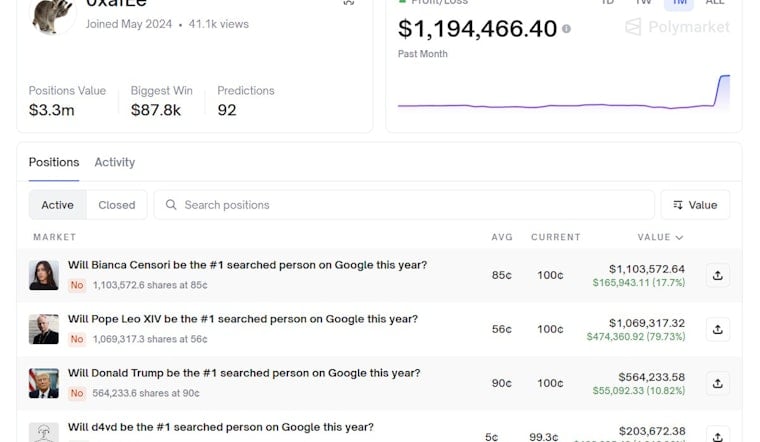
On Tuesday night, a tweet from New York–based Meta software engineer Haeju Jeong lit a fuse under Polymarket. Jeong — a Senior SWE at Meta with a background in blockchain and web3 development — shared a series of posts and screenshots that he claims showed a "Google insider has officially been exposed on Polymarket ... profited $1,000,000 in a single day betting on the Google search markets." Within 24 hours, his post amassed over 3.7 million views and ignited a frenzy of speculation about gambling akin to insider trading on one of the internet’s fastest-growing prediction markets.
The Meta Engineer Whose Tweet Set Off the Firestorm
Jeong isn’t some pseudonymous anon. His LinkedIn profile identifies him as a longtime full-stack developer who has worked at AWS, contributed to multiple DeFi and NFT projects, and recently joined Meta as a Senior Software Engineer. He also runs a personal site highlighting his work in crypto, market-making, and smart-contract development. The combination of technical credibility and crypto fluency helped his post spread with unusual speed.
A Google insider has officially been exposed on Polymarket.
— haeju.eth (@JeongHaeju) December 4, 2025
This dude just profited $1,000,000 in a single day betting on the Google search markets.
Google accidentally pushed the results early, then removed them, but not before it revealed he went 22/23 on his bets and… pic.twitter.com/44raBXoD4x
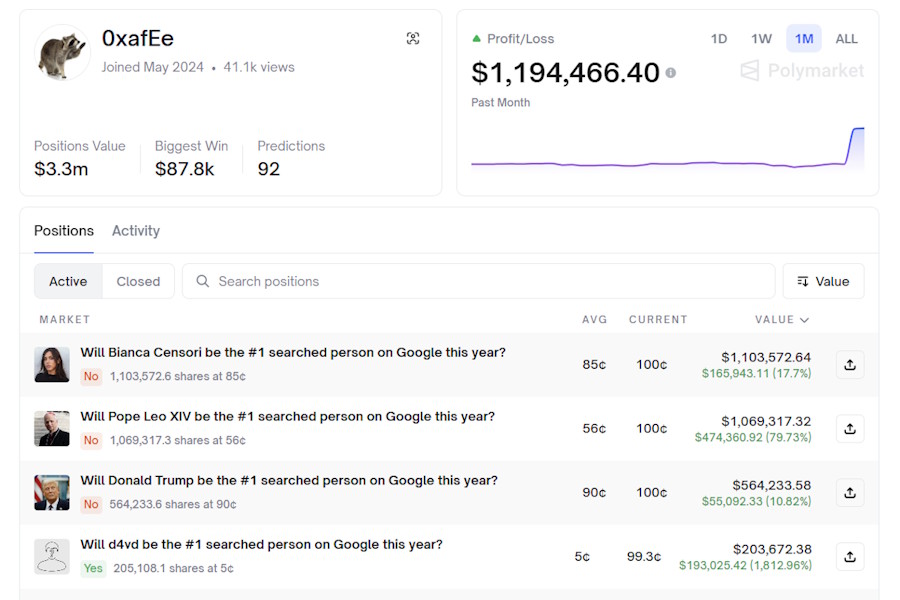
His tweet centered on a Polymarket account previously called “AlphaRaccoon,” whose dashboard showed $3.9M in open positions and more than $1.19M in profit over the past month. The majority of those earnings came from markets tied directly to Google’s end-of-year search rankings — the kind of data that typically isn’t public until Google releases its annual report.
“One of the Wildest Things I’ve Seen on the Platform”
In his post, Jeong suggested that Google may have “accidentally pushed the results early,” allowing the trader to go 22-for-23 on related bets before the data was pulled. He did not present evidence of that leak, but his framing struck a nerve in online trading circles, where many already believe that Polymarket’s biggest whales rely on privileged information.
The replies read like a Greek chorus: “That’s what corporate insider trading looks like.” “A heist.” “The house always wins — unless you work for it.” Others debated whether the trader’s lone losing bet — a $12,000 hedge on Kendrick Lamar — meant the bettor was merely cautious, not omniscient.
The Screenshots That Launched a Thousand Conspiracies
Jeong’s thread included a series of market breakdowns showing how AlphaRaccoon’s profits stacked up across Google-themed contracts.
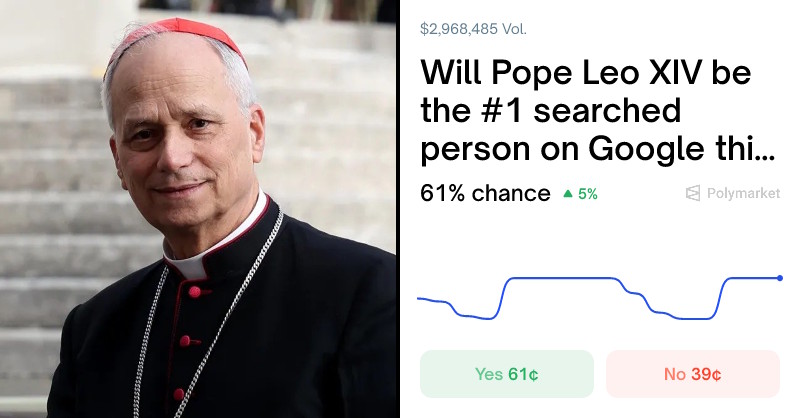
The markets themselves look almost random to an outsider — popes, rappers, niche creators — but the bets weren’t small. Six-figure positions turned into six-figure profits. A simple “No” bet on Pope Leo XIV being the most-searched person of the year alone netted over $1,068,000.
The Polymarket Page Only Added Fuel to the Fire
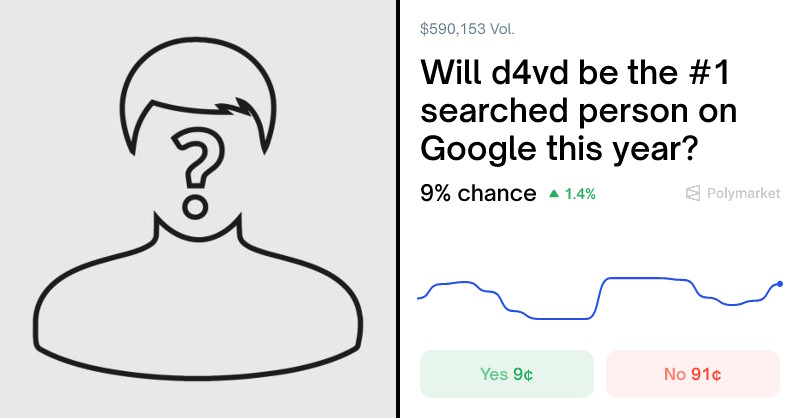
By the time Jeong’s tweet hit its first million views, traders were already gathering in the comment section of Polymarket’s own “#1 Searched Person on Google This Year” listing — a market that had ballooned to an eye-popping $53.8 million in volume. The market was in “Final Review,” had been disputed multiple times, and showed an improbable 99% chance that the musician d4vd — not Trump, not Pope Leo XIV, not Bianca Censori — would finish as Google’s most-searched person of 2025.
The comment section reads like a collective nervous breakdown. “Nice scam,” one user wrote. “Prediction market is just a joke,” another added. Several traders accused the result of being influenced by bot farms, pointing to sudden spikes in Google Trends for d4vd. One commenter claimed the official Google Trends result was “an artificial forgery,” while another alleged “scam activity” and a “big blow on the credibility of prediction markets.”
In the middle of it all, a user casually dropped a link to the now-infamous wallet at 0xafEe, noting that it appeared to match the massive winning positions circulating on X. “That guy buys like a normal human,” another replied, as if trying to talk themselves down from a ledge.
Even without Jeong’s viral post, the market itself was descending into confusion — with users openly debating whether Google’s reported search rankings were correct, manipulated, or prematurely published. The perfect conditions, in other words, for a conspiracy theory to gain traction.
Is This Actual Insider Trading or Just a Perfectly Timed Lucky Streak?
That’s the million-dollar question — and as of now, no one has the answer. What is confirmed is that a trader on Polymarket made an enormous amount of money very quickly on Google-related prediction markets. Outlets like Inc. and Benzinga have both reported on the massive earnings, while carefully noting that the “insider” label is still unproven.
No evidence has surfaced linking the anonymous trader to Google, nor has Google commented publicly on whether any internal data was briefly published early. As with an earlier Nobel Prize betting controversy — now under formal investigation by Norwegian officials — the pattern of trades looks suspicious from the outside, but suspicion is not confirmation.
The Internet Has Already Made Up Its Mind
Regardless of the facts, Jeong’s tweet has become the story of the week in prediction-market circles. It taps into a broader cultural anxiety: that as platforms like Polymarket go mainstream, the people with the best data — tech workers, analysts, insiders — will always be one step ahead of retail bettors.
For now, all anyone knows for certain is that one anonymous wallet walked away with a massive payday, and that a tweet from a Meta engineer turned the entire episode into a viral referendum on transparency, information asymmetry, and the future of prediction markets.
Everything else is speculation — fitting, perhaps, for a story born on Polymarket.





