

























































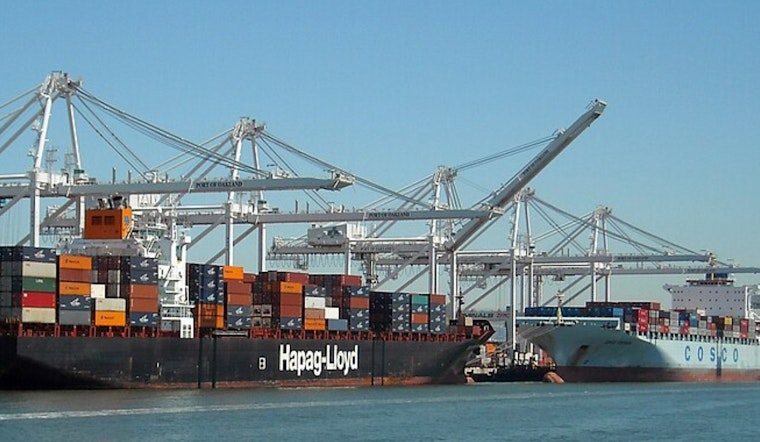
The Port of Oakland has reported a dip in cargo movement for November this year, handling 174,239 twenty-foot equivalent units (TEUs), as per a recent release. This number indicates a 4.1% decrease compared to the same month a year ago and a slight 4.7% fall from October’s figures, suggesting a typical seasonal slowdown paired with changes in global shipping patterns. Despite the overall decline, the Port witnessed an upswing in exports, particularly of agricultural commodities, a sector for which the Port of Oakland is known as a major U.S. exporter.
In November, the export volume moderately increased by 3.3% year over year to 68,824 TEUs, and managed to outpace October's performance by 4.0%, according to the Port of Oakland's statement. Conversely, loaded imports were to slightly falter, coming in at 73,092 TEUs, registering a decline both year over year by 9.3% and from October by 11.1%. Bryan Brandes, the Port of Oakland's Maritime Director, emphasized the importance of export consistency, stating, “Export strength continues to be a key driver for Oakland,” and acknowledged the role of exporters in maintaining steady goods movement.
When combining the figures for both loaded imports and exports, the port experienced a 3.6% year-over-year decrease, with the total standing at 141,915 TEUs. However, there has been little fluctuation from the October tally, indicating some level of market stability. On the other hand, empty container handling saw a drop, down to 32,324 TEUs—6.4% less than last year, and showing a 6.3% decrease since October, attributable mainly to carriers adjusting their equipment positions.
Vessel traffic seems to have followed a similar downward trend, with the port recording only 76 calls in the month of November—an 8.4% year-over-year decline and a 11.6% dip from October. This shift is partly due to shipping companies opting to send out larger vessels and consolidate their services to optimize their operations. Despite fewer calls, improved cargo per vessel averages have helped to maintain an equilibrium in the port's throughput, as the maritime industry evolves and adapts to the changing global dynamics.





.jpg)