

























































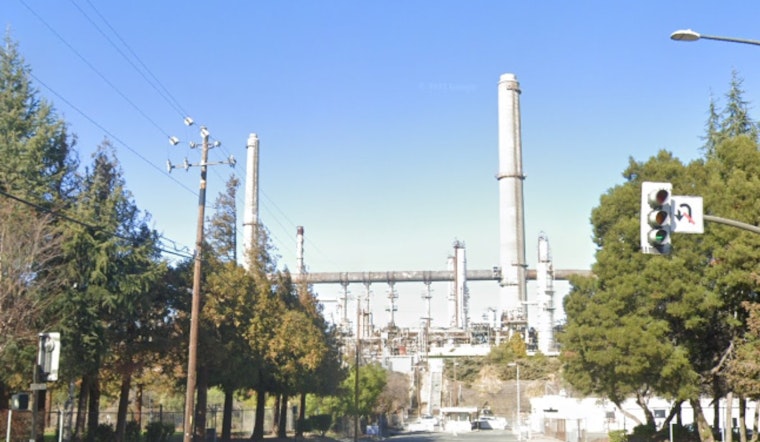
A new county review says firefighters trying to contain the massive February blaze at the Martinez Refining Company were flying half blind, hobbled by radios that could not talk to each other and a command structure that took nearly two hours to fully kick in.
Investigators with the Contra Costa County Fire Protection District found that on-site refinery crews were carrying radios that could not directly connect with local public-safety channels, which meant responders were juggling multiple devices and relying on workarounds during the critical first phase of the emergency. The report also notes that the unified command center, the hub that is supposed to coordinate a big incident like this, was not fully established for almost two hours. Inside the facility, the refinery’s own fire brigade had only limited access to the regional EBRICS radio system.
Residents and county supervisors told the Board of Supervisors that the findings help explain why the fire burned for days and why key processing units stayed offline for months afterward.
According to The Mercury News, ConFire Deputy Chief Aaron McAlister walked supervisors through the review and laid out how incompatible radio systems blocked immediate contact between refinery responders and ConFire units. The presentation also reported that Martinez Refining Company had only a handful of EBRICS radios on site, none of them assigned to the internal brigade, which left early communication dependent on improvised methods instead of standard channels.
Supervisor Ken Carlson, who serves on the board that oversees EBRICS deployment in the East Bay, told colleagues that a lack of cohesiveness among government partners added to the communication problems.
Martinez Refining Company has disclosed that roughly 170 barrels, about 7,140 gallons, of hydrocarbon materials were released during the February 1 incident, most of which the company says burned off in the fire, according to ABC7. Contra Costa Health’s public oversight page for the incident shows air-sampling data and independent investigations that detected elevated levels of benzene and other hazardous compounds near the refinery during the event. Those readings triggered shelter-in-place advisories and a county-led review.
County materials state that the fire damaged internal equipment and disrupted refining operations for months while agencies and outside consultants assessed the fallout.
Radio Gaps And A Late Start At The Top
ConFire’s review zeroed in on radio interoperability as a central failure. Responders could not reliably talk to each other on shared frequencies, and crews were forced to carry two separate radios to bridge incompatible systems. That kind of juggling might work during a drill, but during a refinery fire it can slow everything down.
McAlister told supervisors that the unified command, created to centralize decisions and keep everyone working off the same playbook, was delayed nearly two hours, which slowed resource requests and situational updates, according to Mercury News. The district recommended regular cross-agency training that bakes radio switching into daily routines and wider EBRICS access for industrial fire brigades, not just public agencies.
Neighbors Fume Over Flaring And Smoke
For people living around the refinery, the technical explanations landed on top of months of simmering frustration about flaring and smoke that followed the blaze.
“This is very concerning that a contractor can open the wrong flange and cause extensive devastation to workers, our community, it's just not acceptable,” Heidi Taylor, a founding member of the Healthy Martinez refinery accountability group, told ABC7. Residents and activists repeated calls for tougher oversight as Contra Costa Health officials, Cal/OSHA and the Bay Area Air Quality Management District continue air sampling and enforcement reviews tied to the incident.
County Game Plan And A Long Timeline
County staff told supervisors they have sorted the review’s findings into high, medium and low priority buckets and have assigned follow-up tasks that ConFire and partner agencies will work through over the next 12 to 24 months, according to Contra Costa Health.
The county’s oversight portal hosts the independent incident investigation, the risk assessment and air-sampling results. It also notes that outside toxicologists are reviewing soil and air data for longer-term impacts. Officials say they plan a full-facility audit and a stronger on-site presence for any phased restart of damaged refinery units.
Who Owns The Refinery, And Who Is Watching It
The Martinez refinery is a 157,000 barrel per day facility that PBF Energy acquired from Shell in 2020, a deal described in company filings and press materials. According to PR Newswire, the acquisition pulled Martinez into PBF’s West Coast system, which plays a central role in California’s fuel supply.
Local reporting and county documents state that regulators including Contra Costa Health and the Bay Area Air Quality Management District are still reviewing emissions and potential violations linked to the February fire as they consider enforcement and remediation steps.
Board members said the review is a blunt reminder that new equipment and better training, while necessary, will not be enough by themselves to rebuild public trust. Residents say they want clear timelines, visible upgrades and faster, clearer alerts when smoke or flaring hit the sky.
Supervisors asked ConFire and county staff to report back on how the recommendations are being implemented and to move quickly on getting on-site teams the radios and training they need to avoid another communication breakdown of this scale.





