

























































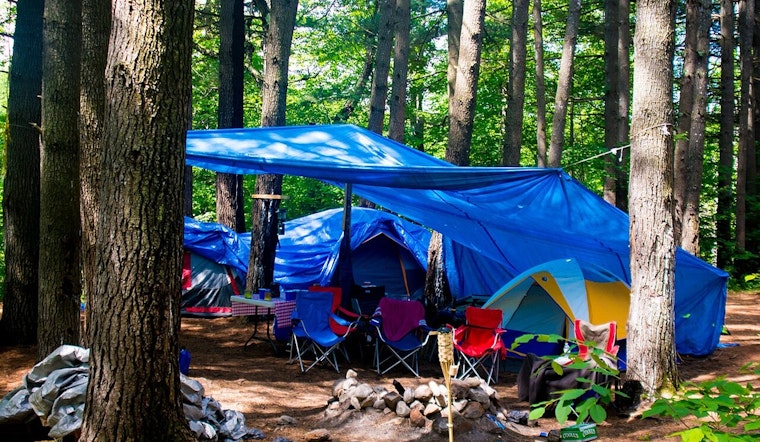
Sacramento County leaders are getting ready to close a camping loophole that neighbors say has turned empty lots into de facto campgrounds.
On Dec. 16, the Sacramento County Board of Supervisors is set to weigh an update to the county’s unlawful-camping rules that would let officials clear illegal encampments on private property even when the owner is absent, unreachable or unwilling to step in. District 4 Supervisor Rosario Rodriguez outlined the proposal in a local column, framing it as a fix for an enforcement gap that residents say shifted camps from parks and riverways onto vacant parcels, commercial strips and land next to neighborhood open spaces.
Board To Weigh Ordinance Change
Rodriguez wrote that the county already relies on a nuisance-abatement process to deal with hazardous conditions on private property, but that “illegal camping had never been formally connected to it.” As she described it, the proposed change would allow county staff to start abatement on private parcels through that same process when an owner cannot be reached or chooses not to act, according to Rio Linda Online.
Court Ruling Reopened Enforcement
The timing is no accident. The push follows the U.S. Supreme Court’s 2024 reversal of the Ninth Circuit’s standard in City of Grants Pass v. Johnson, a decision that cleared the way for cities and counties to enforce bans on camping on public property. Sacramento County updated its public-camping ordinance last year and already lays out abatement rules for public land in the Sacramento County code.
Private Land Is Hard To Police
County officials and residents say stepped-up enforcement on parks, trails and river corridors pushed some encampments onto private parcels where ownership is murky or property holders live far away. Some landowners post signs or sign a so-called “602 notice,” which lets the Sheriff’s Office handle trespassing even when the owner is not on site, but many parcels do not have that paperwork in place. Supervisors say the ordinance tweak is meant to close that gap, as per Rio Linda Online.
How The County Would Abate Camps
Under the nuisance-abatement framework the county already uses for other hazardous conditions, officials can issue written notices, hold administrative hearings and, if needed, carry out summary abatement and secure properties so they are harder to re-occupy. The Sacramento County code spells out how notice must be given and how personal property left behind during abatement has to be stored. The new proposal would explicitly fold illegal camping into that existing process.
Law Enforcement And Outreach
Rodriguez and county staff stress that deputies and outreach workers are expected to continue offering services first, with efforts to connect people to housing, behavioral health care and substance use treatment before any removals take place. Local coverage notes that law enforcement backs the change because it would give a clearer path to address blight and unsafe conditions around neighborhoods, as mentioned by the Folsom Times.
How Residents Can Comment
The Board’s Dec. 16 meeting will serve as the public venue for debate and testimony on the proposal. Residents who want more details or who plan to weigh in ahead of the hearing can contact Supervisor Rodriguez’s office at 916-874-5491 or [email protected], as noted by Supervisor Rosario Rodriguez's district page.
Pushback And Next Steps
Advocates have long argued that camping bans and sweeps do not replace the need for shelter and services and can push people into even riskier corners of the county. Those criticisms surfaced last year when Sacramento County moved to ban camping on public property, as local coverage documented. Expect pointed testimony and a policy fight at the Dec. 16 meeting over whether this procedural fix actually balances neighborhood safety with sustained outreach and long-term housing strategies, according to reporting by California Insider.




