

























































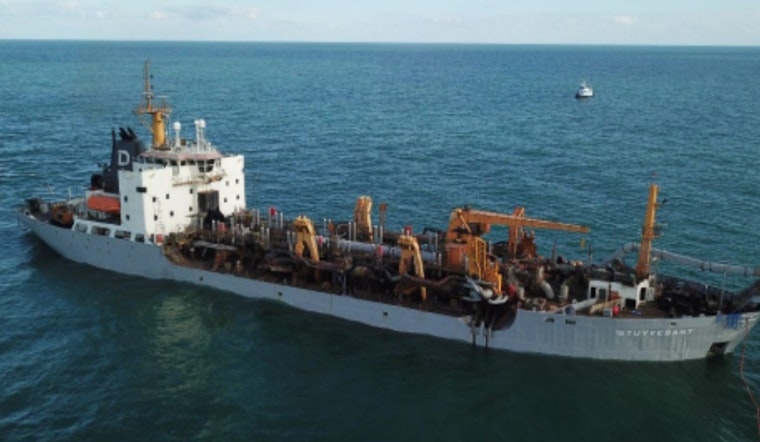
What started as routine work in the engine room of a San Rafael-based dredge turned into a fatal emergency last fall, when a fire aboard the Dutra Group’s hopper dredge Stuyvesant killed a mariner and heavily damaged the ship near Jacksonville. Federal investigators have since traced the blaze to maintenance missteps and say the casualty has already triggered changes aboard Dutra vessels and fresh scrutiny of engine-room practices across the dredging world.
NTSB report: maintenance lapse allowed lube oil to ignite
According to the National Transportation Safety Board, the Stuyvesant’s engine-room fire broke out on Nov. 2, 2024, while the hopper dredge was holding station in the St. Johns River near Jacksonville. Investigators found that crew members had carried out routine maintenance on a port auxiliary diesel generator, then remotely started the engine. A plug from the lube oil filter housing had not been reinstalled, allowing pressurized lube oil to spray and ignite.
The NTSB put the damage estimate at roughly $18 million and documented the sequence that followed, including the shipboard rescue and the transfer of the injured engineer first to shore and then by air to Gainesville. The report notes that after the accident, the operating company updated its procedures to require post-maintenance inspections and local engine starts so crews can verify repairs before bringing equipment back online from a distance.
Victim identified and background
The mariner who died in the fire was identified by local reporting as 43-year-old Daniel Fults IV, a licensed U.S. Coast Guard mariner and marine engineer who lived in Bluffton, South Carolina, and is survived by his wife and a 3-year-old son, according to the Marin Independent Journal. The paper reported that the medical examiner cited burns and inhalation of combustion products as the cause of death and that Fults had about a dozen years of experience as a marine engineer.
Dutra, repairs and fleet moves
The Stuyvesant is owned and operated by the Dutra Group of San Rafael. Industry notices and company materials state that the vessel underwent a significant engine-room rebuild and completed sea trials before returning to work in mid-2025. Coverage from industry outlets describes a repair effort led by contractors and the shipyard that brought the dredge back into service.
At the same time, the Dutra Group has moved to recapitalize its fleet, issuing a notice to proceed for a new trailing-suction hopper dredge named Adele, as it works to balance near-term repairs with longer-term renewal plans. Maritime Executive and company notices provide details of the restoration of the Stuyvesant and the new-build announcement.
Local context and company notes
Closer to home, Dutra has remained active in Marin County business and permitting issues. Regional reporting has noted a recent transition involving the company’s Bay Area materials operations, with Ireland-based materials company CRH buying those operations while Dutra stays involved in quarry ownership.
The Marin Independent Journal quoted Dutra executive Molly Jacobson saying the Nov. 2 fire marked the first work-related death for a Dutra hopper-dredge crew and that the company cooperated with investigators.
Regulatory takeaways and safety lessons
The NTSB stressed that its inquiries are fact-finding in nature and do not assign blame, but the agency’s report draws a straight line between the missed maintenance step and the engine-room fire, and it spells out specific safety lessons intended to prevent a repeat. Investigators noted close coordination with Coast Guard Sector Jacksonville during the probe.
According to the National Transportation Safety Board, recommended changes include starting machinery locally after maintenance and requiring redundant post-maintenance checks so crews can catch issues before systems are run from remote controls. The report frames these operational shifts as the central safety takeaways from a casualty that turned a common engine-room task into a deadly emergency.




