

























































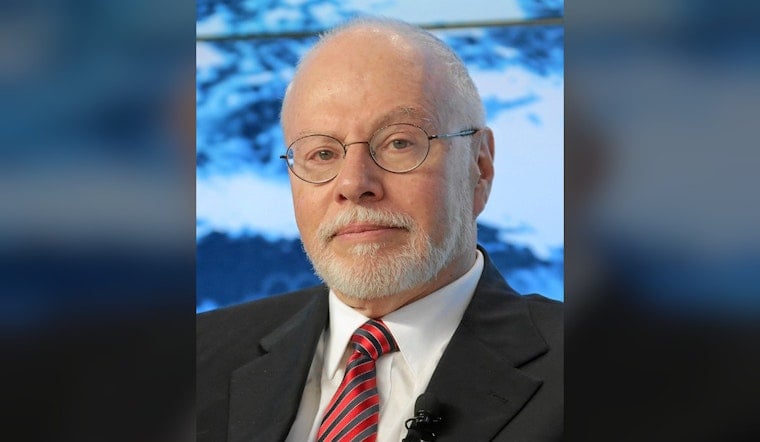
A controversial federal court auction that wrapped up in November has positioned a New York billionaire hedge fund manager with deep ties to Manhattan, West Palm Beach, and Aspen to potentially reap billions from Venezuela's political upheaval—and his close relationship with President Trump may have just cleared the final obstacles.
And while Singer is best known as a New York and Palm Beach power broker, Elliott Investment Management has also been making strategic moves in San Francisco. In July The Real Deal reported, the firm partnered with SF-based Probis to buy the distressed debt tied to the Financial District office tower at 101 Mission Street, signaling a quiet bet on Bay Area real estate turmoil as well.
Paul Singer, the 81-year-old founder of Elliott Investment Management, donated at least $8 million to help Trump get elected in 2024, according to NPR and federal filings. Now his investment firm stands to make a killing on its $5.9 billion purchase of Citgo Petroleum, Venezuela's U.S.-based oil subsidiary—a deal that was forced by a Delaware court after Venezuela defaulted on its bonds, and one that Venezuela's former president Nicolás Maduro had desperately opposed.
The timing couldn't be more fortuitous for Singer, whose hedge fund specializes in what critics call "vulture capitalism"—buying distressed assets at steep discounts, then using aggressive legal tactics to extract maximum value. Elliott's subsidiary Amber Energy won the court-ordered auction for Citgo in November with a bid that analysts say valued the company at roughly half its actual worth, potentially setting up the fund for a windfall of up to $6 billion, according to industry valuations reported by CNN.
From Manhattan to Miami: The Hedge Fund's Strategic Moves
Singer's Elliott Management, which manages $66 billion in assets, has maintained a complex geographic footprint that mirrors its founder's lifestyle. While the firm moved its headquarters from Manhattan to West Palm Beach during the pandemic in 2020, it never fully abandoned New York. Last July, Elliott signed a new lease for 149,000 square feet at 280 Park Avenue, relocating from its previous Midtown offices at 40 West 57th Street, according to Commercial Observer.
The hedge fund titan himself maintains residences that read like a billionaire's real estate portfolio: an apartment on Manhattan's Upper West Side, the West Palm Beach area where his company is now headquartered, and two homes in Aspen's exclusive Two Creeks neighborhood in Snowmass Village valued at over $12.7 million combined, according to The Denver Post.
This geographic spread isn't just about lifestyle—it's strategic. Singer has cultivated relationships with power brokers across these locations, hosting Republican fundraisers in his Manhattan home and maintaining proximity to Trump's Mar-a-Lago resort in Florida.
A Complicated Political Dance
Singer's relationship with Trump hasn't always been smooth sailing. In 2016, he actually funded opposition research against Trump through the conservative Washington Free Beacon, which hired Fusion GPS—the same firm that later produced the infamous Steele dossier. But by 2024, Singer had fully embraced Trump's candidacy, contributing $5 million to Make America Great Again Inc. and tens of millions more to support Republican congressional candidates, according to Common Dreams.
Singer has reportedly met with Trump directly at least four times since 2016, most recently in 2024, though it's unknown whether Venezuela came up in those discussions. What is clear is that organizations funded by Singer have been pushing hard for regime change in Venezuela. The Manhattan Institute, where Singer has donated over $10 million and sits on the board, published articles praising Trump's "consistent policies against Venezuela's Maduro" in recent months.
The Citgo Gambit
The Citgo acquisition represents classic Elliott Management strategy—what The Wall Street Journal once described as Singer's specialty in "distressed debt investing." The company owns three major U.S. refineries—in Lake Charles, Louisiana; Corpus Christi, Texas; and Lemont, Illinois—that together can process over 800,000 barrels of oil daily.
Analysts estimate Citgo's true value at between $11 billion and $13 billion, yet Elliott's winning bid valued the enterprise at just $7.3 billion. The deal still needs approval from the U.S. Treasury's Office of Foreign Assets Control (OFAC), which oversees sanctioned assets—a hurdle that may have just gotten significantly lower with Maduro's removal from power.
"They need approval from Treasury's OFAC, which is the office that looks at assets that are under sanctions," Wall Street Journal reporter Benoît Morenne told NPR. "My sources close to the situation said that the appeal could be resolved in the first half of this year and then—if Treasury then approves the deal, it could close shortly after that."
With Venezuelan Vice President Delcy Rodríguez now serving as interim president and signaling a willingness to work with Washington on oil access—a dramatic shift from calling the Citgo sale "fraudulent" just weeks ago—Singer's bet appears to be paying off handsomely.
Suspicious Bets and Insider Questions
The Venezuela situation has also raised eyebrows in the world of online prediction markets. An anonymous Polymarket user who joined the platform just days before Maduro's capture turned $32,000 into over $400,000 by correctly betting on the Venezuelan leader's removal by January 31, according to NBC News.
The trader placed their largest bets on Friday night, hours before U.S. forces moved in—timing that has sparked widespread speculation about potential insider trading. The account was created less than a week before the operation and only placed bets related to Maduro's exit and U.S. military action against Venezuela.
"It clearly suggests that the bettor did have access to inside information," Dennis Kelleher, CEO of financial reform advocacy group Better Markets, told CBS News. The incident has prompted Rep. Ritchie Torres (D-N.Y.) to introduce legislation banning federal officials from trading on prediction markets.
A Pattern of Profit
This wouldn't be the first time Elliott Management has profited from South American political turmoil. Singer famously made headlines when his fund seized an Argentine naval vessel and ultimately forced the country to pay $2.4 billion on defaulted bonds Elliott had purchased for a fraction of that amount—a nearly 400% return, according to MR Online.
The strategy has earned Singer both enormous wealth—Forbes pegs his net worth at $6.7 billion—and sharp criticism. The Forward described him as "a pioneer in the business of buying up sovereign bonds on the cheap, and then going after countries for unpaid debts."
Now, with Trump's administration openly discussing plans to extract Venezuelan oil wealth and Singer's hedge fund positioned to control key refining infrastructure, the billionaire appears poised for another massive payday. As Trump told Joe Scarborough in a phone call this week, the difference between Iraq and Venezuela is simple: "We're going to keep the oil."
For Singer, who once played on stage with Meat Loaf and maintains a family rock band with his two sons, the Venezuelan gambit represents perhaps his boldest bet yet—one that required not just financial acumen but political connections at the highest levels of American power.
Legal Implications
The Citgo acquisition faces several legal hurdles beyond Treasury approval. Venezuelan parties have filed appeals challenging the sale, and there are ongoing disputes with holders of PDVSA bonds who claim the Citgo shares were pledged as collateral. The complexity of these legal challenges could delay the final transfer for months, though Maduro's removal may have shifted the political calculus significantly in Elliott's favor.
Moreover, questions about the propriety of the auction process itself have emerged, with Venezuela's opposition-appointed Citgo board raising concerns about potential conflicts of interest involving court officials. These issues could provide grounds for future legal challenges, though Elliott's track record in navigating complex international litigation suggests the firm is well-prepared for a protracted battle.


