

























































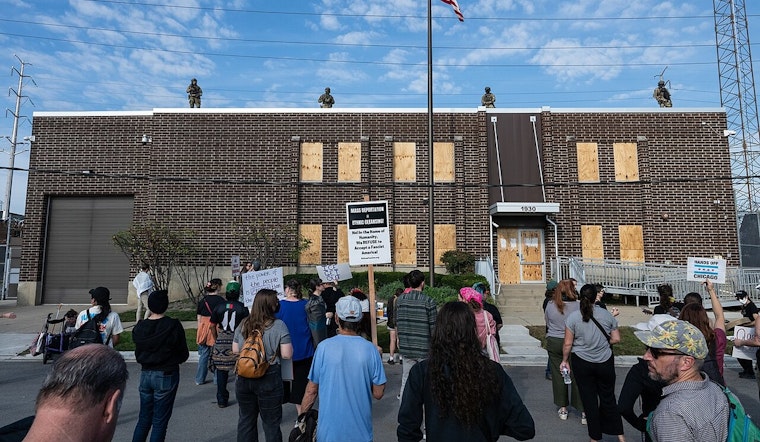
Lawyers for six people charged in a high-profile Broadview protest pressed a federal judge on Thursday to let the public see surveillance video and other evidence, arguing that deadly encounters between federal immigration agents and civilians in Minneapolis show exactly why secrecy is dangerous. U.S. District Judge April Perry ordered the Department of Homeland Security to preserve five days of surveillance footage and heard lawyers clash over whether the government can keep the material limited to "attorneys' eyes only."
Court Fight Over How Secret the ICE Video Stays
At a hearing in the Dirksen U.S. Courthouse, defense attorneys said the prosecutors' proposed "attorneys' eyes only" restriction is far too tight and pushed the court to force DHS to preserve and eventually turn over footage for public viewing, according to the Chicago Tribune. The paper reports that while the government pushed back on broad disclosure, Judge Perry still ordered DHS to lock down several days of surveillance from the Broadview facility. Prosecutors told the court their case presentation would likely be relatively short, estimating about three days, as the judge and lawyers worked through scheduling and floated a possible May trial window.
Deadly Minneapolis Encounters Loom Over Chicago Case
Defense lawyers insisted their transparency push is not some abstract free speech exercise. They pointed to two recent deaths in Minneapolis involving federal immigration agents as proof that the public has a real stake in how evidence is handled. National coverage of those incidents, including reporting on the Jan. 24 killing of Alex Pretti and the Jan. 7 killing of Renée Good, has raised sharp questions about how federal agencies secure and share video and other records, as detailed by The Guardian and Time. Defense teams told Judge Perry that those episodes only heighten public interest in whatever was captured at Broadview.
Defense Strategy: Push Back on Secrecy, Press First Amendment
The lawyers signaled that the legal battle will not stop at a discovery fight. Attorney Terrence Campbell argued against any overly restrictive protective order, while Josh Herman indicated he expects to move to toss the conspiracy charge on First Amendment grounds, the Tribune reports. Herman also told the court that if the conspiracy count is not dismissed he will seek a speedy trial, citing the strain the case places on congressional candidate Katherine "Kat" Abughazaleh's campaign and public profile. Separately, defense teams have asked DHS to preserve additional surveillance and to narrow what the government is allowed to keep from public view.
Who the Broadview Six Are and What They Are Accused Of
The six defendants are congressional candidate Katherine "Kat" Abughazaleh, Catherine "Cat" Sharp, Village trustee Brian Straw, Michael Rabbitt, Joselyn Walsh and Andre Martin, and all have pleaded not guilty, according to local coverage. A federal grand jury indicted them over a Sept. 26 incident that, prosecutors say, involved surrounding an ICE vehicle, banging on its windows and allegedly damaging the car. The charges include a felony conspiracy count along with related counts of impeding agents. Local reporting by FOX 32 Chicago and public radio outlet WGLT note that the conspiracy charge carries a maximum of six years in prison, while some related counts carry up to one year.
Legal Stakes: Transparency, Protest Rights and Federal Power
Defense lawyers framed their transparency push as both a constitutional fight and an accountability check on federal power. They argue that when federal agencies lean on secrecy it can chill lawful protest activity and potentially shield misconduct from public scrutiny. Civil rights and oversight groups have raised similar alarms about federal deployments and the use of force around protests, including in Illinois, as documented by Human Rights Watch. Scholars have also warned that criminal cases built on broad conspiracy theories can raise novel First Amendment questions in the modern protest era, a trend explored in legal coverage and commentary.
What Happens Next in the Broadview Six Case
The next stretch of the case is expected to be dominated by written motions and more argument over the protective order and preserved footage, with formal filings anticipated in the coming days. Supporters rallied outside Federal Plaza during Thursday's hearing, underscoring the political spotlight now fixed on the case. The transparency fight over what DHS must keep and what the public will ultimately get to see is shaping up as an early test of how far federal agencies can go in keeping surveillance video out of public view.



.jpg)